
Introduction
The landscape of modern software development is being reshaped by automation and cloud scale. At the heart of this shift is the AWS DevOps Engineer – Professional certification. This is not just a badge; it is a rigorous validation of the ability to manage, operate, and scale complex systems on Amazon Web Services. It represents the highest level of technical expertise for those who build the bridges between code and customers.
In today’s ecosystem, speed is everything. However, speed without stability is a recipe for failure. This certification matters because it teaches how to maintain high velocity while ensuring that systems remain secure and resilient. It focuses on Continuous Delivery (CD) and the automation of compliance, which are the hallmarks of a mature engineering organization.
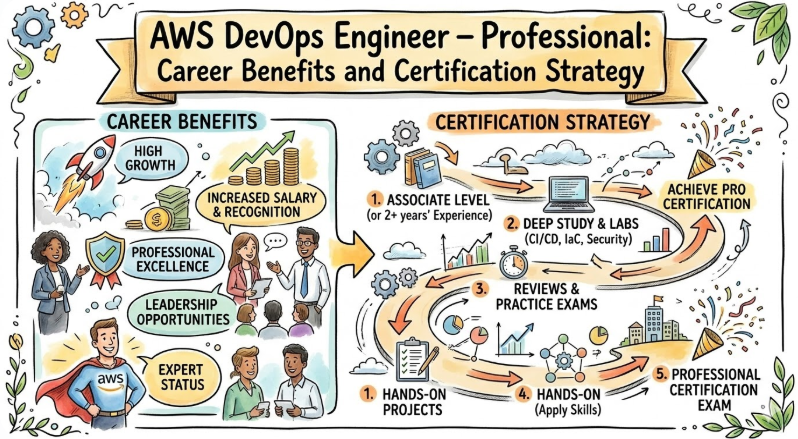
For engineers, this path offers a way to stand out in a crowded market. It proves that one can handle real-world challenges, not just theoretical scenarios. For managers, having certified team members is a sign of operational excellence. It ensures that the team speaks a common language of best practices, reducing technical debt and improving the overall quality of the software lifecycle.
Certification Overview Table
| Track | Level | Who it’s for | Prerequisites | Skills Covered | Recommended Order |
| AWS DevOps | Professional | DevOps & Cloud Engineers | Associate Level Knowledge | Automation, SDLC, HA, Monitoring | After SysOps or Developer Associate |
Why Choose DevOpsSchool?
When looking for a partner in this learning journey, DevOpsSchool is often selected for its deep industry roots. The curriculum is designed by professionals who have spent decades in the trenches of software delivery. It is not just about passing an exam; it is about gaining the confidence to handle production environments. Practical labs and real-world scenarios are integrated into the training, ensuring that the knowledge gained is immediately applicable to one’s daily work. The focus remains on building a solid foundation of engineering principles that stay relevant even as tools evolve.
Certification Deep-Dive: AWS DevOps Engineer – Professional
What is this certification?
This is a professional-level credential that validates technical expertise in provisioning, operating, and managing distributed application systems on the AWS platform. It focuses heavily on automation and the “Infrastructure as Code” philosophy.
Who should take this certification?
It is designed for individuals who have a few years of experience in a DevOps role. It is ideal for those who are responsible for managing continuous delivery systems and want to prove their ability to automate complex operational tasks.
Skills you will gain
- Implementation of continuous delivery systems and methodologies.
- Automation of security controls and compliance validation.
- Deployment of monitoring, metrics, and logging systems on AWS.
- Design and management of self-healing and highly available infrastructures.
- Optimization of the software development lifecycle for speed and scale.
Real-world projects you should be able to do
- Building a fully automated CI/CD pipeline that spans multiple AWS accounts.
- Setting up auto-scaling groups that respond to custom application metrics.
- Implementing automated “Blue/Green” or “Canary” deployment strategies.
- Creating a centralized logging solution for hundreds of microservices.
Preparation Plan
- 7–14 Days Plan: Focus on high-level services like AWS CodePipeline, CodeBuild, and CloudFormation. Review the official exam guide and take a practice test to identify weak areas.
- 30 Days Plan: Deep dive into whitepapers and documentation. Spend time on OpsWorks, Elastic Beanstalk, and cross-account IAM roles. Practice building multi-region architectures in a lab environment.
- 60 Days Plan: This is the most recommended path. Combine theoretical study with hands-on projects. Focus on edge cases in deployment and complex troubleshooting scenarios involving Lambda and EventBridge.
Common mistakes to avoid
- Ignoring the importance of IAM and security policies.
- Focusing only on tools and neglecting the underlying DevOps principles.
- Not spending enough time on monitoring and logging services like CloudWatch and X-Ray.
- Relying solely on practice exams instead of hands-on console experience.
Best next certification after this
- Same track: AWS Certified Security – Specialty.
- Cross-track: AWS Certified Solutions Architect – Professional.
- Leadership / management: Certified Kubernetes Administrator (CKA) or a focus on FinOps for cost management.
Choose Your Learning Path
1. DevOps Path
This is for those who want to master the end-to-end delivery of software. It is best for Software Engineers transitioning into operations who want to automate everything from commit to production.
2. DevSecOps Path
Security is integrated into every step here. This is best for security-minded engineers who want to ensure that automated guardrails are built into the CI/CD pipeline to catch vulnerabilities early.
3. Site Reliability Engineering (SRE) Path
The focus is on system availability and latency. This path is perfect for those who enjoy troubleshooting complex distributed systems and want to balance the rate of change with system stability.
4. AIOps / MLOps Path
This path is tailored for those working with data science teams. It focuses on the automation of machine learning models and using AI to improve IT operations and incident response.
5. DataOps Path
Best for data engineers. It emphasizes the automated flow of data and the maintenance of data quality throughout the lifecycle, ensuring that analytics and reporting are always accurate.
6. FinOps Path
This is a newer, vital path. It is best for those who want to bridge the gap between engineering and finance. The focus is on cloud cost optimization and financial accountability in a cloud-first world.
Role → Recommended Certifications Mapping
- DevOps Engineer: AWS DevOps Engineer – Professional, Terraform Associate.
- Site Reliability Engineer (SRE): AWS DevOps Professional, CKA (Kubernetes).
- Platform Engineer: AWS Solutions Architect – Professional, HashiCorp Vault.
- Cloud Engineer: AWS SysOps Associate, AWS DevOps Professional.
- Security Engineer: AWS Security – Specialty, Certified DevSecOps Professional.
- Data Engineer: AWS Data Analytics – Specialty.
- FinOps Practitioner: FinOps Certified Practitioner.
- Engineering Manager: AWS Cloud Practitioner, Leading SAFe.
Next Certifications to Take
- For the AWS Pro: Same-track: AWS Certified Advanced Networking – Specialty.
- Cross-track: Google Professional Cloud DevOps Engineer.
- Leadership: TOGAF (The Open Group Architecture Framework).
- For the SRE:
- Same-track: Chaos Engineering Practitioner.
- Cross-track: AWS Security Specialty.
- Leadership: ITIL 4 Foundation.
Training & Certification Support Institutions
DevOpsSchool
Training is provided here with a heavy focus on industry readiness. Comprehensive courses are offered that cover the entire DevOps lifecycle, from basic scripting to advanced orchestration.
Cotocus
A personalized approach is taken at this institution to help professionals upskill. Mentorship is provided by experts who bring real-world experience into the classroom, making complex topics easier to grasp.
ScmGalaxy
This community-driven platform is known for its vast library of resources. Deep technical insights are shared here, making it a go-to spot for those who want to stay updated with the latest in SCM and DevOps.
BestDevOps
Specialized training is conducted here for various cloud and automation tracks. A clear path is provided for learners to move from beginner to expert through structured, hands-on modules.
devsecopsschool.com
The focus is strictly on the intersection of security and operations. Learners are taught how to bake security into the pipeline from the very first line of code.
sreschool.com
Reliability is the core focus here. Practical lessons on error budgets, SLIs, and SLOs are delivered to help engineers build systems that rarely fail.
aiopsschool.com
Modern operations are explored through the lens of artificial intelligence. Techniques are taught on how to use data to predict and prevent system outages.
dataopsschool.com
The management of data pipelines is the priority. Instruction is provided on how to automate data movement while maintaining strict quality and compliance standards.
finopsschool.com
Cloud economics is the primary subject. Engineers and managers are taught how to master the “spend” side of the cloud to maximize business value.
FAQs Section
1. Is the AWS DevOps Professional exam hard?
Yes, it is considered one of the most challenging exams in the AWS catalog because it requires deep practical knowledge of many services.
2. How long does it take to prepare?
For most professionals, 2 to 3 months of consistent study is required to feel fully prepared.
3. Are there any prerequisites?
While no longer strictly required by AWS, having an Associate-level certification is highly recommended.
4. What is the sequence for taking this exam?
Usually, it is taken after the SysOps Administrator Associate or the Developer Associate exam.
5. Does this certification help in getting a promotion?
Professional-level certifications are often seen by management as a sign that an engineer is ready for more responsibility.
6. What roles can I apply for with this?
Roles such as Senior DevOps Engineer, Cloud Architect, or Site Reliability Engineer can be pursued.
7. How often should I renew it?
The certification is valid for three years, after which a recertification exam must be passed.
8. Can a beginner take this exam?
It is not recommended for absolute beginners; some hands-on experience with AWS services is essential.
9. Is training mandatory?
While not mandatory, structured training is helpful to ensure all domains of the exam are covered systematically.
10. Does it cover Kubernetes?
While AWS services like EKS are mentioned, the primary focus is on native AWS automation tools.
11. Is the exam multiple choice?
Yes, it consists of multiple-choice and multiple-response questions.
12. How much does the exam cost?
The standard price set by AWS is 300 USD.
FAQs for AWS DevOps Professional
13. What is the passing score?
A minimum score of 750 out of 1000 is required to pass.
14. How many questions are on the exam?
There are typically 75 questions to be answered within 180 minutes.
15. Is CloudFormation covered deeply?
Yes, a deep understanding of Infrastructure as Code through CloudFormation is critical.
16. Are cross-account strategies important?
Absolutely, many questions focus on how to manage resources across multiple AWS accounts securely.
17. What is the weightage of monitoring?
Monitoring and Logging account for about 20% of the exam content.
18. Does it cover migration?
Yes, some aspects of migrating on-premises workloads to AWS using DevOps tools are included.
19. How important is Lambda for this exam?
Lambda is very important, especially for automating responses to infrastructure events.
20. Is the exam available online?
Yes, it can be taken at a testing center or via an online proctored environment.
Testimonials
Ananya R., Senior DevOps Engineer
A huge boost in confidence was felt after achieving this certification. The complex concepts of CI/CD on AWS became much clearer, and the skills were applied immediately to our production pipelines.
Rahul M., SRE
Real-world application of auto-scaling and monitoring was the biggest takeaway for me. It helped me design a more resilient system for our global users, and the career path became very clear.
Siddharth S., Cloud Engineer
Preparation for this exam forced me to explore services I hadn’t used before. The depth of knowledge gained was instrumental in my move to a more senior role within my team.
Priya K., Security Engineer
Integration of security into the DevOps flow was something I wanted to master. This certification provided the framework needed to build automated compliance checks into our delivery process.
Vikram J., Engineering Manager
The performance of my team was improved significantly after several engineers completed this track. A common standard of excellence was established, which has reduced our deployment errors.
Conclusion
The AWS DevOps Engineer – Professional certification is more than just a title. It is a comprehensive journey into the heart of modern cloud operations. For any engineer looking to reach the peak of their career, this path offers the technical depth and industry recognition needed to succeed. Long-term career benefits include higher visibility, better compensation, and the ability to lead high-impact projects. Strategic learning is encouraged, and with the right support, this milestone is well within reach for dedicated professionals.

