
Introduction
The protection of cloud-native infrastructure has become a primary concern for modern enterprises. As organizations transition toward containerized environments, the complexity of securing these systems has increased. Among the various professional credentials available, the Certified Kubernetes Security Specialist (CKS) is recognized as a high-level standard for ensuring that clusters are robust and resilient against threats.
This guide is prepared to provide a comprehensive look into the CKS program, its requirements, and the career growth it facilitates.
What is the Certified Kubernetes Security Specialist (CKS)?
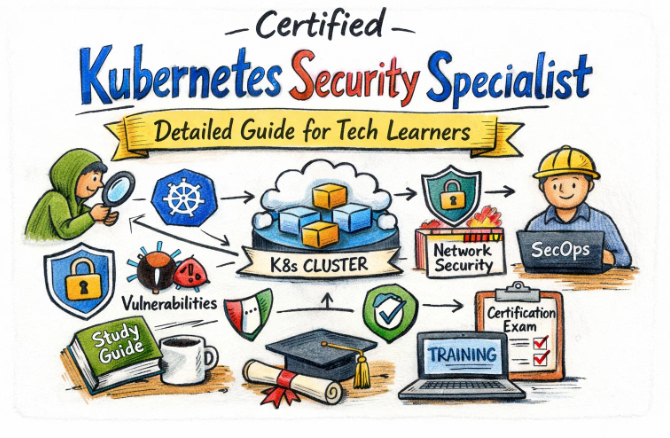
The Certified Kubernetes Security Specialist (CKS) is a performance-based certification program. It is designed to verify that a professional can secure container-based applications and Kubernetes platforms throughout the build, deployment, and runtime phases. The exam is conducted in a simulated environment where practical tasks must be completed to prove competency in cluster hardening and vulnerability management.
Why it matters in today’s software, cloud, and automation ecosystem
In an era where automation is the standard, the speed of deployment must be balanced with the integrity of the system. A single security flaw in a Kubernetes cluster can expose sensitive data or lead to system-wide failures. The CKS program is valued because it ensures that professionals are equipped to handle these risks. It promotes a “defense-in-depth” strategy where multiple layers of protection are implemented to safeguard the infrastructure.
Why certifications are important for engineers and managers
For engineers, certifications are viewed as a method to validate expertise that has been gained through experience. It provides a structured path for learning advanced security concepts that are often overlooked in daily operations. For managers, certifications act as a reliable metric for assessing the capabilities of a team. It is understood that a certified professional is more likely to follow industry best practices, thereby reducing the overall risk profile of the organization.
Why choose DevOpsSchool?
Training is provided by industry experts who have handled complex security scenarios in real-world environments. The curriculum at DevOpsSchool is designed to be practical and is updated frequently to reflect the latest changes in the Kubernetes ecosystem. Learners are given access to high-quality labs and study materials that simplify complex topics. A supportive community is maintained where professionals can share insights and seek guidance throughout their learning journey.
Comprehensive Analysis: Certified Kubernetes Security Specialist (CKS)
What is this certification?
This is an advanced-level credential focused strictly on the security aspects of the Kubernetes platform. It is intended to test the ability of a professional to secure the cluster from the operating system level up to the application layer.
Who should take this certification?
This path is intended for those who already possess a valid CKA certification. It is ideal for Security Engineers, Platform Architects, and DevOps professionals who are responsible for maintaining secure and compliant cloud environments.
Strategic Overview Table
| Track | Level | Intended For | Required Baseline | Core Competencies | Recommended Order |
| DevSecOps | Specialist | Security Architects | Valid CKA | Hardening, Compliance | After CKA |
| DevOps | Advanced | DevOps Engineers | Valid CKA | Pipeline Security, RBAC | After CKA |
| SRE | Professional | SREs | Valid CKA | Monitoring, Auditing | After CKA |
| AIOps/MLOps | Expert | ML Engineers | Valid CKA | Model & Data Protection | After CKA |
| DataOps | Specialist | Data Engineers | Valid CKA | Pipeline Integrity | After CKA |
| FinOps | Consultant | Cloud Analysts | Valid CKA | Secure Cost Management | After CKA |
Skills you will gain
- Cluster Hardening: Access to the API server is restricted and the management of administrative permissions is mastered through RBAC.
- System Level Security: The host operating system is secured by reducing the attack surface and utilizing security kernels.
- Microservice Protection: Network policies are implemented to ensure that pods only communicate with authorized entities.
- Supply Chain Integrity: Trusted base images are selected, and automated scanning for vulnerabilities is performed during the build process.
- Monitoring and Logging: Audit logs are configured and analyzed to detect suspicious behavior within the cluster.
- Runtime Threat Detection: Tools are used to monitor system calls and identify potential breaches in real-time.
Real-world projects you should be able to do after this certification
- Hardening a Live Cluster: A production-grade Kubernetes cluster is secured using CIS benchmarks and system hardening techniques.
- Building a Secure CI/CD Pipeline: A deployment pipeline is created where every image is scanned for security flaws before being allowed into the registry.
- Implementing Zero-Trust Networking: Granular network policies are enforced to restrict pod-to-pod communication based on the principle of least privilege.
- Automating Runtime Alerts: A monitoring system is configured to send alerts whenever unauthorized system calls or file modifications are detected.
- Secret Management Strategy: A secure way to manage sensitive data like passwords and API keys is implemented using encrypted vaults and Kubernetes secrets.
Preparation Plan
7–14 days plan (Revision Focus)
- Days 1-4: Focus is placed on RBAC and API server security. Official documentation is reviewed extensively.
- Days 5-8: Hands-on labs are completed for system hardening and network policies.
- Days 9-11: Supply chain security and runtime tools like Falco are practiced.
- Days 12-14: Practice exams are taken under timed conditions to ensure speed.
30 days plan (Standard Pace)
- Week 1: The syllabus is explored in detail, starting with cluster setup and hardening.
- Week 2: Time is spent on mastering microservice security and the protection of images.
- Week 3: Advanced security tools and auditing techniques are practiced in a dedicated lab environment.
- Week 4: Mock tests are performed, and areas of weakness are addressed through focused study.
60 days plan (Deep Learning)
- Month 1: Theory is studied thoroughly. Each security domain is explored at a deep level to understand the underlying mechanics.
- Month 2: Extensive practical work is performed. Complex, multi-stage scenarios are simulated and resolved to build resilience and deep expertise.
Common mistakes to avoid
- Neglecting the CKA Foundation: It is often found that candidates struggle because their basic Kubernetes administration skills are not strong enough.
- Over-reliance on Automated Tools: The exam requires manual configuration; therefore, a deep understanding of the command line is essential.
- Ignoring the Documentation: Since only official documentation is allowed during the exam, the ability to find information quickly is a critical skill.
- Poor Time Management: Valuable time is often wasted on a single difficult question, leading to incomplete tasks elsewhere.
Best next certification after this
- Same track: Certified Kubernetes Application Developer (CKAD) to gain the developer’s perspective on security.
- Cross-track: Certified DevSecOps Professional (CDP) for a broader view of security in the delivery pipeline.
- Leadership / management: Certified Information Security Manager (CISM) for those moving into executive leadership roles.
Selecting Your Professional Trajectory
DevOps Learning Path
This path is designed for those who want to automate security within the infrastructure. It is best for professionals who build and maintain the tools that developers use for deployment.
DevSecOps Learning Path
The focus is placed on shifting security to the left. This is ideal for those who wish to specialize in vulnerability management and automated compliance.
Site Reliability Engineering (SRE) Learning Path
Security and reliability are treated as two sides of the same coin. This path is intended for those who ensure that secure systems remain stable and available.
AIOps / MLOps Learning Path
The security of artificial intelligence models and data pipelines is the main focus. It is best for those managing advanced data workloads in the cloud.
DataOps Learning Path
The protection of data as it flows through a pipeline is emphasized. This path is suited for data engineers who must ensure that information remains private and secure.
FinOps Learning Path
The cost implications of security are managed. This path is for professionals who want to ensure that security measures do not lead to ballooning cloud costs.
Role → Recommended Certifications Mapping
| Professional Role | Primary Recommendation | Secondary Skill | Leadership Track |
| DevOps Engineer | CKS | Terraform Associate | DevOps Leader |
| SRE | CKS | Prometheus Certified | SRE Foundation |
| Platform Engineer | CKS | CKA | ITIL Expert |
| Cloud Engineer | CKS | AWS Solutions Architect | PMP |
| Security Engineer | CKS | Certified Ethical Hacker | CISM |
| Data Engineer | CKS | DataOps Professional | CDMP |
| FinOps Practitioner | CKS | FinOps Certified | MBA in Tech |
| Engineering Manager | CKS | Agile Coach | CSM |
Next Certifications to Take
A balanced approach is suggested for every learner. If a technical certification like CKS is completed, it is often beneficial to pursue a cross-track certification in a domain like FinOps to understand the business side of the cloud. For those aiming for higher management, a leadership-focused certification is recommended to complement technical skills.
Educational Support Institutions
DevOpsSchool
A holistic approach to learning is followed here. Practical knowledge is emphasized through live projects and mentorship from seasoned professionals. Career support is provided to help individuals navigate the complex landscape of cloud certifications.
Cotocus
Tailored training solutions are provided for both individuals and corporate teams. A strong focus is maintained on the latest tools and methodologies, ensuring that learners are always prepared for industry demands.
ScmGalaxy
A vast repository of technical articles and community forums is available. It serves as a central hub for professionals looking to enhance their knowledge in configuration management and automation.
BestDevOps
Specialized training programs are curated for various DevOps and SRE tracks. The goal is to bridge the gap between classroom learning and the requirements of the modern workforce.
devsecopsschool.com
This platform is dedicated to the integration of security into the DevOps process. Detailed modules on secure coding and container security are offered to help professionals specialize.
sreschool.com
The principles of system resilience and reliability are taught here. It is ideal for those who wish to master the art of maintaining high-availability systems in the cloud.
aiopsschool.com
The use of artificial intelligence to optimize IT operations is the primary focus. Training is provided on how to leverage machine learning for automated incident response.
dataopsschool.com
Data management and pipeline automation are explored in detail. Skills are taught to ensure that data flows are secure and efficient.
finopsschool.com
Education on cloud financial management is provided. Techniques are shared to help organizations optimize their cloud spend while maintaining top-tier security.
Informational FAQ Section
- Is the CKS certification worth the effort?
It is considered one of the most valuable credentials due to the high demand for specialized security skills. - How long does it take to prepare for the CKS?
Typically, a period of 1 to 3 months is needed, depending on existing knowledge. - Can the exam be taken without a CKA?
A valid CKA certification is a mandatory requirement before sitting for the CKS. - What is the best way to start the preparation?
It is suggested that a professional training course be joined to get access to hands-on labs. - What career growth can be expected?
Certified individuals often see an increase in job offers for senior and specialized roles. - Which job titles are relevant for CKS holders?
Titles like Cloud Security Architect and DevSecOps Engineer are very common. - Is the certification recognized globally?
Yes, it is accepted by major tech companies and startups across the world. - How long is the CKS valid?
The certification is valid for a period of two years from the date it is earned. - Are retakes available for the exam?
Most exam purchases include one free retake if the first attempt is not successful. - What is the passing criteria?
A score of 67% or higher is required to be successful in the exam. - Is the exam conducted at a center?
The exam is taken online and is monitored remotely by a proctor. - Can documentation be accessed during the test?
Yes, specific sites containing official documentation are allowed to be used.
CKS Domain-Specific FAQs
- What version of Kubernetes is used in the exam environment?
The environment is usually updated twice a year to reflect the latest stable release. - How much focus is placed on third-party tools?
Tools like Falco, Trivy, and Kube-bench are an essential part of the curriculum. - Is the environment difficult to use?
It is a Linux-based terminal environment that requires comfort with the command line. - How important is RBAC in the exam?
A significant portion of the tasks involves configuring and troubleshooting RBAC policies. - Are network policies frequently tested?
Yes, the ability to restrict traffic between pods is a core part of the assessment. - What is involved in runtime security?
Monitoring system activities and detecting anomalies within running containers are key skills. - Is image security a major topic?
Yes, scanning images for vulnerabilities and using secure registries are frequently covered. - How is auditing tested?
The configuration of audit policies and the analysis of log data are required for several tasks.
Testimonial
Kartik
The skill improvement gained through the CKS program was substantial. Concepts like runtime security, which were previously unknown, are now part of my daily workflow. It has provided a much stronger sense of confidence in my work.
Meera
Real-world application is the biggest benefit of this certification. The labs provided by the training institution were essential in understanding how to harden a cluster beyond the basic setup. It is a highly recommended path for any engineer.
Siddharth
Career clarity was achieved after completing this credential. It allowed for a transition into a specialized security role that was previously out of reach. The investment in learning has truly been worthwhile.
Neha
Confidence growth was immediate once the exam was passed. Being able to secure a cluster and verify its integrity is a skill that is highly valued by my current organization. It has led to new opportunities for leadership.
Rajesh
As an engineering manager, the value of a certified team is clear. Having professionals who have passed the CKS ensures that our infrastructure is built on a solid foundation of security best practices.
Final Considerations
The Certified Kubernetes Security Specialist (CKS) certification is a critical asset for those who wish to excel in the field of cloud security. It provides the necessary tools to protect complex environments and ensures that a professional is ready for high-stakes challenges. Long-term benefits include enhanced career opportunities, higher earning potential, and the ability to lead strategic security initiatives. Strategic planning and a commitment to continuous learning are encouraged for all who seek this elite designation.

