
Introduction
The Azure DevOps Engineer Expert (AZ-400) is often viewed as the final peak for professionals working within the Microsoft cloud ecosystem. It is not merely a test of tool knowledge; rather, it is a validation of one’s ability to design a cohesive strategy for people, processes, and technologies. In today’s fast-paced automation landscape, this certification is seen as a badge of high-level competence.
Why does it matter so much? As organizations transition toward “Everything as Code,” the demand for engineers who can orchestrate complex delivery pipelines is growing rapidly. For an engineer, being certified is a way to stay competitive. For a manager, it provides a standard framework to ensure that the team is following the best possible practices for reliability and security.
Certification Overview Table
| Track | Level | Who it’s for | Prerequisites | Skills Covered | Recommended Order |
| Cloud & DevOps | Expert | Senior Engineers & Architects | AZ-104 or AZ-204 | Instrumentation, SRE, CI/CD, Compliance | Advanced Mastery |
Why Choose DevOpsSchool?
When a career-defining certification like the AZ-400 is pursued, the quality of guidance is paramount. DevOpsSchool is frequently chosen because the training is built on practical, industry-first methodologies. Instead of just theoretical lectures, the focus is placed on solving real-world production issues. This ensures that the learner is not just “exam-ready” but “job-ready.”
Certification Deep-Dive: Azure DevOps Engineer Expert (AZ-400)
What is this certification?
The AZ-400 is an expert-level credential that confirms a professional’s proficiency in combining development, delivery, and operations. It focuses on creating a “continuous value stream” for businesses using Azure technologies.
Who should take this certification?
- Infrastructure Architects who want to automate their workflows.
- Senior Developers looking to lead DevOps transformations.
- Security Professionals aiming to integrate compliance into pipelines.
- Technical Project Managers who need to understand modern delivery.
Skills you will gain
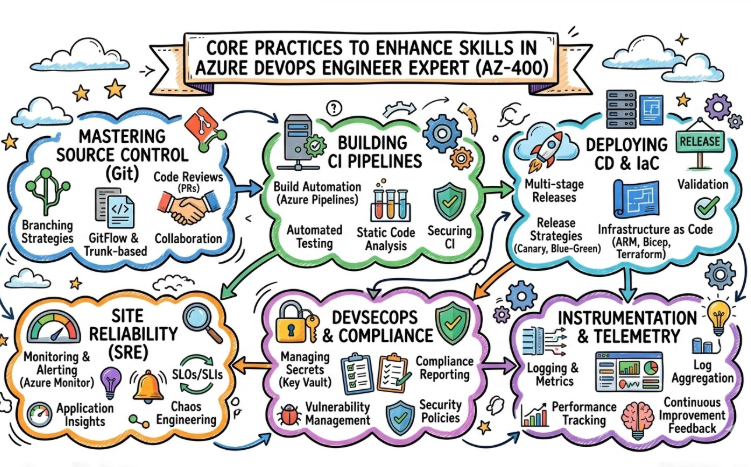
- Designing a comprehensive strategy for logging and telemetry.
- Implementing Site Reliability Engineering (SRE) within a team.
- Developing security and compliance plans for CI/CD.
- Mastering Git-based source control and branching strategies.
- Automating infrastructure using ARM templates, Bicep, or Terraform.
Real-world projects you should be able to do
- Migrating a legacy on-premise application to a fully automated Azure pipeline.
- Implementing a “Zero Trust” security model within a deployment workflow.
- Building an auto-scaling environment that responds to real-time traffic alerts.
- Designing a multi-region disaster recovery plan for cloud-native apps.
Preparation plan
7–14 Days Plan (The Quick Polish)
- Focus: Spend this time taking practice exams and filling gaps in knowledge.
- Key Areas: Review YAML syntax for pipelines and Azure Monitor configurations.
30 Days Plan (The Professional Pace)
- Focus: One week is dedicated to each of the four main exam domains.
- Key Areas: Deep dive into GitHub Actions, Azure Boards, and container security.
60 Days Plan (The Complete Mastery)
- Focus: This allows for hands-on lab work alongside theoretical study.
- Key Areas: Spend the first month mastering the prerequisite (AZ-104/204) and the second month on Expert-level automation.
Common mistakes to avoid
- Relying too much on the Azure Portal (GUI) instead of learning CLI and YAML.
- Ignoring the cultural aspects of DevOps that are tested in the exam.
- Underestimating the depth of the “Instrumentation” and “SRE” sections.
Best next certification after this
- Same Track: Azure Solutions Architect Expert (AZ-305).
- Cross-Track: Azure Security Engineer Associate (AZ-500).
- Leadership / Management: Certified Kubernetes Administrator (CKA) or PMP.
Choose Your Learning Path
1. The DevOps Strategy Path
This is designed for those who want to oversee the entire lifecycle of software. It is about creating speed and quality through automation.
2. The DevSecOps Path
This path is chosen by those who believe security is a shared responsibility. It focuses on “shifting security left” in the development cycle.
3. The Site Reliability (SRE) Path
Focused on the “Operations” part of DevOps. It is for engineers who prioritize system health, performance, and uptime above all else.
4. The AIOps / MLOps Path
A specialized path for those working with AI. It involves creating pipelines that can handle the unique needs of machine learning models.
5. The DataOps Path
This is meant for data professionals. It applies DevOps discipline to data movement and storage to ensure data quality.
6. The FinOps Path
This is for the “Cloud Economists.” It focuses on managing the financial health of cloud deployments and reducing waste.
Role → Recommended Certifications Mapping
| Role | Recommended Certifications |
| DevOps Engineer | AZ-400 (Expert), AZ-104 (Associate) |
| SRE | AZ-400 (Expert), AZ-700 (Network Engineer) |
| Platform Engineer | AZ-305 (Architect), AZ-400 |
| Cloud Engineer | AZ-104, AZ-500 (Security) |
| Security Engineer | AZ-500, AZ-400 |
| Data Engineer | DP-203 (Data Engineer), AZ-400 |
| FinOps Practitioner | FinOps Certified Practitioner, AZ-900 |
| Engineering Manager | AZ-900 (Fundamentals), AZ-400 (Overview) |
Next Certifications to Take
- For the Career Climber: A same-track certification like the Azure Solutions Architect Expert is recommended to broaden architectural knowledge.
- For the Specialist: A cross-track certification such as the Certified Kubernetes Administrator (CKA) is suggested for mastering container orchestration.
- For the Aspiring Leader: A leadership-focused certification like ITIL 4 Strategic Leader is advised for moving into executive roles.
Training & Certification Support Institutions
DevOpsSchool
This is a leading institution that provides specialized training in DevOps and Cloud technologies. Their programs are designed to be highly interactive and are led by industry veterans.
Cotocus
Training solutions that are tailored to modern IT needs are offered here. The focus is placed on emerging technologies like AIOps and DevSecOps to keep professionals ahead of the curve.
ScmGalaxy
A resource-rich platform that supports engineers in mastering configuration management and automation. It is a hub for community learning and technical documentation.
BestDevOps
Practical, hands-on training for various DevOps tools and certifications is provided by this group. Their curriculum is structured to help learners pass exams on their first attempt.
devsecopsschool.com
This institution is dedicated to the integration of security into the DevOps workflow. It is the go-to place for learning how to secure the modern software supply chain.
sreschool.com
All aspects of Site Reliability Engineering are covered here. The training focuses on how to build systems that are both scalable and incredibly reliable.
aiopsschool.com
This school focuses on the future of operations through Artificial Intelligence. It teaches engineers how to use machine learning to automate complex IT tasks.
dataopsschool.com
The principles of DevOps are applied to data management at this school. It is designed for data engineers who want to automate their data pipelines.
finopsschool.com
Training on the financial management of the cloud is provided here. It helps teams understand how to balance performance with cost-efficiency.
FAQs Section
1. Is the AZ-400 exam based mostly on coding?
While deep coding is not required, a strong understanding of scripting and YAML for pipelines is expected.
2. What is the biggest challenge in this certification?
The broad range of topics—from source control to SRE and security—is what makes it difficult.
3. Is industry experience mandatory?
While not strictly mandatory, having 1-2 years of Azure experience is highly recommended for success.
4. How does this benefit an Engineering Manager?
It allows a manager to speak the same language as their technical teams and make better strategic decisions.
5. Are GitHub tools covered in the AZ-400?
Yes, tools like GitHub Actions and GitHub Enterprise are now a significant part of the syllabus.
6. How long is the certification valid?
It is valid for one year, but it can be renewed for free through a Microsoft assessment.
7. Can I skip the Associate-level exams?
No, you must have either the AZ-104 or AZ-204 to be officially recognized as an Expert after passing AZ-400.
8. Is there a focus on Open Source tools?
Yes, the exam includes concepts related to tools like Terraform, Docker, and Kubernetes.
9. How is the exam structured?
It typically consists of multiple-choice questions, case studies, and sometimes performance-based labs.
10. What is the value of this certification in India?
In the Indian market, this credential is highly sought after by top MNCs and cloud consulting firms.
11. Does it cover “Soft Skills”?
Yes, a portion of the exam focuses on “People and Processes,” which includes team collaboration and communication.
12. What is a passing score?
A score of 700 is needed to pass the examination.
AZ-400 Specific FAQs
1. Are microservices discussed in AZ-400?
Yes, strategies for deploying and monitoring microservices are key parts of the curriculum.
2. Is it possible to self-study for this?
Yes, but many professionals prefer structured training to ensure all exam domains are covered.
3. How much weight is given to Site Reliability Engineering?
About 10-15% of the exam is dedicated to SRE strategies.
4. Does this certification help with remote jobs?
Absolutely, as Azure is a global platform, this expert-level status is recognized worldwide.
5. Are there any specific labs to practice?
Labs focusing on Azure Pipelines and Azure Monitor are highly recommended.
6. What is the best way to stay updated on exam changes?
Checking the official Microsoft exam page regularly is the best practice for any candidate.
7. Is this certification relevant for Data Engineers?
Yes, if the Data Engineer is responsible for the automation and deployment of data pipelines.
8. Why is the “Expert” label important?
It signifies a level of mastery that goes beyond basic implementation into strategic design.
Testimonials
Vikram
The skill improvement I experienced was immediate. After finishing the program, the way I look at automation has completely changed. My confidence in handling production environments has grown significantly.
Anjali
The career clarity provided by this certification path was exactly what I needed. I moved from a generalist role into a specialized SRE position. The real-world application is the most valuable part.
Rohan
Setting up pipelines used to be a struggle. Now, it is a streamlined process for me. My skills have improved to a point where I am now leading the automation efforts for my entire team.
Suresh
As a Cloud Engineer, I wanted to move toward architecture. This certification gave me the technical foundation and the professional recognition to make that jump. It was a great investment in my future.
Megha
The confidence growth was the most important thing for me. I can now participate in high-level architectural meetings and contribute meaningfully. It has clarified my path toward being an Engineering Manager.
Conclusion
The Azure DevOps Engineer Expert (AZ-400) certification is more than a milestone; it is a gateway to the most advanced roles in the cloud industry. By mastering the balance between speed and reliability, an engineer becomes an invaluable asset to any organization.
Strategic learning and careful planning are required to reach this expert level. The long-term career benefits, ranging from higher salaries to leadership opportunities, make the journey highly rewarding.

