
Introduction
A significant shift is being observed in the world of technology. The old ways of managing software are being replaced by smarter and more reliable methods. Modern systems are expected to be available at all times. When a website or an app goes down, big losses are faced by companies. This is where Site Reliability Engineering becomes very important.
Reliability is no longer seen as just a feature. It is now treated as the most basic requirement for any digital service. This guide is created to help professionals understand how to master these skills. The focus is placed on a specific path that leads to becoming a Certified Site Reliability Professional.
Insights are shared here for engineers who want to grow. Whether someone is working in India or anywhere else in the world, the need for uptime is the same. High-quality training and certification are needed to meet these global standards.
What is Certified Site Reliability Professional
The Certified Site Reliability Professional is a specialized credential. It is designed to prove that an individual knows how to balance new features with system stability. This certification is not just about theory. It is focused on the practical application of SRE principles.
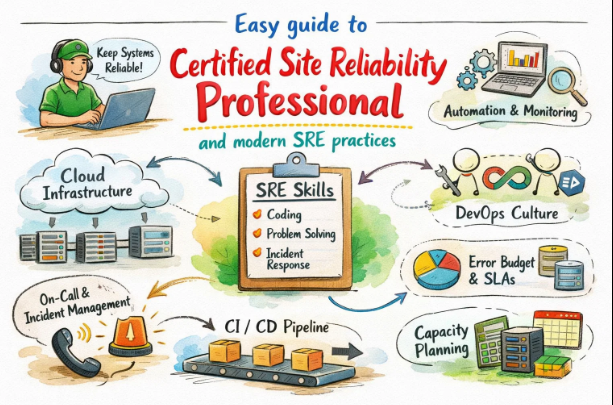
Automation is emphasized over manual work. Error budgets are used to manage risks. These concepts are taught so that systems can be made more resilient. It is considered one of the most respected paths for those who wish to excel in platform operations.
Why it matters today?
Speed is demanded by every business today. New code is being pushed to production every hour. Without a proper reliability framework, frequent crashes are experienced. The Certified Site Reliability Professional program matters because it provides a standard way to handle these challenges.
Complexity in cloud environments is increasing. Tools are changing fast, but the core principles of reliability remain the same. Professionals who hold this certification are seen as experts who can handle high-pressure situations. They are the ones who ensure that the digital world keeps running smoothly.
Why Certified Site Reliability Professional certifications are important
Trust is built through certification. When a candidate is certified, their skills are verified by an external body. This makes the hiring process easier for engineering managers. It is observed that certified professionals often receive better opportunities and higher salaries.
A structured learning path is provided by this program. Instead of learning random tools, a focused curriculum is followed. This ensures that no gaps are left in the knowledge of the engineer. Consistency in work is achieved when everyone in a team follows the same certified standards.
Why choose SRESchool?
High-quality education is provided by SRESchool. The curriculum is kept updated with the latest industry trends. Practical knowledge is given more importance than just passing an exam. Mentorship is offered by people who have spent a long time in the industry.
A global community is made available to every student. This helps in networking and sharing knowledge across borders. Support is provided at every step of the certification journey. This school is chosen by many because of its focus on real-world reliability challenges.
Certification Deep-Dive
What is this certification?
The Certified Site Reliability Professional is a professional validation of SRE skills. It is used to demonstrate expertise in managing scalable and highly available distributed systems.
Who should take this certification?
This program is intended for software engineers, system administrators, and DevOps professionals. It is also highly recommended for platform engineers who want to improve system uptime.
Certification Overview Table
| Track | Level | Who it’s for | Prerequisites | Skills Covered | Recommended Order |
| DevOps | Professional | Engineers | Basic Linux | CI/CD, Automation | First |
| DevSecOps | Professional | Security Pros | DevOps Knowledge | Security Scanning | Second |
| SRE | Professional | Ops & Devs | System Admin | SLIs, SLOs, Error Budgets | Third |
| AIOps/MLOps | Advanced | Data Scientists | Python, SRE | Model Monitoring | Fourth |
| DataOps | Professional | Data Engineers | SQL, Pipeline | Data Reliability | Fifth |
| FinOps | Professional | Managers | Cloud Basics | Cost Optimization | Sixth |
Skills you will gain
- Monitoring and Observability techniques are mastered.
- Incident Management processes are learned.
- Error Budgets and SLOs are implemented correctly.
- Automation of repetitive tasks is achieved using scripts.
- Capacity planning for large-scale systems is understood.
- Post-mortem analysis is conducted to prevent future failures.
Real-world projects you should be able to do after this certification
- A fully automated observability dashboard is built.
- An incident response playbook is created for a web application.
- Service Level Objectives are defined for a microservices architecture.
- Chaos engineering experiments are performed to test system limits.
- Deployment pipelines are optimized for reliability and speed.
Preparation plan
7–14 days plan
The core concepts of SRE are reviewed. The official documentation provided by sreschool.com is read. Basic monitoring tools are practiced.
30 days plan
Detailed study of SLIs and SLOs is completed. Hands-on labs are performed twice a week. Practice exams are taken to identify weak areas.
60 days plan
In-depth projects are completed. Real-world scenarios are simulated. All modules of the Certified Site Reliability Professional course are mastered.
Common mistakes to avoid
- Practical labs are often ignored in favor of reading theory.
- The importance of soft skills in incident management is underestimated.
- Only one tool is focused on instead of understanding the principles.
- Practice tests are not taken seriously before the final exam.
Best next certification after this
Same track: Certified SRE Expert
Cross-track: Certified DevSecOps Professional
Leadership / management: Certified Engineering Manager
Choose Your Learning Path
DevOps Path
The focus is placed on the collaboration between development and operations. This path is best for those who want to automate the software delivery lifecycle.
DevSecOps Path
Security is integrated into every stage of the pipeline. This is ideal for professionals who want to ensure that code is both reliable and safe.
Site Reliability Engineering (SRE) Path
Reliability is treated as a software problem. This path is best for engineers who love solving complex infrastructure issues using code.
AIOps / MLOps Path
Artificial intelligence is used to enhance operations. This is recommended for those working with large data sets and machine learning models.
DataOps Path
The flow of data is managed with high quality and speed. This is perfect for data engineers and analysts.
FinOps Path
Cloud spending is optimized for better business value. This path is best for those who want to bridge the gap between finance and engineering.
Role → Recommended Certifications Mapping
| Role | Recommended Certification |
| DevOps Engineer | Certified DevOps Professional |
| Site Reliability Engineer | Certified Site Reliability Professional |
| Platform Engineer | Certified Platform Engineer |
| Cloud Engineer | Certified Cloud Operations Professional |
| Security Engineer | Certified DevSecOps Professional |
| Data Engineer | Certified DataOps Professional |
| FinOps Practitioner | Certified FinOps Professional |
| Engineering Manager | Certified Technical Management Professional |
Next certifications to take
One same-track certification: Advanced Site Reliability Architect A higher level of expertise is provided through this advanced program. It is specifically created for professionals by whom the professional level has already been mastered. Deep architectural concepts for systems that operate on a global scale are covered in this track. Complex design patterns and high-level reliability strategies are explored to ensure that massive infrastructures remain stable under any condition.
One cross-track certification: Certified DevSecOps Professional A strong connection is shared between system reliability and security. This certification is highly recommended so that the knowledge of keeping systems safe while high availability is maintained can be gained. Security practices are integrated into the automated lifecycle. It is ensured that protection is provided to the infrastructure without any compromise on the speed of delivery or system performance.
One leadership-focused certification: Certified FinOps Practitioner When a transition into leadership is made by an engineer, the management of budgets is found to be crucial. This certification is designed to help in understanding how cloud spending is optimized efficiently. Financial accountability is brought to the technical team. It is ensured that the best possible business value is achieved from the cloud resources being used.
Training & Certification Support Institutions
DevOpsSchool
Complete training for DevOps and SRE is provided here. Hands-on projects and expert guidance are offered to all students.
Cotocus
A wide range of technical certifications is supported by this institution. Real-world scenarios are used to teach complex cloud concepts.
ScmGalaxy
Information on software configuration management is shared here. Support for various community-led certification programs is also provided.
BestDevOps
Specialized courses for modern engineering roles are found at this site. Focus is kept on practical skills that are needed in the job market.
devsecopsschool.com
A dedicated platform for security-focused engineering is managed here. The gap between security and operations is bridged through their training.
sreschool.com
The primary source for SRE certifications is found here. The Certified Site Reliability Professional program is managed by this organization.
aiopsschool.com
Knowledge about using AI in operations is shared on this platform. It is a great place to learn about the future of automation.
dataopsschool.com
Reliability in data pipelines is the main topic here. Training is provided for those who manage large-scale data environments.
finopsschool.com
Cloud financial management is taught at this school. It is chosen by professionals who want to control cloud costs efficiently.
FAQs Section
1. How difficult is the certification exam?
A moderate level of difficulty is found in the exam. Success is achieved if the concepts are understood and the labs are practiced well.
2. How much time is required to prepare?
Usually, 30 to 60 days are needed for a working professional. A few hours every day should be dedicated to study.
3. Are there any prerequisites for this program?
Basic knowledge of Linux and any programming language is helpful. Understanding of cloud basics is also recommended.
4. What is the recommended certification sequence?
It is suggested that DevOps is started first. Then, the Certified Site Reliability Professional is taken to specialize in reliability.
5. How much career value is added by this credential?
High value is added to any resume. It is recognized by top tech companies across India and the globe.
6. Which job roles can be applied for after completion?
Roles such as SRE, DevOps Engineer, and Platform Engineer are easily accessible. Senior positions are also often offered to certified individuals.
7. Is the certification recognized globally?
Yes, global recognition is enjoyed by those who pass the exam. The standards followed are accepted in various international markets.
8. Can the exam be taken online?
The exam is conducted in an online format. It can be taken from any location with a stable internet connection.
9. What is the passing score for the exam?
A score of 70 percent is usually required to pass. The exact details are provided during the registration process.
10. Is retaking the exam allowed?
Yes, the exam can be retaken if the first attempt is not successful. A specific waiting period must be followed between attempts.
11. How long is the certification valid?
Validity is typically for two years. Renewal is done by staying active in the community or taking an update exam.
12. Are training materials provided by the school?
Comprehensive study guides and lab access are provided. All necessary resources are included in the program fee.
Certified Site Reliability Professional FAQs
- How is the Certified Site Reliability Professional exam structured?
The exam is composed of multiple-choice questions and scenario-based tasks. Accuracy and speed are both tested. - Is hands-on experience required for the certification?
Practical knowledge is very important. The questions are designed to test if the candidate has worked on real systems. - What tools are covered in the SRE curriculum?
Tools for monitoring, logging, and automation are included. Focus is placed on industry-standard software. - How are SLIs and SLOs tested in the exam?
Candidates are asked to define and calculate these metrics for given scenarios. The logic behind choosing them is evaluated. - Is programming knowledge necessary for this certification?
A basic understanding of scripting is expected. Python or Go is often used to explain SRE automation concepts. - How does this certification help in salary growth?
A significant increase in salary is often reported by certified professionals. Reliability experts are in high demand in the current market. - Are post-mortems included in the study plan?
The process of writing blameless post-mortems is taught. It is considered a core part of the reliability mindset. - Where is the official exam registered?
Registration is completed on the official sreschool.com website. Clear instructions are provided on the certification page.
Testimonials
Arjun
Great improvement in technical skills is felt after this program. Reliability concepts are now used daily in my work.
Deepa
Career clarity was gained through this certification. The path to becoming a senior engineer was made very clear.
Rohan
Confidence in handling system failures has grown significantly. The incident management training was very helpful.
Sana
Real-world applications were explained in a very simple way. The knowledge gained is being used to optimize our cloud infrastructure.
Vikram
A better understanding of the SRE role was achieved. This certification helped me transition from a developer role to a reliability expert.
Conclusion
The importance of the Certified Site Reliability Professional certification cannot be overstated. It is a powerful tool for anyone looking to secure their future in technology. Long-term career benefits are enjoyed by those who invest time in learning these skills. A strategic approach to certification planning is encouraged. By following the right learning path, a position of authority in the industry can be reached. The journey toward excellence starts with a single step toward professional certification.

