
Introduction
The need for security in the software development process has never been more critical than it is today. As organizations move toward faster delivery cycles, the traditional approach of checking for security at the end of the cycle is found to be insufficient. This is where DevSecOps comes into play. It is an approach where security is integrated into every stage of the pipeline. To help professionals master this, the Certified DevSecOps Engineer program has been developed. This guide is written to provide a clear path for anyone looking to build a career in this high-demand field.
What is Certified DevSecOps Engineer
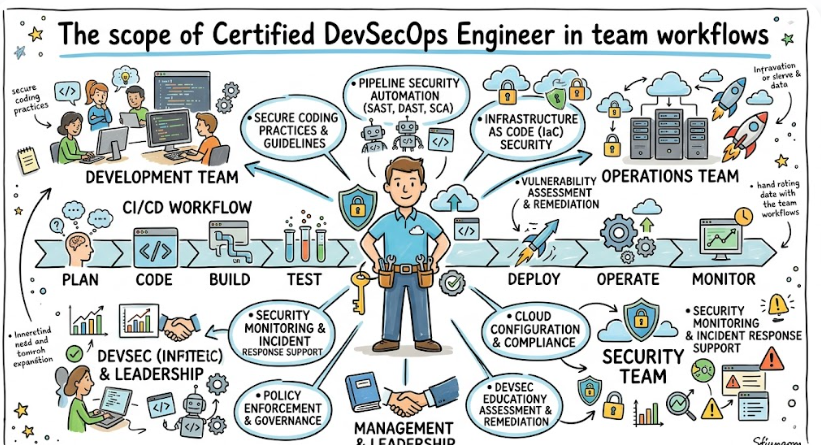
A Certified DevSecOps Engineer is a professional who is trained to integrate security practices into the DevOps workflow. In this role, security is treated as a shared responsibility rather than a final step. Tools and processes are automated to ensure that vulnerabilities are identified and fixed early in the development process. The certification is designed to validate a candidate’s ability to use security tools, manage risks, and maintain compliance within a continuous integration and continuous deployment (CI/CD) environment.
Why it matters today?
In the modern world, data breaches and cyberattacks are becoming more frequent and sophisticated. Speed of delivery is often prioritized, but without security, that speed can lead to significant financial and reputational damage. By adopting DevSecOps, security is “shifted left,” meaning it is addressed at the very beginning of the project. This reduces the cost of fixing bugs and ensures that the software delivered to users is safe and reliable. Companies across the globe are looking for experts who can bridge the gap between development, operations, and security teams.
Why Certified DevSecOps Engineer certifications are important
Certifications are highly valued because they provide a structured way to learn complex topics. For an engineer, a certification serves as a formal validation of skills that are recognized by employers worldwide. It demonstrates a commitment to professional growth and staying updated with industry trends. Furthermore, the process of preparing for a certification helps in gaining hands-on experience with various tools that are used in real-world scenarios. It provides a competitive edge during job interviews and opens up opportunities for higher-level roles and better salaries.
Why choose DevSecOpsSchool?
DevSecOpsSchool is chosen by many professionals because the training provided is deeply rooted in practical industry needs. The curriculum is updated regularly to reflect the latest tools and security practices. Mentors with extensive field experience guide the learners, ensuring that complex concepts are explained in a simple and understandable manner.
A strong emphasis is placed on hands-on labs and real-world projects, which helps in building confidence. Additionally, a supportive community is provided where learners can interact and share knowledge. The certification from DevSecOpsSchool is respected by many top organizations, making it a reliable choice for career advancement.
Certification Deep-Dive
What is this certification?
The Certified DevSecOps Engineer program is a comprehensive training that focuses on the automation of security within the DevOps lifecycle. It covers the implementation of security checks in the coding, building, and deployment phases.
Who should take this certification?
This certification is ideal for Software Engineers, DevOps Engineers, Security Professionals, and Engineering Managers who wish to master the art of securing modern cloud-based applications.
Certification Overview Table
| Track | Level | Who it’s for | Prerequisites | Skills Covered | Recommended Order |
| DevOps | Intermediate | System Admins, Devs | Linux, Scripting | CI/CD, Docker, Git | 1 |
| DevSecOps | Advanced | DevOps, Sec Engineers | DevOps Basics | SAST, DAST, SCA | 2 |
| SRE | Advanced | Ops Engineers | Cloud, Automation | Monitoring, SLIs/SLOs | 3 |
| AIOps/MLOps | Specialized | Data Scientists | Python, ML basics | Model Deployment | 4 |
| DataOps | Specialized | Data Engineers | SQL, ETL basics | Data Pipelines | 5 |
| FinOps | Management | Finance/Eng Managers | Cloud Billing | Cost Optimization | 6 |
Skills you will gain
- The implementation of Static Application Security Testing (SAST) is mastered.
- Dynamic Application Security Testing (DAST) tools are configured and managed.
- Software Composition Analysis (SCA) is used to find vulnerabilities in open-source libraries.
- Security is integrated into Jenkins, GitLab, or GitHub Actions pipelines.
- Container security and image scanning are performed effectively.
- Compliance as Code is implemented using automated auditing tools.
- Secret management and encryption techniques are applied.
Real-world projects you should be able to do after this certification
- A fully automated DevSecOps pipeline is built for a microservices application.
- A vulnerability management system is established to track and fix security flaws.
- Automated compliance checks are created for cloud infrastructure using Terraform.
- A secure container registry is set up with automated image scanning.
- A centralized logging and monitoring system for security events is deployed.
Preparation plan
7–14 days plan
The focus is placed on understanding the core concepts of DevSecOps. The official course materials are reviewed, and the basics of security automation are studied. Quick labs on SAST and SCA tools are completed to get a feel for the tools.
30 days plan
A deeper study into pipeline integration is conducted. Different security tools are integrated into a CI/CD pipeline. Mock exams are taken to identify weak areas. Time is spent on understanding container security and cloud-native security practices.
60 days plan
A comprehensive approach is taken where every module of the certification is thoroughly practiced. Complex real-world scenarios are simulated and solved. Extensive hands-on labs are performed to ensure mastery over tool configuration and troubleshooting.
Common mistakes to avoid
- The fundamental concepts of DevOps are often ignored before jumping into security.
- Only theoretical knowledge is gained without performing enough hands-on labs.
- The importance of culture and collaboration in DevSecOps is underestimated.
- Only one specific tool is focused on instead of understanding the overall security process.
- Regular practice and revision of complex security configurations are neglected.
Best next certification after this
- Same track: Certified DevSecOps Professional or Expert level.
- Cross-track: Certified Site Reliability Engineer (SRE) to focus on reliability.
- Leadership / management: Certified FinOps Practitioner or Engineering Management programs.
Choose Your Learning Path
DevOps
This path is best for those who want to master the automation of software delivery. It focuses on the collaboration between development and operations teams.
DevSecOps
This path is designed for engineers who want to specialize in securing the delivery pipeline. It is best for those with a background in DevOps or Security.
Site Reliability Engineering (SRE)
This path is intended for professionals who focus on the stability and reliability of large-scale systems. It is best for those who enjoy system administration and automation.
AIOps / MLOps
This path is suitable for those working with artificial intelligence and machine learning models. It ensures that ML models are deployed and managed efficiently.
DataOps
This path is best for data engineers and analysts. It focuses on improving the quality and speed of data delivery through automation.
FinOps
This path is ideal for those who want to manage cloud costs. It is best for cloud architects and finance professionals looking to optimize spending.
Role → Recommended Certifications Mapping
| Role | Recommended Certification | Key Focus |
| DevOps Engineer | Certified DevOps Engineer | Automation & CI/CD |
| Site Reliability Engineer | Certified SRE | Reliability & Scaling |
| Platform Engineer | Certified Cloud Native Engineer | Infrastructure Platforms |
| Cloud Engineer | Certified Cloud Architect | Cloud Infrastructure |
| Security Engineer | Certified DevSecOps Engineer | Security Automation |
| Data Engineer | Certified DataOps Professional | Data Pipeline Automation |
| FinOps Practitioner | Certified FinOps Associate | Cost Management |
| Engineering Manager | Certified Digital Transformation | Strategy & Leadership |
Next Certifications to Take
For DevOps Learners:
- Same-track: Certified Kubernetes Administrator (CKA).
- Cross-track: Certified DevSecOps Engineer.
- Leadership: Certified Engineering Manager.
For Security Learners:
- Same-track: Certified Cloud Security Professional.
- Cross-track: Certified SRE.
- Leadership: Certified IT Director.
Training & Certification Support Institutions
DevOpsSchool
This institution is known for its wide range of courses and a very large community of learners. Comprehensive training programs are provided for DevOps and related technologies.
Cotocus
Specialized training and consulting services are offered by this organization. A focus is maintained on providing high-quality, practical learning experiences for technical professionals.
ScmGalaxy
A vast knowledge base and community support are provided through this platform. It serves as a hub for resources related to software configuration management and automation.
BestDevOps
Quality-focused learning paths are created here to help engineers advance their careers. The curriculum is designed to be simple and easy to follow for all levels.
devsecopsschool.com
This is the primary site for specialized security training. It is dedicated to promoting DevSecOps practices through certifications and workshops.
sreschool.com
A dedicated platform for learning Site Reliability Engineering is provided here. The courses focus on creating reliable and scalable systems.
aiopsschool.com
Training for the integration of AI in operations is offered. It helps professionals understand how to use machine learning to improve IT processes.
dataopsschool.com
This site focuses on the growing field of DataOps. It provides the skills needed to manage data lifecycles with an automated approach.
finopsschool.com
Resources for cloud financial management are provided here. It is a great place to learn about optimizing cloud costs and accountability.
FAQs Section
- How difficult is the Certified DevSecOps Engineer exam?
The exam is considered to be of an intermediate to advanced level, requiring a good mix of theory and hands-on skills. - How much time is required to prepare for this certification?
A period of 30 to 60 days is usually sufficient for most professionals, depending on their existing knowledge. - Are there any prerequisites for taking this exam?
A basic understanding of DevOps processes and some familiarity with the Linux command line are recommended. - What is the recommended sequence for certifications?
It is often suggested to start with a basic DevOps certification before moving to specialized tracks like DevSecOps or SRE. - What is the career value of becoming a DevSecOps Engineer?
Significant career growth is often seen, as security experts are in high demand and command higher salaries. - Which job roles can I apply for after this certification?
Roles such as DevSecOps Engineer, Security Automation Engineer, and Cloud Security Architect can be pursued. - Is hands-on practice included in the training?
Yes, a large portion of the training is dedicated to practical labs and real-world project simulations. - How does this certification help in job growth?
A clear validation of specialized skills is provided, making the candidate more attractive to top-tier employers. - Is the certification recognized globally?
The certification from DevSecOpsSchool is respected and recognized by organizations across many different countries. - What tools are covered in the DevSecOps program?
Tools for SAST, DAST, SCA, container scanning, and pipeline security are all covered in detail. - Can an Engineering Manager benefit from this?
Yes, managers gain the knowledge needed to oversee security teams and make informed technical decisions. - Is there any community support available?
Access to a global community of experts and fellow learners is provided for ongoing support.
Additional FAQs for Certified DevSecOps Engineer
- What is the primary focus of the Certified DevSecOps Engineer course?
The main focus is on the automation of security checks within the software development life cycle. - Will I learn about cloud security in this program?
Yes, security practices for major cloud platforms and containerized environments are included. - Are open-source tools used in the training?
Many popular open-source security tools are used to ensure the skills gained are widely applicable. - How is the exam conducted?
The exam is typically conducted online in a proctored environment to maintain its integrity. - What is the validity period of the certification?
The certification is usually valid for a specific period, after which renewal or advanced certifications are encouraged. - Can beginners in security take this course?
Yes, the course is designed to take a learner from basic security concepts to advanced automation. - Is “Compliance as Code” taught in this certification?
Yes, the automation of compliance and auditing is a key part of the curriculum. - What kind of support is provided if I get stuck in a lab?
Dedicated mentors and a support team are available to help resolve any technical issues encountered during labs.
Testimonials
Aarav
The skills gained from this program were applied directly to my daily tasks. The confidence level in handling security pipelines was significantly improved.
Ananya
A very clear path was provided for my career transition. The real-world projects helped me understand how security is managed in large organizations.
Vikram
The training was very practical and easy to follow. A much better understanding of vulnerability management was achieved through the hands-on labs.
Ishaan
The complex topics of DevSecOps were explained in a very simple way. The certification has definitely helped in getting better job opportunities.
Rohan
The focus on automation was exactly what was needed for my role. The knowledge gained has allowed for a more secure and efficient deployment process.
Conclusion
The role of a Certified DevSecOps Engineer is becoming a cornerstone of modern software development. As security becomes a top priority for every business, the demand for skilled professionals will only continue to rise. By following a structured learning path and gaining recognized certifications, a successful and rewarding career can be built.
Strategic planning and continuous learning are the keys to long-term success in this field. Whether the journey is just beginning or an advancement in the current role is sought, the Certified DevSecOps Engineer program offers the tools and knowledge required to excel.

