
Introduction
The integration of machine learning models into modern software products has become a standard practice. However, a significant gap is often found between the creation of a model and its reliable operation in a production environment. This gap is bridged by MLOps, a discipline that combines data science with operational excellence. The MLOps Certified Professional (MLOCP) program is recognized as a vital step for engineers who wish to master this transition. In this guide, the certification is explored in great detail to help professionals navigate their career growth.
What is MLOps Certified Professional (MLOCP)
The MLOps Certified Professional (MLOCP) is a specialized credential that validates the ability to manage the entire lifecycle of machine learning. It is not just about writing code; it is about building the factory that produces and maintains AI models. The certification is structured to cover the intersection of Machine Learning, DevOps, and Data Engineering. It ensures that the principles of automation are applied to the unique challenges of data and model management.
Why it matters in today’s software, cloud, and automation ecosystem
The complexity of software is greatly increased when AI is involved. Traditional software is usually static until a new version is released, but machine learning models are dynamic. They can change their behavior as the data they process changes. Without MLOps, these models often become “technical debt” that is difficult to monitor or update. In the current cloud ecosystem, where efficiency is paramount, MLOps provides the framework needed to make AI scalable, repeatable, and safe. It is viewed as the essential glue that holds modern automation together.
Why certifications are important for engineers and managers
Certifications are treated as a reliable benchmark of proficiency in a rapidly changing market. For engineers, a structured path is provided, ensuring that no critical gaps in knowledge are left behind. For managers, the risk of hiring or promoting is reduced when a candidate’s skills are validated by a recognized program like MLOCP. In competitive markets such as India and the global tech landscape, a certification acts as a badge of commitment to continuous learning and professional standards.
Certification Overview Table
| Track | Level | Who it’s for | Prerequisites | Skills Covered | Recommended Order |
| MLOps | Professional | DevOps, Data Engineers, Architects | Basic DevOps & Python knowledge | CI/CD for ML, Model Monitoring, Orchestration | After DevOps Fundamentals |
Why choose DevOpsSchool?
DevOpsSchool is chosen by many professionals because the training is rooted in real-world scenarios rather than just theory. The curriculum is constantly updated to reflect the latest tools and industry shifts. A strong community of experts is maintained, providing learners with a network that extends far beyond the classroom. The focus is always placed on making the student “job-ready” by simulating the high-pressure environments found in top-tier tech companies.
Certification Deep-Dive: MLOps Certified Professional (MLOCP)
What is this certification?
This certification is a comprehensive program designed to teach the principles of Machine Learning Operations. It is focused on the specialized tools and processes required to manage the ML lifecycle—from the initial ingestion of data to the final deployment and continuous monitoring of models in production.
Who should take this certification?
- Software Engineers: Those who are transitioning into AI/ML roles and need to understand the operational side of the field.
- DevOps Engineers: Professionals who are tasked with supporting data science teams and need to adapt their CI/CD knowledge to ML.
- Data Engineers: Individuals who are responsible for the data pipelines that feed machine learning models and want to automate those flows.
- Engineering Managers: Leaders who oversee AI-driven projects and need to understand the technical hurdles their teams face.
Skills you will gain
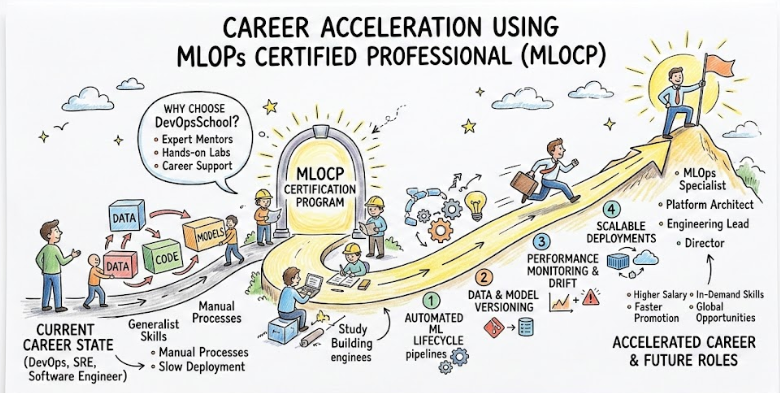
- Automated ML Pipelines: The ability to build robust CI/CD pipelines that are specifically designed for the unique requirements of machine learning models.
- Data and Model Versioning: Proficiency is gained in versioning not just the code, but also the massive datasets and the resulting model artifacts to ensure reproducibility.
- Automated Testing for ML: Knowledge is acquired regarding how to test models for accuracy, bias, and performance before they reach the user.
- Model Drift Monitoring: Skills are developed in setting up systems that detect when a model’s performance begins to degrade due to changing real-world data.
- Scalable Infrastructure: An understanding is built on how to use containerization and orchestration tools like Kubernetes to serve models to millions of users.
Real-world projects you should be able to do after this certification
- End-to-End Recommendation Engine Pipeline: A fully automated system is built where a model is trained, tested, and deployed every time the underlying data is updated.
- Real-time Accuracy Dashboard: A monitoring system is created that alerts the engineering team the moment a model’s prediction accuracy falls below a certain threshold.
- Elastic Model Serving Infrastructure: A scalable environment is deployed using Kubernetes that can handle sudden spikes in traffic for an AI service.
- Data Lineage and Versioning System: A system is implemented that allows an organization to track exactly which version of data was used to train a specific model version.
Preparation plan
7–14 days plan (The Fast Track):
- Day 1-3: The fundamental principles of the ML lifecycle and the roles of different stakeholders are reviewed.
- Day 4-7: Intensive laboratory exercises are performed, focusing on setting up basic CI/CD pipelines for small ML models.
- Day 8-11: Advanced tools for data versioning and model monitoring are practiced in a sandbox environment.
- Day 12-14: Practice exams are completed, and time is spent addressing any remaining technical gaps.
30 days plan (The Balanced Path):
- Week 1: A deep dive is taken into the core theory of MLOps, including the differences between DevOps and MLOps.
- Week 2: Hands-on experience is gained with industry-standard tools such as MLflow, DVC, or specialized cloud ML services.
- Week 3: Focus is shifted to the infrastructure layer, including containerization and the orchestration of ML workloads on the cloud.
- Week 4: Final revision is conducted, and multiple mock tests are performed to build confidence for the exam.
60 days plan (The Deep Learner):
- Month 1: The first month is dedicated to mastering the foundations of both DevOps and Machine Learning independently to build a strong base.
- Month 2: Complex, multi-stage projects are built from scratch. Extensive time is spent on troubleshooting and understanding why pipelines fail in real-world scenarios.
Common mistakes to avoid
- Treating ML like traditional software: The mistake of ignoring the fact that ML models require continuous retraining and data management is often made.
- Neglecting Data Versioning: It is frequently forgotten that code versioning is not enough; the data used for training must also be tracked.
- Underestimating Monitoring: Many engineers focus only on the deployment and forget that a model can “rot” in production if it is not monitored for drift.
- Tool Over-focus: Too much time is often spent learning a specific tool rather than understanding the underlying MLOps process that applies to all tools.
Best next certification after this
- Same track: Advanced MLOps Architect (focusing on enterprise-scale AI).
- Cross-track: AIOps Professional Certification (applying AI to improve general IT operations).
- Leadership / management: Certified Engineering Manager in AI/ML (focusing on leading high-performing AI teams).
Choose Your Learning Path
Selecting a path that aligns with personal career goals is essential. Six primary paths are described below:
- DevOps Path: This is designed for those who find fulfillment in automation and infrastructure. The goal is to make the software release process as fast and safe as possible.
- DevSecOps Path: This is ideal for security-focused professionals. It ensures that security checks are integrated into every single step of the automation pipeline.
- Site Reliability Engineering (SRE) Path: This is best for those who enjoy solving complex problems related to system uptime, scalability, and performance monitoring.
- AIOps / MLOps Path: This path is chosen by those working at the cutting edge of AI. It focuses on making complex machine learning systems reliable and manageable.
- DataOps Path: This is for professionals who want to ensure that high-quality data is delivered to the right people at the right time with maximum agility.
- FinOps Path: This is perfect for those who want to bridge the gap between engineering and finance by optimizing cloud costs and resource usage.
Role → Recommended Certifications Mapping
A clear roadmap for different professional roles is provided here:
- DevOps Engineer: DevOps Certified Professional → MLOCP.
- Site Reliability Engineer (SRE): SRE Certified Professional → MLOCP.
- Platform Engineer: Kubernetes Certified Professional → MLOCP.
- Cloud Engineer: Cloud Architect Certification → MLOCP.
- Security Engineer: DevSecOps Certified Professional → MLOCP.
- Data Engineer: DataOps Professional → MLOCP.
- FinOps Practitioner: FinOps Certified Professional → MLOCP.
- Engineering Manager: Certified Engineering Manager → MLOCP.
Next Certifications to Take
Following the completion of the MLOCP, the following certifications are recommended based on industry demand:
- One same-track certification: Advanced Machine Learning Pipeline Specialist.
- One cross-track certification: DataOps Certified Professional (to understand the upstream data flow).
- One leadership-focused certification: Strategic AI Management Certification (for those moving into executive or director roles).
Training & Certification Support Institutions
Support for these certifications is provided by several specialized institutions:
- DevOpsSchool: A wide range of training programs is offered with a focus on community and practical labs. The institution is known for helping students gain job-ready skills.
- Cotocus: This organization is specialized in corporate training. Customized learning paths are provided to help large engineering teams adopt MLOps and DevSecOps.
- ScmGalaxy: A massive repository of technical resources and community-driven tutorials is maintained here. It is a preferred destination for learning configuration management.
- BestDevOps: Intensive bootcamps are the specialty of this platform. The programs are designed to get students certified and working in the field quickly.
- devsecopsschool.com: A dedicated focus is placed on the security aspect of the automation lifecycle.
- sreschool.com: Expert-level training on site reliability and high-availability systems is delivered.
- aiopsschool.com: The use of artificial intelligence to optimize IT operations is taught in detail.
- dataopsschool.com: Principles of data quality, agility, and governance are the primary focus here.
- finopsschool.com: Professional education on managing cloud finances and maximizing cloud value is provided.
FAQs Section
General FAQs
- Is the MLOCP exam considered difficult?
The exam is viewed as moderately difficult because it requires a mix of operational knowledge and data science concepts. - How much preparation time is usually required?
Between 4 and 8 weeks of consistent study are generally recommended for most professionals. - Are there any strict prerequisites?
While not mandatory, a basic understanding of Python and the Linux command line is highly beneficial. - Is MLOps just for data scientists?
No, it is actually designed more for engineers who want to support the work of data scientists. - What is the job market like for MLOps?
The demand is currently very high, as many companies are struggling to move their AI models into production. - Can the certification be taken online?
Yes, the exam and the training are typically offered in a digital format for global accessibility. - Is hands-on experience included in the training?
Most reputable providers, like DevOpsSchool, include extensive lab work in their programs. - How does MLOps differ from DevOps?
While DevOps focuses on code, MLOps must also manage data and the changing behavior of models. - What salary growth can be expected?
A significant “certification bump” is often seen in the salaries of those who hold the MLOCP title. - Is the certification recognized in India?
Yes, it is widely recognized by top IT firms and startups across the country. - How often should I recertify?
Recertification is usually encouraged every two to three years to stay updated with new tools. - Are there any group discounts for teams?
Many institutions, such as Cotocus, offer specialized pricing for corporate groups.
MLOCP Specific FAQs
- Does the program cover Kubernetes?
Yes, Kubernetes is typically used as the primary tool for orchestrating model deployments. - Is model security part of the curriculum?
Basic security for ML models and data is usually addressed in the professional track. - Are specific cloud providers like AWS or Azure used?
The principles are taught in a cloud-agnostic way, though specific clouds may be used for labs. - What happens if the exam is failed?
Retake options are usually provided after a short waiting period for further study. - Is Python the only language used?
Python is the primary language, as it is the standard for the machine learning industry. - Does MLOCP cover Generative AI?
The deployment and operations of LLMs and GenAI models are increasingly being included in the curriculum. - Is data privacy discussed?
Yes, the ethical and legal aspects of handling data are often touched upon. - How are labs accessed?
Remote lab environments are typically provided by the training institution for the duration of the course.
Testimonials
“The transition from a traditional DevOps role to AI was made simple by the MLOCP program. The way model versioning was explained changed my entire workflow.”
— Ananya R., DevOps Engineer
“A massive difference in our system’s reliability was seen once we implemented the monitoring strategies taught in this course. It is essential for modern SREs.”
— Vikram S., Site Reliability Engineer
“The career clarity I gained was worth the effort. I now understand exactly how to bridge the gap between our data science and engineering teams.”
— David L., Cloud Engineer
“Security in AI is often overlooked, but the MLOCP certification gave us the tools to secure our pipelines from the ground up.”
— Sarah K., Security Engineer
“Managing AI projects used to feel like guesswork. Now, I have a clear framework to hold my team accountable and ensure project success.”
— Rahul M., Engineering Manager
Conclusion
The MLOps Certified Professional (MLOCP) certification is more than just a title; it is a gateway to the future of software engineering. It is designed to empower professionals with the skills needed to manage the most complex systems in the world today. Long-term career benefits, including specialized roles and higher compensation, are consistently reported by those who complete the program. A strategic plan for learning and certification is highly recommended for anyone who wishes to lead in the AI era.
