
Introduction
In the fast-moving world of software, technical skills are only half the battle. As companies grow, they need more than just people who can write scripts or manage clouds. They need leaders. They need professionals who can look at a messy process and turn it into a high-speed delivery engine. This is where the role of a DevOps Manager becomes vital.
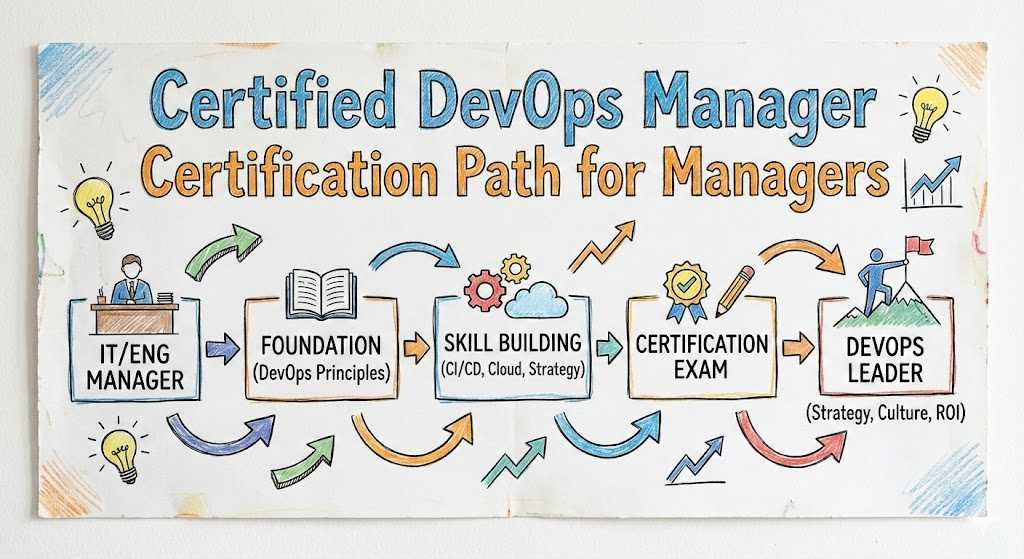
If you are looking to step up from engineering to leadership, or if you are already managing teams and want a solid framework, the Certified DevOps Manager program is a game-changer. This guide explores everything you need to know to master this path and advance your career.
1. Defining the Certified DevOps Manager Role
What exactly is a Certified DevOps Manager?
A Certified DevOps Manager is a professional who has mastered the art of balancing people, processes, and technology. Unlike an entry-level engineer who focuses on specific tools, a manager looks at the entire “Value Stream.” This certification proves you know how to lead a cultural shift, manage technical debt, and ensure that software reaches the customer faster and with fewer errors. It transforms you from a “doer” into a “strategist” who understands how every piece of the pipeline connects to business revenue.
The Value of Modern Automation Leadership
Today’s software ecosystem is complex. With the rise of microservices, serverless computing, and hybrid clouds, teams can easily get lost in the noise. A certified manager acts as the navigator. They ensure that automation isn’t just done for the sake of it, but to solve real business problems. This role is the bridge between the high-level goals of the CEO and the daily tasks of the engineering team. Without this leadership, organizations often suffer from “tool fatigue,” where they have too much technology but not enough efficiency.
Why Industry Credentials Matter Now
In a crowded job market, certifications act as a filter. For engineers in India and across the globe, having a recognized credential like this one shows you are serious about your craft. It proves you have been tested against industry standards. For an employer, it reduces the risk of hiring someone who might not understand the complexities of scaling a DevOps culture. It signals that you are not just guessing; you are applying proven frameworks and methodologies to solve complex delivery challenges.
2. Vital Statistics: The Certification Roadmap
| Specialty Track | Expertise Level | Target Professional | Necessary Skills | Primary Focus | Sequence |
| Leadership | Senior Management | Leads, Architects | Strategic Planning | ROI & Culture | Post-Professional |
Why is DevOpsSchool the Right Choice?
When choosing a training partner, you need someone who understands the “real world.” DevOpsSchool stands out because they don’t just teach from a textbook. Their curriculum is built by veterans who have spent decades in the trenches of IT. They understand the nuances of modern infrastructure and the common pitfalls that teams face.
They provide a hands-on environment where you can practice management scenarios, not just code. With a massive library of resources and a community of thousands of experts, they provide the support system you need to actually succeed in a new job, not just pass an exam. Their focus is on “employability” and “practical application,” ensuring that what you learn on the weekend can be used in your office on Monday morning.
3. Deep-Dive into the Manager Certification
Understanding the Managerial Track
The Core of the Program
This program is specifically built to transform a technical expert into a strategic leader. It covers the high-level view of the entire DevOps lifecycle, focusing on governance, team structures, and financial accountability. You move away from asking “How do I configure this server?” to asking “How does this server configuration help us release features faster?”
Who is this meant for?
- Senior DevOps Engineers: Those who are tired of just closing tickets and want to start defining the roadmap.
- Team Leads: Professionals who need to manage larger budgets and guide junior engineers effectively.
- Project Managers: Individuals who are overseeing cloud migrations and need to understand the technical workflow.
- IT Directors: Leaders who want to modernize their department’s workflow and adopt agile practices.
Top Skills You Will Acquire
- Strategic Roadmap Design: You will learn how to plan a multi-year DevOps journey for a large company, breaking down complex transformations into manageable phases.
- Performance Metrics (KPIs): Master the DORA metrics—Deployment Frequency, Lead Time, Change Failure Rate, and MTTR—and learn how to visualize them for stakeholders.
- Team Mentorship: Gain the “soft skills” needed to hire, train, and keep top-tier engineering talent, reducing burnout and turnover in high-pressure environments.
- Risk Management: Understand how to maintain security and compliance without slowing down the developers, integrating “DevSecOps” principles at the management level.
- Budget Optimization: Learn how to prove the return on investment (ROI) of your automation efforts to your bosses, translating technical wins into financial success.
Practical Challenges You Will Solve
- Designing a Global CI/CD Pipeline: You will learn to architect systems that work across different time zones and different cloud providers, ensuring consistency in deployment.
- Cultural Transformation Projects: You will practice how to break down “silos” between developers and operations teams in a real-world simulation, fostering collaboration.
- Incident Response Planning: You will build frameworks for how a team should react when a major system goes down, focusing on “Blameless Post-Mortems” to learn from mistakes.
The Preparation Blueprint
- The 14-Day Sprint: Spend the first two weeks mastering the vocabulary of DevOps leadership. Focus on the core principles like the “Phoenix Project” philosophy and the “Three Ways of DevOps.” Read about the history of Agile and Lean manufacturing to understand the roots of the movement.
- The 30-Day Deep Dive: Dedicate this month to studying metrics and governance. Learn how to use data to tell a story about your team’s productivity. Practice setting up dashboards that track real-time project health.
- The 60-Day Mastery: Use the final month for mock exams and practical labs. Review case studies from companies like Netflix, Amazon, or Etsy to see how they scaled their management practices. Engage in peer discussions to test your understanding.
Typical Pitfalls to Sidestep
- The Tool Trap: Do not fall into the trap of thinking that buying a new tool fixes a broken process. You must fix the process and culture first; the tool is just an enabler.
- Ignoring the Humans: Technical changes are easy; changing human behavior is hard. Never ignore the cultural side or the resistance to change that often comes from legacy teams.
- Losing Technical Edge: While you are a manager, you must still understand the tech so your team respects your decisions. Do not become completely detached from the code.
What Comes Next?
- Related Track: Certified Site Reliability Lead (to master uptime strategies).
- Branching Out: Certified DevSecOps Professional (to master security integration).
- Executive Growth: Advanced Corporate Leadership certifications (to aim for CTO/CIO roles).
4. Selecting Your Professional Learning Path
The Classic DevOps Route
This is the most common path. It starts with automation and ends with you managing the entire delivery flow of a product. It’s best for those who love seeing code go live safely and efficiently. You focus on removing manual toil and speeding up the release cycle.
The Security-First (DevSecOps) Route
For those who believe security is everyone’s job. This path leads to roles where you manage the “Shield” of the company, ensuring that every line of code is safe from day one. You shift security “left,” making it part of the design rather than an afterthought.
The Reliability (SRE) Route
Perfect for the “firefighters” of the tech world. This path is for those who want to manage the stability and uptime of massive, global systems that can never go down. You focus on Service Level Objectives (SLOs) and Error Budgets to balance innovation with reliability.
The Intelligent Ops (AIOps/MLOps) Route
The future of tech. This path is for leaders who want to use machine learning to predict outages before they happen and manage the lifecycle of AI models. It involves automating the operational tasks using smart algorithms to reduce human intervention.
The Data-Driven (DataOps) Route
Best for those working with Big Data. You will learn how to apply the speed of DevOps to the world of data engineering and analytics. This ensures that data scientists get clean, reliable data quickly, allowing the business to make faster decisions.
The Financial (FinOps) Route
A very high-demand path. This is for leaders who want to focus on “Cloud Economics,” ensuring the company doesn’t waste millions of dollars on unused cloud resources. You bridge the gap between engineering teams and the finance department.
5. Roles and Their Matching Credentials
- DevOps Professional: Focus on the Certified DevOps Manager and Advanced Automation tracks to solidify your grasp on CI/CD pipelines.
- Reliability Expert: Look toward SRE Leadership and Observability tracks to master the art of keeping systems online under high pressure.
- Infrastructure Leader: Focus on Cloud Architecture and Platform Engineering management to build robust foundations for developers.
- Security Architect: Prioritize the DevSecOps Manager track to lead the initiative on secure coding and vulnerability management.
- Data Architect: Move toward DataOps leadership to streamline the complex flow of information across the enterprise.
- Business Unit Head: The FinOps and Certified DevOps Manager certifications are your best tools to align technology spending with business value.
6. Advancing to the Next Level
Once you have mastered the manager level, you must keep growing. The industry never stops.
- Stay in your lane: If you love DevOps, go deeper into Platform Engineering. Learn how to build “Internal Developer Platforms” (IDP) that treat developers as customers.
- Move across: If you are a DevOps lead, take a Security certification to become a “T-Shaped” leader. This breadth of knowledge makes you invaluable during crisis situations.
- Move up: Focus on leadership certifications that teach you about business strategy and high-level negotiation. This prepares you for executive roles where you define the company’s technical vision.
7. Organizations Supporting Your Growth
DevOpsSchool
This is the premier institution for those seeking deep, technical knowledge combined with leadership training. They offer a massive variety of courses that fit every career stage, from beginner to expert. Their focus on community-driven learning ensures you are never studying alone.
Cotocus
A specialized hub known for its intense, bootcamp-style training. They focus on the most modern tools like Kubernetes and Istio, making sure you are ahead of the curve. Their rigorous schedule is designed to immerse you completely in the technology.
ScmGalaxy
One of the oldest and most respected communities in the industry. They provide a wealth of free resources, blogs, and tutorials that complement their professional training. It is a great place to find answers to obscure technical questions and network with peers.
BestDevOps
Focuses on making students “industry-ready.” Their curriculum is designed to fill the gap between what you learn in college and what you actually need on the job. They emphasize practical scenarios that mimic real corporate challenges.
devsecopsschool.com
The top choice for anyone wanting to specialize in the intersection of security and automation. They provide deep dives into compliance standards and automated security testing.
sreschool.com
A dedicated platform for learning the Google-born discipline of Site Reliability Engineering. They focus on the math and science behind system availability and scaling.
aiopsschool.com
The place to go for training on the next generation of IT—automated operations driven by artificial intelligence. They teach you how to implement predictive maintenance for your infrastructure.
dataopsschool.com
Specifically designed for data professionals who want to bring agility to their data pipelines. They cover the orchestration of complex data flows.
finopsschool.com
Focused on the business and financial side of the cloud, helping you become a master of cloud cost management. They teach you how to read a cloud bill and optimize it effectively.
8. Common Questions and Answers
General Industry Inquiries
- Is the manager exam very hard?
It is challenging because it asks about “what to do” in a crisis, not just which button to click. You need to demonstrate judgment and experience. - How long do I need to study?
Most professionals find that 6-8 weeks of consistent study is the “sweet spot” to absorb the material without burning out. - What if I don’t have a degree?
Experience and certifications often count for more than a degree in modern DevOps. Practical skills are what employers value most. - In what order should I learn?
Start with the basics of Linux and Cloud, then move to Professional DevOps, and finally, the Manager level. This builds a strong foundation. - What is the return on this investment?
Certified managers often see a 25-40% increase in job offers and salary packages because they bring strategic value. - Are these tools-specific?
No, the manager track is “tool-agnostic,” meaning it works whether you use AWS, Azure, or Jenkins. The principles apply everywhere. - Is there global demand?
Yes, the need for DevOps leads is growing in the US, Europe, and especially India as more companies adopt cloud-native technologies. - Can I balance this with a full-time job?
Yes, most programs are designed for working professionals with weekend or evening sessions to accommodate your schedule. - What about non-technical managers?
They can take it, but they should have a basic understanding of how software is built to get the most out of the course. - How do I keep the certification active?
By participating in the community and taking short “delta” exams every few years to stay updated with new trends. - Are labs included?
Yes, you cannot learn management without seeing how a team handles a technical lab and solving the friction points that arise. - Is there placement support?
Many institutions like DevOpsSchool have strong ties with global tech firms and provide assistance with resume building and interviews.
Certified DevOps Manager Specifics
- Does it cover Agile?
Yes, it teaches you how DevOps fits into the Scrum and Kanban frameworks, ensuring your operations align with development sprints. - Will I learn about ROI?
Yes, calculating the cost-savings of automation is a major topic, helping you justify your budget requests. - Does it cover remote team management?
Modern versions of the course include leading distributed and remote engineering teams, a critical skill in today’s world. - Is the exam multiple-choice?
Usually, yes, but the questions are based on complex scenarios where you must choose the “best” answer among several good ones. - Do I need to be a coder?
You don’t need to be a developer, but you must be able to read and understand code logic to communicate effectively with your team. - Does it help with executive presence?
Yes, it gives you the language to speak with VPs and CTOs, translating technical metrics into business outcomes. - Is change management included?
Yes, learning how to handle organizational change and resistance is a vital part of the curriculum. - What is the focus of the labs?
The labs focus on building delivery pipelines and monitoring system health, simulating real-world outages and deployment failures.
9. Real-World Success Stories
Suresh
“I had reached a ceiling in my career as a senior engineer. This program gave me the management framework to lead a team of twenty. It completely changed how I approach my daily work and gave me the confidence to mentor others.”
Meera
“The focus on metrics was the most helpful part for me. I can now walk into a boardroom and explain exactly how our DevOps practices are saving the company money, which has earned me a lot of respect from the leadership.”
Rajesh
“Coming from a traditional ops background, I was deeply worried about the shift to the cloud. This certification made that transition smooth and gave me the confidence to lead migration projects without fear.”
Kavita
“I learned that DevOps is more about people than tools. My team is much happier now because our processes are clear, our goals are measurable, and the blame game has stopped completely.”
Amit
“This was the best investment I made in myself. It cleared up all the confusion I had about how to scale automation across multiple departments. I finally feel like a true leader in the tech space.”
Conclusion
The journey to becoming a Certified DevOps Manager is about more than just a certificate; it is about a mindset shift. It prepares you to be the leader that modern tech companies are desperately searching for. By focusing on both the high-level strategy and the practical reality of engineering, you position yourself for long-term success.
If you are ready to stop just “doing” DevOps and start “leading” it, now is the time to plan your certification path. This is your opportunity to define the future of software delivery in your organization.
