
Introduction
The landscape of modern technology has been transformed by the sheer volume of data being generated every second. In the past, data was simply collected and stored in silos, often becoming stagnant and difficult to access. However, in today’s fast-paced market, data must be treated as a living entity that flows through an organization. This shift has led to the rise of DataOps, a methodology that brings the discipline of DevOps to data management. To master this complex field, the Dataops Certified Professional program has been established. It is designed to provide engineers and managers with a structured framework to ensure data is reliable, accessible, and delivered with speed.
What is Dataops Certified Professional?
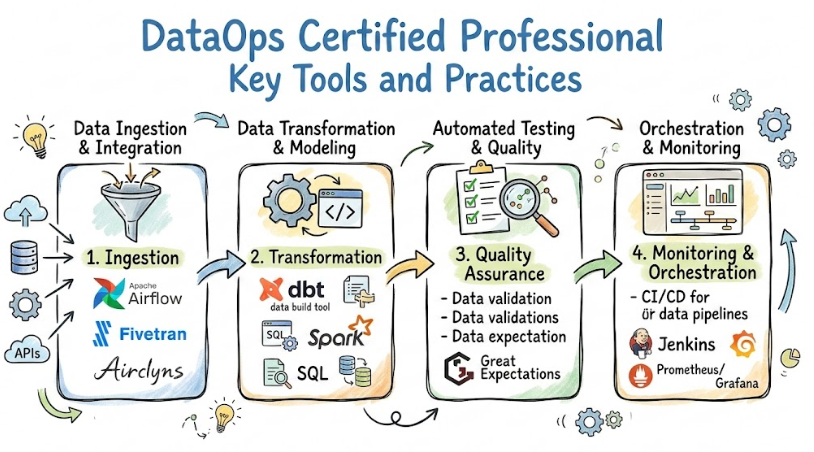
The Dataops Certified Professional is a specialized certification that focuses on the integration of data engineering, data quality, and operational efficiency. It is built on the belief that data pipelines should be as robust as software delivery pipelines. Through this program, the principles of automation and continuous improvement are applied to the entire data lifecycle. It is not merely a course on tools, but rather a comprehensive guide on how to build a culture where data is treated with the same rigor as code. The goal is to eliminate the friction that often exists between data producers and data consumers.
Why it matters in today’s software, cloud, and automation ecosystem
In the current ecosystem, businesses are no longer competing just on features; they are competing on how quickly they can gain insights from their data. When data pipelines are manual and prone to error, the entire organization is slowed down. DataOps matters because it introduces predictability and transparency into data workflows. By using automated testing and monitoring, the risk of “bad data” reaching the end-user is significantly reduced. In a world where cloud costs are rising and automation is the standard, having a certified understanding of DataOps is a necessity for maintaining a competitive edge.
Why certifications are important for engineers and managers
For engineers, a certification serves as a formal recognition of their technical depth and commitment to the craft. It provides a clear learning path that covers aspects of the job that might not be encountered in daily tasks. For managers, certifications are a tool for risk mitigation. When a team is composed of certified professionals, a certain standard of quality and knowledge is guaranteed. It ensures that best practices are followed consistently across the department. Furthermore, in global markets like India and the USA, certifications are often used as a benchmark during the hiring and promotion process, making them a valuable asset for career longevity.
Certification Overview Table
| Track | Level | Who it’s for | Prerequisites | Skills Covered | Recommended Order |
| DataOps | Professional | Engineers & Tech Leads | Basic Data & Linux | Pipeline Automation, Data Quality, Monitoring | 1st in Data Track |
Why Choose DevOpsSchool?
DevOpsSchool is frequently chosen by professionals because the training is rooted in real-world scenarios rather than just theory. The curriculum is designed by individuals who have spent decades solving complex infrastructure and data problems. A heavy emphasis is placed on hands-on labs, ensuring that the concepts learned can be applied immediately in a professional environment. Additionally, the support provided extends beyond the classroom, with a vast community of alumni and experts available for guidance. The flexibility of the learning modules allows working professionals to balance their career goals with their daily responsibilities effectively.
Certification Deep-Dive: Dataops Certified Professional
What is this certification?
This program is an intensive journey into the world of automated data management. It is structured to teach the intersection of data engineering and DevOps, ensuring that data is delivered with high quality and minimal manual intervention.
Who should take this certification?
- Software Engineers: Those who are involved in building applications that rely heavily on real-time data processing will find this highly beneficial.
- DevOps/Cloud Engineers: Professionals who want to move beyond infrastructure automation and dive into the specific challenges of data pipelines.
- Data Engineers: Individuals who are looking to move away from manual data cleaning and toward automated, scalable data architectures.
- Engineering Managers: Leaders who need to understand the strategic value of DataOps to better guide their teams and optimize resources.
Skills you will gain
- Automated Pipeline Construction: The ability to design and implement end-to-end data pipelines that require zero manual touchpoints is developed.
- Data Quality Assurance: Techniques for integrating automated testing into data workflows are mastered, ensuring that only high-quality data is processed.
- Orchestration Mastery: Knowledge of how to use sophisticated tools to manage complex dependencies within a data environment is acquired.
- Observability and Monitoring: Skills in setting up real-time alerts and dashboards to monitor the health and performance of data flows are sharpened.
- Collaborative Frameworks: A deep understanding of how to foster better communication between data scientists, engineers, and operations teams is gained.
Real-world projects you should be able to do
- CI/CD for Data: A system where data schema changes are tested and deployed automatically, just like software code, can be built.
- Data Drift Detection: A monitoring solution that identifies when data patterns change unexpectedly, preventing downstream errors, can be implemented.
- Self-Healing Pipelines: Workflows that can automatically restart or reroute data in the event of a minor failure can be designed and deployed.
- Centralized Data Governance: A framework where data access and security are managed through automated policies across the organization can be created.
Preparation Plan
7–14 Days Plan (Quick Revision)
- Days 1-4: The fundamental principles of the DataOps Manifesto and the core differences between DevOps and DataOps are studied in detail.
- Days 5-9: The primary tools used for orchestration and version control in a data context are reviewed through quick practical exercises.
- Days 10-14: Several mock exams are completed to identify gaps in knowledge, followed by a focused review of the most difficult topics.
30 Days Plan (Standard)
- Week 1: A solid foundation is built by studying the history of data management and the emergence of the DataOps movement.
- Week 2: The focus is shifted to the technical aspects of building automated pipelines and managing data as code.
- Week 3: Advanced topics such as data security, compliance, and automated testing are explored through guided labs.
- Week 4: Time is dedicated to refining hands-on skills and completing a comprehensive final review of all certification modules.
60 Days Plan (Deep Learning)
- Month 1: A slow and thorough exploration of the entire ecosystem is conducted, starting from Linux basics to advanced data architecture.
- Month 2: The second month is spent working on multiple real-world projects, ensuring that every theoretical concept is backed by practical experience.
Common mistakes to avoid
- Over-complicating the Stack: Beginners often try to learn too many tools at once rather than mastering the underlying principles of the methodology.
- Neglecting Data Testing: Many professionals focus on moving data quickly but forget to implement the checks that ensure the data is actually correct.
- Ignoring the Culture: It is often forgotten that DataOps is as much about people and communication as it is about technology and automation.
- Lack of Documentation: Failing to document the automated flows can lead to “black box” systems that are difficult for others to maintain or troubleshoot.
Best next certification after this
- Same track: The Advanced DataOps Architect program is recommended for those who want to lead large-scale data transformations.
- Cross-track: The MLOps Certified Professional is a great choice for those who want to apply operational excellence to Machine Learning models.
- Leadership / management: The Engineering Manager Certification is ideal for professionals moving into strategic decision-making roles.
Choose Your Learning Path
DevOps Path
The DevOps path is selected by those who want to be the backbone of software delivery. It focuses on the speed and reliability of code deployments. This path is essential for ensuring that the infrastructure is always ready to support the latest application features.
DevSecOps Path
This path is chosen by professionals who believe that security should never be an afterthought. By integrating security checks into the automated pipeline, vulnerabilities are caught early. It is a critical path for organizations handling sensitive user data.
Site Reliability Engineering (SRE) Path
The SRE path is focused on the balance between releasing new features and keeping the system stable. It is chosen by engineers who enjoy using software engineering principles to solve operational problems and reduce manual “toil.”
AIOps / MLOps Path
This specialized path is for those working at the cutting edge of Artificial Intelligence. It addresses the unique challenges of deploying and monitoring models that learn and change over time, ensuring they remain accurate and performant.
DataOps Path
The DataOps path is the ideal choice for anyone who sees data as the most valuable asset of a company. It ensures that the “data supply chain” is never interrupted and that insights are delivered to the business without delay.
FinOps Path
The FinOps path is focused on the financial accountability of the cloud. It is chosen by professionals who want to ensure that every dollar spent on cloud resources is optimized and provides maximum value to the company.
Role → Recommended Certifications Mapping
- DevOps Engineer: The DevOps Certified Professional is the starting point, followed by specialized certifications in GitOps and Containerization.
- Site Reliability Engineer (SRE): The SRE Certified Professional is essential, with a secondary focus on Chaos Engineering to test system resilience.
- Platform Engineer: Kubernetes Certified Professional and Platform Ops certifications are recommended to master the art of building internal developer platforms.
- Cloud Engineer: Certifications in specific cloud providers (AWS/Azure/GCP) are paired with the Terraform Associate for infrastructure as code.
- Security Engineer: The DevSecOps Certified Professional is the primary goal, ensuring security is woven into the automation fabric.
- Data Engineer: The Dataops Certified Professional is the core certification, often followed by the Big Data Architect program for a wider perspective.
- FinOps Practitioner: The FinOps Certified Professional is the standard for those managing cloud budgets and optimization strategies.
- Engineering Manager: A combination of Leadership for Engineers and Agile Project Management is recommended to lead technical teams effectively.
Next Certifications to Take
For the Data Learner
After completing the initial DataOps certification, a move toward Advanced Data Engineering is often seen. This is followed by an MLOps Professional track to handle machine learning workloads. Finally, a Strategic Data Management course is taken to prepare for executive roles.
For the Infrastructure Learner
The journey usually continues with an Infrastructure as Code Specialist certification. Once that is mastered, a move toward FinOps Professional is made to understand the cost implications. Leadership is then addressed through an IT Operations Manager program.
For the Security Learner
A logical next step is the Cloud Security Professional certification. Following this, the SRE Professional track is often explored to understand how security impacts reliability. The path concludes with a Chief Security Officer leadership track.
Training & Certification Support Institutions
DevOpsSchool
At DevOpsSchool, a comprehensive ecosystem for learning is provided. The focus is kept on ensuring that students understand the “why” behind every tool. Expert-led sessions and a deep repository of project work make it a top choice for serious learners.
Cotocus
Cotocus is recognized for its specialized training in emerging technologies. The programs are tailored to meet the high standards of modern tech firms. Support is given to ensure that every professional can navigate their unique career path with confidence.
ScmGalaxy
A wealth of community-driven knowledge is found at ScmGalaxy. It serves as a hub for professionals who want to stay ahead of industry trends. The guidance provided here is often cited as a key factor in the successful completion of various certifications.
BestDevOps
Practicality is the hallmark of BestDevOps. The training modules are designed to be concise and impactful. It is highly regarded by those who need to gain specific technical skills in a short amount of time without sacrificing quality.
devsecopsschool.com
This institution is dedicated entirely to the world of security within DevOps. The curriculum is updated constantly to reflect the latest threats and defense strategies in the software industry.
sreschool.com
A deep dive into the world of reliability is offered here. The training is focused on teaching engineers how to manage large-scale, complex systems with minimal downtime.
aiopsschool.com
The bridge between artificial intelligence and IT operations is built at this school. Students are taught how to leverage AI to automate and improve traditional operational tasks.
dataopsschool.com
This is the primary destination for anyone pursuing the DataOps track. Every aspect of the data lifecycle, from ingestion to delivery, is covered in their detailed certification programs.
finopsschool.com
The complex world of cloud economics is simplified at this institution. It provides the tools and knowledge needed to manage large-scale cloud budgets effectively.
FAQs Section
General Career FAQs
- What is the difficulty level of these certifications?
The difficulty is considered moderate. While the concepts are straightforward, a strong grasp of practical automation is required to pass the exams. - How much time is required to prepare?
For most working professionals, a period of 4 to 8 weeks is usually dedicated to study, depending on their prior experience with Linux and data. - Are there any prerequisites?
While no formal degrees are required, a basic understanding of how data is stored and moved, along with basic command-line skills, is highly recommended. - In what sequence should certifications be taken?
It is often suggested to start with a broad DevOps certification before narrowing down into a specialized track like DataOps or DevSecOps. - What is the career value of these programs?
Professionals often report a significant increase in their market value. These certifications are viewed as a mark of quality by top-tier global employers. - Can an Engineering Manager benefit from these?
Absolutely. A manager with technical certification is better equipped to estimate project timelines and understand the challenges faced by their team. - Is hands-on experience included in the training?
Yes, the majority of the training time is spent in virtual labs, performing the actual tasks that are required in a professional setting. - How long is the certification valid?
Most industry-standard certifications are valid for 2 years. After this, a recertification or a higher-level exam is usually encouraged to keep skills fresh. - Are these certifications recognized in India?
Yes, they are highly respected in the Indian IT sector, as well as by multinational corporations operating in global markets. - Do I need to be an expert coder?
An expert level is not required, but being comfortable with basic scripting (like Python or Bash) is very helpful for the automation parts of the course. - Is there post-certification support?
Yes, alumni networks and community forums are available to help with job placements and technical queries even after the exam is passed. - Can these programs help me transition from a non-tech role?
It is possible, but it is recommended to complete a foundational IT course before jumping into specialized certifications like DataOps.
Dataops Certified Professional Specific FAQs
- Is this a data science certification?
No, this program focuses on the engineering and operational side of data, ensuring it is delivered safely and efficiently to the data scientists. - Which tools are emphasized in the course?
A variety of orchestration, versioning, and monitoring tools are used, though the focus remains on the principles that apply to any toolset. - Is cloud experience a must?
While not strictly required, having a basic understanding of cloud environments (like AWS or Azure) will make the learning process much smoother. - Does the course cover big data technologies?
Yes, the principles of DataOps are explored in the context of both traditional databases and modern big data environments. - How is data quality addressed?
Data quality is treated as an automated step in the pipeline. Tests are written to catch errors before they propagate through the system. - Is this suitable for Database Administrators (DBAs)?
Yes, it is the perfect path for DBAs who want to modernize their skills and move into the world of cloud-native data operations. - What kind of real-world projects are included?
Students are required to build a fully automated data pipeline that includes testing, deployment, and monitoring phases. - What is the format of the exam?
The exam typically consists of multiple-choice questions along with a practical lab component to test real-world application skills.
Testimonials
Arnav, DevOps Engineer
“A whole new perspective on data management was provided by this course. The transition from traditional DevOps to DataOps was made seamless by the expert mentors.”
Priya, SRE
“The importance of data reliability was finally understood. The practical labs allowed for the implementation of observability in our data pipelines almost immediately.”
Karthik, Cloud Engineer
“The gap between our infrastructure and data teams was bridged thanks to this certification. The simple language used in the training made complex topics easy to grasp.”
Meera, Security Engineer
“Security within data flows is often ignored, but this program taught me how to automate those checks. My confidence in handling sensitive data has grown tremendously.”
Rajesh, Engineering Manager
“A clear roadmap for our team’s growth was provided. By standardizing our DataOps practices, our delivery speed has increased while our error rates have dropped.”
Conclusion
The decision to become a Dataops Certified Professional is an investment in the future of technology. As data continues to grow in importance, the need for professionals who can manage it with precision and automation will only increase. Long-term career benefits, including higher salary potential and job stability, are consistently seen by those who take this step. Strategic planning of one’s learning journey is the key to staying relevant in a rapidly changing industry. By mastering DataOps today, a position of leadership is secured for the challenges of tomorrow.
