
Introduction
The landscape of software delivery has undergone a significant transformation. It is observed that the traditional silos between development and operations are being dismantled in favor of integrated, automated workflows. For a professional to remain competitive, a verified level of expertise is required. The DevOps Certified Professional (DCP) is considered a vital milestone in this journey. This guide is provided to help engineers and managers understand the depth, requirements, and long-term benefits of this respected credential.
1. Foundational Understanding of the Program
Defining the DevOps Certified Professional (DCP)
The DevOps Certified Professional (DCP) is recognized as a comprehensive validation of an individual’s technical and cultural proficiency. It is designed to go beyond the surface level of tool usage. Instead, a deep understanding of the entire software development lifecycle (SDLC) is promoted. By earning this certification, an engineer is acknowledged as a practitioner who can design, implement, and manage complex automation pipelines that bridge the gap between code creation and production stability.
The Necessity of DCP in Current Engineering Environments
In the current industry, the demand for high-speed delivery is coupled with the need for extreme system reliability. It is understood that manual processes are no longer sufficient to meet these demands. The DCP program focuses on the core pillars of modern engineering: automation, continuous integration, and continuous monitoring. It ensures that the workforce is prepared to handle the intricacies of cloud-native applications and microservices architectures. Without such a framework, the risk of deployment failure is significantly increased.
The Strategic Value of Certifications for Professionals
For the individual engineer, a certification is viewed as a clear signal of competency to the global market. It provides a structured learning path that might otherwise be missed through fragmented on-the-job learning. For engineering leadership, certifications are utilized as a benchmark for team capability. It is believed that a certified team is more likely to adhere to industry standards, resulting in fewer security vulnerabilities and more predictable release cycles. In regions like India, where the tech talent pool is vast, this credential is used to differentiate top-tier talent.
2. Comprehensive Certification Summary
A detailed overview of the DevOps Certified Professional (DCP) is presented in the table below for quick reference.
| Professional Track | Skill Level | Target Demographic | Prerequisites | Primary Competencies | Suggested Order |
| DevOps | Professional | Engineers, SysAdmins, Architects | Linux & Basic Coding | CI/CD, Docker, Kubernetes, Git | Core Foundation |
The Rationale for Selecting DevOpsSchool
DevOpsSchool is chosen by many due to its deep commitment to practical, hands-on education. It is not just a training provider; it is an institution that focuses on real-world application. The curriculum is regularly updated to ensure that it reflects the latest changes in the technology stack. High-quality mentorship is provided by veterans of the industry, and a vast repository of resources is made available to every student. By choosing this provider, a learner is guaranteed a path that is both academically rigorous and professionally relevant.
3. Deep-Dive: DevOps Certified Professional (DCP)
Understanding the Certification
This credential is built to serve as a master-level guide for those who wish to lead automation initiatives. It is structured to ensure that every phase of the pipeline—from the first line of code to the final deployment—is understood and optimized.
Who is Encouraged to Enroll?
This path is primarily intended for software developers who wish to take ownership of their deployments. It is also highly recommended for system administrators who are looking to move away from manual server management. Furthermore, cloud engineers and quality assurance professionals will find immense value in learning how to integrate their work into an automated flow.
Core Competencies to be Developed
- Version Control Mastery: Advanced strategies for branching and merging in Git are taught.
- Continuous Integration: The art of automating the build and test process is mastered.
- Containerization Skills: Knowledge of Docker is developed to ensure applications are portable and consistent.
- Orchestration Expertise: Kubernetes is utilized to manage containerized applications at a massive scale.
- Infrastructure as Code (IaC): Tools like Terraform and Ansible are used to treat hardware as software.
- Proactive Monitoring: Skills in logging and observability are gained to identify issues before they affect the user.
Practical Projects to be Completed
- Automated Microservices Pipeline: A complete system is built where code is automatically tested and deployed to a cluster.
- Self-Healing Infrastructure: A system is designed that can automatically recover from hardware or software failures.
- Cloud Migration Project: A legacy application is moved from a local server to a scalable cloud environment using automation.
- Security Integration: A “Shift Left” strategy is implemented where security scans are performed during the build phase.
Strategic Preparation Timelines
- The 14-Day Blueprint: The first two weeks are dedicated to the “DevOps Mindset.” Core concepts of collaboration and basic Linux commands are reviewed.
- The 30-Day Blueprint: Daily practice is focused on tool integration. A local lab is set up where Jenkins, Git, and Docker are integrated into a working flow.
- The 60-Day Blueprint: The final month is reserved for advanced topics like Kubernetes and Terraform. Real-world scenarios are simulated, and mock exams are taken to ensure all concepts are fully internalized.
Frequent Errors to Avoid
- Over-Reliance on Tools: It is often forgotten that DevOps is about people and processes as much as it is about software.
- Neglecting Fundamentals: A lack of understanding of networking and Linux often leads to difficulties in troubleshooting complex pipelines.
- Ignoring Documentation: The importance of maintaining clear, automated documentation is frequently underestimated.
Path for Continued Growth
- Within the Same Track: Advanced Infrastructure Specialist.
- Cross-Track Exploration: SRE (Site Reliability Engineering) Professional.
- Management Focus: Certified DevOps Lead or Platform Director.
4. Selecting Your Professional Learning Path
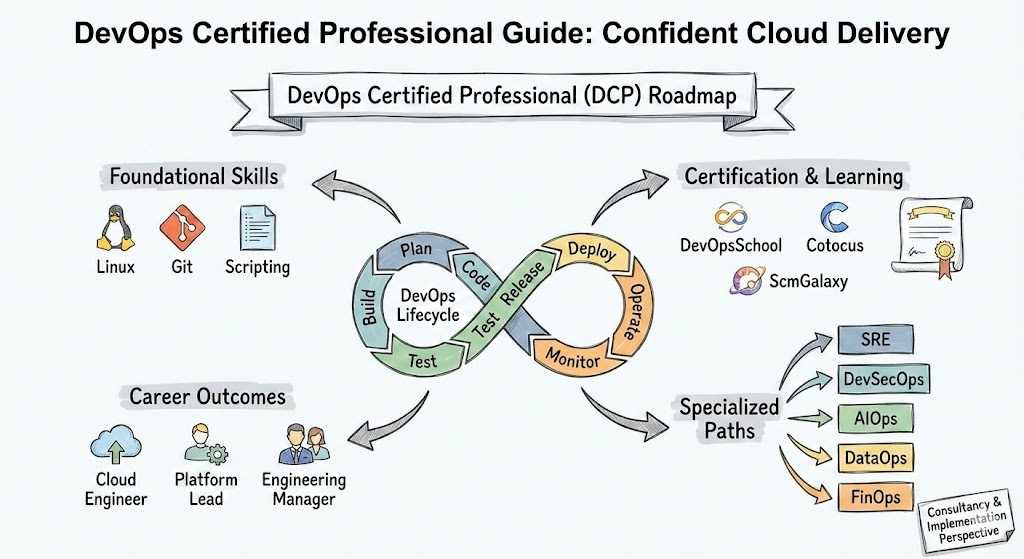
Six distinct pathways have been identified to help professionals specialize according to their career interests:
- The DevOps Pathway: This is the most popular choice for those who want a broad, generalist understanding. Every stage of the application lifecycle is covered, making it ideal for those entering the field.
- The DevSecOps Pathway: For those who are passionate about security, this path focuses on integrating vulnerability management and compliance into the automated pipeline.
- The SRE Pathway: An engineering approach to operations is taken here. This path is perfect for those who want to ensure that large-scale systems remain stable and performant under heavy load.
- The AIOps & MLOps Pathway: As artificial intelligence becomes mainstream, this path is designed for those who want to automate machine learning models and use AI to improve IT operations.
- The DataOps Pathway: The flow of data is treated with the same rigor as software code. This path is intended for data engineers who want to automate data pipelines and ensure high data quality.
- The FinOps Pathway: The financial aspect of the cloud is managed here. This path is best for those who want to bridge the gap between engineering, finance, and business teams.
5. Alignment of Roles to Credentials
To ensure the best career outcomes, the following mapping is suggested for various professional roles:
- DevOps Engineer: DevOps Certified Professional (DCP)
- Site Reliability Engineer: SRE Certified Professional
- Platform Architect: Kubernetes & Platform Specialist
- Cloud Infrastructure Lead: Cloud Infrastructure Professional
- Security Engineer: DevSecOps Certified Professional
- Data Engineer: DataOps Professional
- Cost Management Specialist: FinOps Certified Practitioner
- Engineering Manager: DevOps Leadership & Strategy
6. Planning for Future Advancement
Continuous learning is viewed as the only way to maintain a long-term career in technology. Once the initial certification is completed, the following next steps are recommended:
- For the Technical Expert: A same-track specialization in Advanced Cloud Architecture is suggested.
- For the Versatile Engineer: A cross-track certification in Site Reliability Engineering (SRE) is recommended to understand the engineering side of stability.
- For the Aspiring Leader: A leadership-focused certification in Engineering Management is highly advised to prepare for senior roles.
7. Support Institutions for Training and Certification
The following organizations are recognized for providing exceptional support and training for the DCP program:
- DevOpsSchool: This institution is known for its wide range of courses and deep industry connections. A wealth of technical blogs and community support is provided to all learners.
- Cotocus: A specialized focus on high-end technical consulting and implementation training is maintained here. It is ideal for those who want to learn how to apply DevOps in a corporate setting.
- ScmGalaxy: This platform is used by thousands of professionals to stay updated on Software Configuration Management and automation trends.
- BestDevOps: Practical, job-oriented training is the hallmark of this institution. The focus is placed on skills that are immediately usable in a professional environment.
- devsecopsschool.com: A dedicated space for learning how to secure the modern software pipeline is provided here.
- sreschool.com: This institution focuses exclusively on the principles of reliability, error budgets, and large-scale system management.
- aiopsschool.com: The intersection of machine learning and operations is explored in detail through the specialized courses offered here.
- dataopsschool.com: This platform is designed for data professionals who wish to apply DevOps principles to their data management workflows.
- finopsschool.com: Detailed guidance on cloud financial management and cost optimization is provided to help organizations manage their cloud spend.
8. Essential FAQs
General Career Inquiries
1. Is the DCP program difficult for someone without an engineering degree?
While a technical background is helpful, the program is designed to be accessible to anyone with a strong interest in automation and basic logical thinking.
2. How much time is typically needed to prepare?
It is generally observed that a period of 8 to 12 weeks of consistent study is sufficient for most working professionals.
3. Are there any strict prerequisites?
No formal degrees are required, but a basic understanding of how software is built and a comfort with the command line are strongly suggested.
4. In what order should these certifications be pursued?
The DevOps Certified Professional (DCP) is recommended as the starting point, after which a specialized track like Security or SRE can be chosen.
5. How does this certification impact salary growth?
It is well-documented that certified engineers often command higher salaries due to their verified ability to handle complex, business-critical automation tasks.
6. What job roles can be applied for after certification?
Roles such as Cloud Engineer, Build Engineer, and Automation Architect are commonly available to those who hold the DCP.
7. Is coding a major part of the DevOps role?
Coding is not the primary focus, but the ability to write scripts for automation is considered an essential skill for any DevOps professional.
8. Is the DCP recognized in countries outside of India?
Yes, the certification is based on global standards and is respected by multinational corporations around the world.
9. What is the difference between DevOps and SRE?
DevOps is considered a broad philosophy of collaboration, whereas SRE is viewed as a specific implementation of that philosophy using software engineering tools.
10. Is this program valuable for Engineering Managers?
Absolutely. Managers who understand the technical details of automation are better equipped to lead their teams and make informed architectural decisions.
11. Does AIOps require advanced knowledge of mathematics?
Only a basic understanding of data and logic is required, as the focus is on the application of AI tools rather than theoretical research.
12. Will these certifications remain valid as technology changes?
While specific tools may change, the core principles of automation and CI/CD taught in the DCP program are expected to remain foundational for many years.
DCP Specific Inquiries
13. How does DCP differ from cloud-specific certifications like AWS?
While cloud certifications focus on a single platform, the DCP focuses on the vendor-neutral tools and processes that work across all platforms.
14. Are hands-on labs a part of the examination process?
Yes, the assessment is designed to test practical skills, ensuring that the candidate can actually perform the tasks required in a professional setting.
15. Is Git version control covered in depth?
Yes, Git is treated as the starting point for all automation and is covered extensively in the curriculum.
16. Is the exam format multiple-choice or project-based?
A combination of both is used to ensure that both theoretical knowledge and practical application are verified.
17. Can the DCP be skipped if someone already has cloud experience?
It is not recommended, as the DCP provides the process-oriented framework that is often missing from cloud-specific training.
18. How much focus is placed on Kubernetes?
Kubernetes is a major pillar of the program, and a significant portion of the syllabus is dedicated to mastering container orchestration.
19. Are practice exams made available to students?
Yes, extensive mock tests and practice materials are provided by support institutions like DevOpsSchool.
20. What is considered a passing score for the DCP?
A score of 70% or higher is generally required to demonstrate that the candidate has mastered the necessary skills.
9. Insights from the Professional Community
“The transformation of our deployment process was made possible after I completed the DCP program. The clarity gained in CI/CD was exactly what our team needed.” – Arjun
“A significant career shift was achieved through this certification. The move from manual operations to automated cloud management was handled smoothly.” – Meera
“The engineering approach to reliability is now a core part of my daily work. The SRE concepts learned after the DCP were truly eye-opening.” – Karthik
“Leadership is much easier when the technical bottlenecks are understood. This program provided the foundation I needed to manage a modern engineering team.” – Sita
“Security is no longer a separate phase of development for me. It is now integrated into every automation script I write, thanks to the DevSecOps path.” – Rohan
10. Final Summary and Conclusion
The DevOps Certified Professional (DCP) is more than just a credential; it is a gateway to the future of software engineering. It is understood that as the industry moves toward complete automation, the demand for verified experts will only continue to rise. By following a structured learning path and utilizing the support of recognized institutions, a professional can ensure long-term career growth and stability. Strategic planning and a commitment to continuous improvement are the hallmarks of a true DevOps professional.
