
Introduction
The landscape of software development is undergoing a permanent shift. In the earlier days of my career, security was treated as a final gatekeeper. A project would be completed, and only then would the security team be asked to find flaws. This old way caused massive delays and frustration for everyone involved. Today, we have moved toward a better system where safety is built into the very foundation of the work. This is the heart of DevSecOps. It is the practice of making security a shared responsibility from the very first line of code that is written.
What is DevSecOps Certified Professional Online Training?
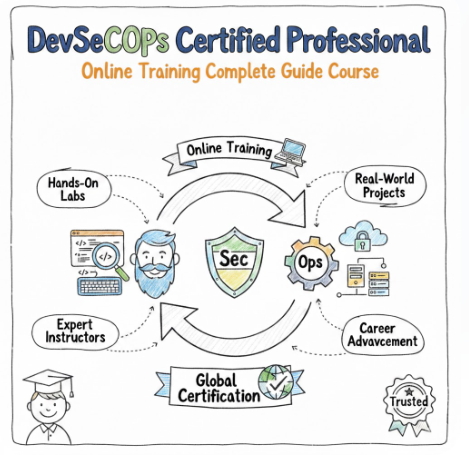
DevSecOps Certified Professional training program is designed to help engineers and managers understand how to weave security into the modern automation pipeline. It is not merely a course about using new software tools; it is a deep dive into a cultural change. The goal of the training is to teach you how to protect your applications without slowing down the speed of delivery. By learning these methods, the wall that once stood between developers and security experts is finally broken down.
Why It Matters in Today’s Ecosystem
In our current world of cloud computing and rapid changes, the old manual ways of checking for errors are simply not fast enough. Every time a new feature is added, a new risk is created. Organizations now desperately need people who can automate the process of finding and fixing these risks. If security is not automated, it becomes a bottleneck that prevents a company from being competitive. This training ensures that you are seen as a professional who can handle both speed and safety simultaneously.
The Importance of Certification
For a working engineer, holding a certification is a way to prove that your skills have been tested against a high standard. It gives you a structured way to learn complex topics that you might not encounter in your daily job. For those in leadership roles, certifications provide a benchmark. When a team is certified, a manager can be sure that the projects are being handled with a consistent and secure methodology. It reduces the chance of expensive data leaks and builds trust with the customers.
Certification Overview Table
| Track | Level | Who it’s for | Prerequisites | Skills Covered | Recommended Order |
| DevSecOps | Intermediate | Engineers, Managers, Leads | Basic DevOps knowledge | Pipeline Security, Compliance, Tooling | First in Track |
Why Choose DevOpsSchool?
When a person decides to further their education, the choice of where to study is a vital decision. Why choose DevOpsSchool? The answer lies in their commitment to real-world application. The lessons are taught by people who have spent many years facing the same technical problems that you face every day.
- Practical Focus: The training is not just about reading books; it is about doing the work in live environments.
- Expert Guidance: You are mentored by seniors who understand the nuances of the industry.
- Career Support: Help is provided even after the course ends, ensuring that you can apply what you learned to your actual job.
- Community Access: You become part of a network of professionals who share knowledge and help each other grow.
Certification Deep-Dive: DevSecOps Certified Professional (DSOCP)
What is this certification?
The DevSecOps Certified Professional (DSOCP) is a high-level program that focuses on the integration of security into every phase of the software lifecycle. It teaches you how to automate security checks so they happen automatically every time code is changed.
Who should take this certification?
This path is perfect for those who are already working as DevOps engineers or software developers but want to specialize in security. It is also a very strong choice for security analysts who want to learn how to work with modern automation tools. Managers who are leading a digital transformation will also find the knowledge indispensable for guiding their teams correctly.
Skills You Will Gain
- Automated Security Scanning: You will learn how to set up tools that automatically check for vulnerabilities in your code.
- Container Protection: The methods for securing Docker and Kubernetes environments are covered in great detail.
- Compliance as Code: You will gain the ability to write scripts that ensure your infrastructure always follows the necessary legal and safety rules.
- Risk Management: Learning how to identify which security threats are the most dangerous and how to fix them first.
- Identity Management: Mastering the ways to control who has access to your systems and ensuring that only authorized people can make changes.
Real-World Projects You Should Be Able to Do
- Secure Pipeline Construction: You will be able to build a complete delivery pipeline that stops a release if a security flaw is detected.
- Image Scanning Systems: You will know how to set up a system that checks every container image for known bugs before it is allowed to run.
- Automated Alerting: Creating a dashboard that shows security threats in real-time and alerts the team immediately when something goes wrong.
- Infrastructure Auditing: Writing code that automatically audits your cloud setup to make sure no doors are left open to attackers.
Preparation Plan
- 7–14 Days Plan: In the first two weeks, the focus is placed on understanding the core philosophy. You will study how security fits into the “Continuous Integration” model and identify the main tools used in the industry.
- 30 Days Plan: During the first month, you will move into the laboratory. You will practice using static analysis tools on sample code and learn how to secure basic containerized applications.
- 60 Days Plan: By the end of the second month, you will be building complex, multi-stage pipelines. You will also spend time taking practice exams to ensure you are ready for the final certification test.
Common Mistakes to Avoid
- Focusing Only on Tools: Many people make the mistake of learning the software but forgetting the mindset. Security is about a change in how people work together.
- Neglecting the Basics: It is important not to skip over fundamental networking and Linux concepts, as these are the building blocks of security.
- Lack of Practice: Reading about security is not enough. You must break things and fix them in a lab environment to truly understand how they work.
Best Next Certification After This
- Same Track: You might consider moving toward becoming a Certified DevSecOps Architect to learn about high-level system design.
- Cross-Track: Learning about Site Reliability Engineering (SRE) is a great way to ensure that your secure systems are also highly stable.
- Leadership: The Certified DevOps Manager path is recommended for those who wish to move away from coding and into a role where they lead people and strategy.
Choose Your Learning Path
1. The DevOps Path
This path is ideal for the generalist who wants to understand the entire flow of software. It is best for those who enjoy making processes more efficient and helping different teams work together better.
2. The DevSecOps Path
This is the specialist path for those who are passionate about safety. It is perfect for professionals who want to ensure that every piece of software delivered is as secure as possible from the very start.
3. Site Reliability Engineering (SRE) Path
If you enjoy the challenge of keeping large-scale systems running smoothly under heavy pressure, this is your path. It focuses on the science of reliability and how to handle incidents when they happen.
4. AIOps / MLOps Path
This is for the forward-thinking engineer who wants to use data and machine learning to manage IT systems. It involves teaching computers how to spot problems and fix them automatically.
5. DataOps Path
For those who work with large amounts of information, this path teaches how to manage data pipelines with the same speed and quality as software pipelines. It is essential for modern data engineers.
6. FinOps Path
This path is for the engineer who also has an interest in the business side. It teaches you how to manage the high costs of cloud computing and ensure that every dollar spent is bringing value to the company.
Role → Recommended Certifications Mapping
- DevOps Engineer: You should focus on the Master in DevOps Engineering and then add the DSOCP to broaden your expertise.
- Site Reliability Engineer (SRE): Starting with SRE Foundation is wise, followed by the DSOCP to ensure you can build reliable and secure systems.
- Platform Engineer: A combination of Kubernetes mastery and the DSOCP is the best way to prove you can build secure platforms for others to use.
- Cloud Engineer: General cloud certifications are important, but the DSOCP is what will set you apart from others by showing you can protect that cloud.
- Security Engineer: For those already in security, the DSOCP is the bridge that helps you understand how to work within modern, fast-moving DevOps teams.
- Data Engineer: A focus on DataOps combined with basic MLOps training will ensure you can handle the modern data lifecycle.
- FinOps Practitioner: Focus on the FinOps Certified Professional program and use the DSOCP to understand the technical side of cloud security.
- Engineering Manager: The Certified DevOps Manager program is your primary goal, with the DSOCP giving you the technical background to lead effectively.
Training & Certification Support Institutions
DevOpsSchool
This institution provides a very thorough support system for its students. A mixture of live classroom sessions and deep technical projects is used to ensure that the knowledge is truly absorbed. Every student is given a clear roadmap to follow.
Cotocus
The focus here is on the practical reality of the job. Mentors who have worked in the highest levels of the tech industry share their personal experiences. This helps students avoid common career mistakes and learn what companies really want.
ScmGalaxy
This group is known for its vast collection of technical resources. They provide a community where learners can find tutorials on almost any tool. It is a great place for those who enjoy self-study combined with expert guidance.
BestDevOps
This is an excellent choice for those who are just starting their journey. The complicated parts of engineering are explained in very simple terms. This builds a strong foundation before moving on to more difficult topics.
devsecopsschool.com
This is a specialized school that focuses entirely on security. Because they are specialists, they can offer much deeper insights into the latest threats and the most modern ways to defend against them.
sreschool.com
For those who want to master the art of reliability, this is the place. The training is centered on how to manage production environments and how to ensure that systems do not fail when they are needed most.
aiopsschool.com
This institution leads the way in teaching how to use artificial intelligence for IT work. They show students how to use data to make smarter decisions and how to automate the monitoring of complex systems.
dataopsschool.com
They treat data with the same respect that software developers treat code. Their training shows you how to build pipelines that move data safely, quickly, and with very high levels of accuracy.
finopsschool.com
This school teaches the financial side of technology. They help engineers understand how to read a cloud bill and how to save their companies significant amounts of money through better resource management.
FAQs Section
Is the certification very difficult to pass?
The exam is designed to be a fair test of your knowledge. If you have done the practical work in the labs and followed the lessons, you should find it quite manageable.
How much time should I set aside each week?
Most successful students spend about five to seven hours a week. This gives you enough time to watch the lessons and then practice what you have learned on your own.
Do I need to be an expert in coding?
No, you do not need to be a professional programmer. However, you should be comfortable with basic scripts and have a general understanding of how software is built.
Will this certification help me get a higher salary?
Yes, in the current market, security skills are in very high demand. Companies are often willing to pay a premium for engineers who can prove they know how to protect their systems.
What is the best way to start?
The best way is to look at the foundational DevOps courses first. Once you understand the basics of automation, moving into the DevSecOps track becomes much easier.
Can I take the training while I am working?
Yes, the courses are designed for working professionals. The online nature of the training allows you to learn at a pace that fits your own schedule.
Is there any support if I get stuck?
Most of these institutions provide forums or direct access to mentors. You are never left to solve a difficult technical problem entirely on your own.
How long does the certification last?
While the knowledge is yours forever, it is always a good idea to refresh your skills every few years as the technology continues to change.
Do I need a special computer for the labs?
A standard modern laptop is usually enough. Most of the heavy work is done in cloud environments that you can access through your web browser.
How is this different from a university degree?
This training is much more focused on specific job skills. While a degree gives you a broad education, this certification proves you can do a specific type of work.
What roles can I apply for after this?
You will be qualified for roles such as DevSecOps Engineer, Cloud Security Specialist, or Automation Architect.
Is the training recognized in India and abroad?
Yes, the concepts and tools taught are used by major companies all over the world, from small startups to the largest global corporations.
DevSecOps Specific FAQs
Does the training cover cloud-specific security?
Yes, you will learn how to secure applications on major platforms like Amazon Web Services (AWS) and Microsoft Azure.
Why is automation so important in security?
Automation is the only way to keep up with the speed of modern development. It ensures that security checks are never forgotten or skipped.
Will I learn about specific security tools?
Yes, you will be trained on a variety of industry-standard tools for scanning code, checking containers, and managing secrets.
What is “Shift Left” in security?
This is a term used to describe moving security checks to the very beginning of the development process. It is a core part of what you will learn.
Is container security different from regular security?
Yes, containers have their own unique risks. The training will teach you exactly how to protect them from the inside out.
How does DevSecOps help with legal compliance?
It allows you to automate the checks that prove your company is following rules like GDPR or HIPAA, making audits much easier and faster.
Can a developer benefit from this as much as an operations person?
Absolutely. In a DevSecOps world, developers need to understand how their code will be protected once it leaves their computer.
Is this training updated for the latest threats?
Yes, the curriculum is regularly reviewed to make sure it covers the newest types of attacks and the most modern ways to stop them.
Testimonials
- Rajesh V. (DevOps Engineer): “The training helped me see the flaws in our current pipeline that I had never noticed before. I now have the skills to fix them permanently.”
- Sneha M. (SRE): “I was worried about the complexity of security, but the lessons broke everything down into simple steps. My system is now much more stable and safe.”
- Ankit R. (Cloud Engineer): “The practical projects were exactly what I needed. I was able to use what I learned in class at my job the very next day.”
- Priya S. (Security Engineer): “Moving from manual security to automated security was a huge change for me. This course gave me the confidence to lead that transition.”
- Vikram T. (Engineering Manager): “Since my team took this training, our release process has become much smoother. We no longer have to stop everything for last-minute security fixes.”
Conclusion
The decision to pursue a DevSecOps Certified Professional certification is a commitment to your long-term career growth. As the world becomes more digital, the need for security will only increase. By mastering these skills now, you are placing yourself at the forefront of the industry. Whether you want to earn a higher salary, lead a team, or simply build better software, this path provides the foundation you need. Take the time to plan your learning journey strategically, and you will see the benefits for many years to come.
