
Introduction
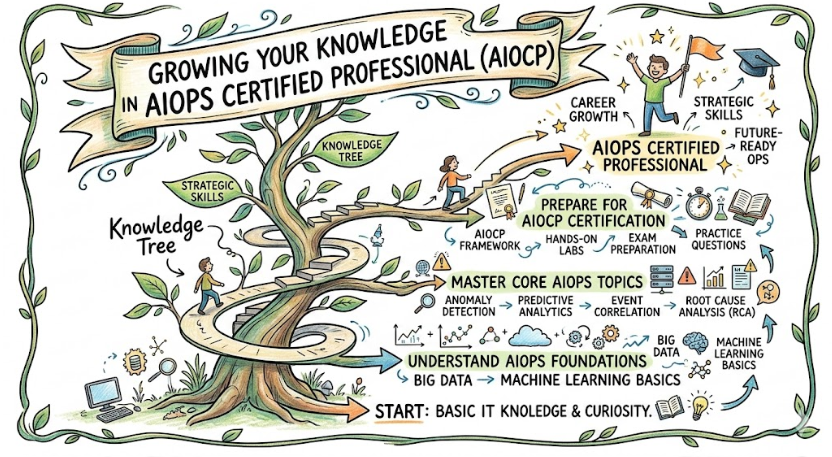
The traditional ways of managing IT infrastructure are being replaced by a more intelligent, data-driven approach. It is recognized that as systems grow in scale, the human capacity to monitor every signal is reached. The AIOps Certified Professional (AIOCP) is defined as a roadmap for engineers who wish to move beyond manual troubleshooting. Through this program, the power of algorithmic analysis is harnessed to ensure that digital services remain uninterrupted.
In the modern software ecosystem, AIOps matters because it provides a “brain” for the “body” of the cloud. Massive streams of data are generated by every application, and without AI, the most important signals are often lost in the noise. For both technical contributors and leadership, certifications are valued as a mark of readiness for the future. A structured validation of these skills is sought by organizations that prioritize high availability and rapid innovation.
Certification Overview Table
| Track | Level | Who it’s for | Prerequisites | Skills Covered | Recommended Order |
| AIOps Track | Professional | Operations & SREs | Linux & Python Basics | Neural Ops, Pattern Discovery | Fundamental |
Why is DevOpsSchool Preferred?
When a foundation for professional growth is built, DevOpsSchool is consistently preferred. A high standard of practical training is maintained, ensuring that the gap between academic learning and industry reality is closed. The curriculum is developed by experts who have managed global-scale infrastructures. Continuous support is provided through a network of peers and mentors, making the learning journey both collaborative and effective.
Certification Deep-Dive: AIOps Certified Professional (AIOCP)
What is this certification?
The AIOCP is described as a professional credential that focuses on the application of artificial intelligence to the world of IT operations. It is intended to teach professionals how to build systems that can think, learn, and react to changes in real-time without constant human guidance.
Who should take this certification?
This program is designed for Cloud Engineers, SREs, and DevOps practitioners who are tired of reactive “firefighting.” It is also highly beneficial for Engineering Managers who are tasked with scaling their teams without exponentially increasing the manual workload.
Skills you will gain:
- Algorithmic Event Correlation: Thousands of related alerts are grouped into a single, meaningful incident using advanced clustering techniques.
- Anomaly Detection in Telemetry: Subtle changes in system behavior that indicate a future failure are identified long before an outage occurs.
- Automated Remediation Workflows: Intelligent triggers are created so that the system can fix common issues—like disk space exhaustion—on its own.
- Capacity Planning through Prediction: Future infrastructure needs are forecasted based on historical usage patterns rather than simple guesswork.
- Log Intelligence: Meaningful insights are extracted from millions of lines of log data using natural language processing and pattern matching.
Real-world projects you should be able to do after this certification:
- A Self-Correcting Web Stack: A system is engineered where a failing server is automatically replaced and traffic is rerouted based on AI-detected health scores.
- A Noise-Reduction Engine: An alerting layer is implemented that silences 90% of non-actionable notifications, allowing the team to focus on what matters.
- Dynamic Cost Allocator: An AI-driven tool is built that predicts cloud spend and automatically shuts down unused resources during off-peak hours.
Preparation plan:
- 7–14 days plan: The first two weeks are dedicated to understanding the data landscape. The different types of telemetry data and the basics of data pipelines are explored.
- 30 days plan: During this month, hands-on experience with machine learning libraries is gained. Small-scale models are trained on sample server logs to find errors.
- 60 days plan: The final phase involves building a complete AIOps pipeline. Mock examinations are taken to ensure the core concepts are fully internalized.
Common mistakes to avoid:
- The “Black Box” Approach: It is often a mistake to trust an AI model without understanding the logic it uses to make decisions.
- Neglecting Baseline Data: An AI cannot find an anomaly if it does not first understand what “normal” looks like for your specific system.
- Ignoring the Human Element: AIOps is meant to assist humans, not replace communication; keeping the team informed of AI actions is crucial.
Best next certification after this:
- Same track: The Expert AIOps Architect program is the natural progression for those aiming for technical leadership.
- Cross-track: A MLOps certification is suggested to bridge the gap between model building and operational maintenance.
- Leadership / management: A focus on Strategic IT Operations Management is recommended for those moving into executive-level roles.
Selecting Your Growth Path
Six distinct paths are identified to help align your certification with your daily work:
- DevOps Path: This is best for those who wish to make the entire software lifecycle more intelligent and less dependent on manual intervention.
- DevSecOps Path: It is recommended for security professionals who want to use AI to find “needles in the haystack” of security logs.
- Site Reliability Engineering (SRE) Path: This path is ideal for those whose primary mission is to maintain 99.99% uptime through automated observation.
- AIOps / MLOps Path: This is tailored for engineers who want to specialize in the infrastructure needed to run AI models at scale.
- DataOps Path: This is chosen by those who focus on the “fuel” for AI—ensuring that data is clean, reliable, and delivered on time.
- FinOps Path: This path is followed by professionals who use AI to ensure that every dollar spent on the cloud is providing maximum value.
Role to Certification Alignment
The following mappings are suggested to maximize career impact:
- DevOps Engineer: AIOCP combined with the Certified DevOps Professional track is seen as a very powerful asset.
- Site Reliability Engineer (SRE): Stability is maximized when AIOCP is paired with the SRE Certified Professional credential.
- Platform Engineer: A focus on AIOps and Infrastructure as Code is recommended for building the next generation of internal platforms.
- Cloud Engineer: AIOCP combined with a specialized Cloud Architect certification is viewed as a gold standard in the industry.
- Security Engineer: Threat detection is improved when AIOCP is integrated with DevSecOps training.
- Data Engineer: Pipeline reliability is achieved by combining AIOps with DataOps certifications.
- FinOps Practitioner: Savings are identified more easily when AIOCP skills are applied to FinOps practices.
- Engineering Manager: Leadership is strengthened by combining AIOCP with DevOps Management training.
Future Learning Steps
To remain competitive, the following recommendations are made:
- Same-Track Growth: The Advanced AIOps Implementation course is suggested for those who want to master the latest algorithmic trends.
- Cross-Track Growth: A move into MLOps is encouraged, as the two fields are becoming increasingly intertwined in modern enterprises.
- Leadership Growth: The Digital Transformation Strategy program is recommended for anyone moving into a C-level or Director role.
Training & Support Partners
High-quality support is provided by the following institutions:
- DevOpsSchool: A wide range of interactive training programs is offered here. The focus is kept on ensuring that students can apply their knowledge to real production environments.
- Cotocus: This organization is known for providing deep-dive technical workshops and consulting for large-scale digital transformations.
- ScmGalaxy: A massive community-led knowledge base is managed by this platform, offering countless resources for automation professionals.
- BestDevOps: This site is utilized by many for its focused career coaching and practical exam preparation materials.
- Niche Schools: Specialized domains are served by platforms like devsecopsschool.com, sreschool.com, and aiopsschool.com, providing laser-focused training for specific career goals.
FAQs Section
General FAQs:
- Is the AIOCP exam considered difficult?
The exam is viewed as a serious assessment of both conceptual and practical skills. - How many hours are needed for study?
Generally, about 100 to 150 hours of study and lab work are found to be sufficient. - Are there specific entry requirements?
A foundational knowledge of IT operations and basic scripting is highly recommended. - In what order should I learn?
Fundamentals of DevOps or SRE are typically mastered before diving into the AIOCP track. - What is the return on investment for this certification?
A significant boost in salary and a greater choice of high-level roles are often reported. - Which titles can be held after certification?
Titles such as AIOps Specialist, Automation Architect, and Senior SRE are common. - Is this credential valid internationally?
Yes, the certification is built on global industry standards and is recognized worldwide. - How is the test taken?
The examination is delivered through a secure, online proctored platform for global accessibility. - Must the certification be renewed?
Yes, periodic renewal is usually required to ensure that skills remain current with technology changes. - Are labs provided during training?
Yes, extensive cloud-based lab environments are provided to all students. - Is this useful for non-technical managers?
Yes, the strategic understanding of how AI improves efficiency is vital for modern management. - Is there help with finding a job?
Many training partners provide support with resume reviews and technical interview coaching.
AIOCP Specific FAQs:
- How is AIOps different from standard monitoring?
Monitoring tells you that something is wrong; AIOps tells you why it is wrong and what will happen next. - Do I need to be a mathematician?
No, the focus is on the application of AI models, not necessarily the deep mathematical theory behind them. - Can AIOCP help with “alert fatigue”?
Yes, the reduction of unnecessary alerts is one of the primary benefits taught in the course. - What machine learning models are emphasized?
Models focused on clustering, classification, and time-series forecasting are primarily used. - Is cloud knowledge a must?
A basic comfort level with cloud services like AWS or Azure is very helpful for the practical exercises. - What tools are usually covered?
Tools such as Elasticsearch, Prometheus, and various Python-based ML libraries are often explored. - Is there a lot of coding involved?
Some scripting is required, but the focus is more on the operational logic and integration of AI. - How does this impact incident response time?
A dramatic reduction in MTTR (Mean Time to Resolution) is typically observed after implementing AIOps.
Testimonials
“A completely new way of looking at infrastructure was developed. The ability to filter out the noise and focus on real issues has saved our team countless hours.”
— Tanvi
“Practical experience was gained through the labs that simply couldn’t be found elsewhere. The confidence to lead an AIOps project was built from the ground up.”
— Varun
“The shift from reactive to predictive operations was made possible. This certification is seen as a turning point in my career.”
— Aditi
“A deeper understanding of how data drives automation was achieved. The career growth since becoming certified has been remarkable.”
— Manish
“Complexity in our systems is now managed with ease. The tools and methodologies learned are being used every single day.”
— Riya
Conclusion
The importance of the AIOps Certified Professional (AIOCP) status is growing as systems become more complex and data-heavy. Long-term career benefits, such as job security and leadership opportunities, are secured by those who embrace this change early. It is encouraged that a clear plan for learning is made and followed, ensuring that the demands of the future are met with a calm and prepared mind. By choosing this path, a professional is not just keeping up with the industry; they are leading it.
