
Introduction
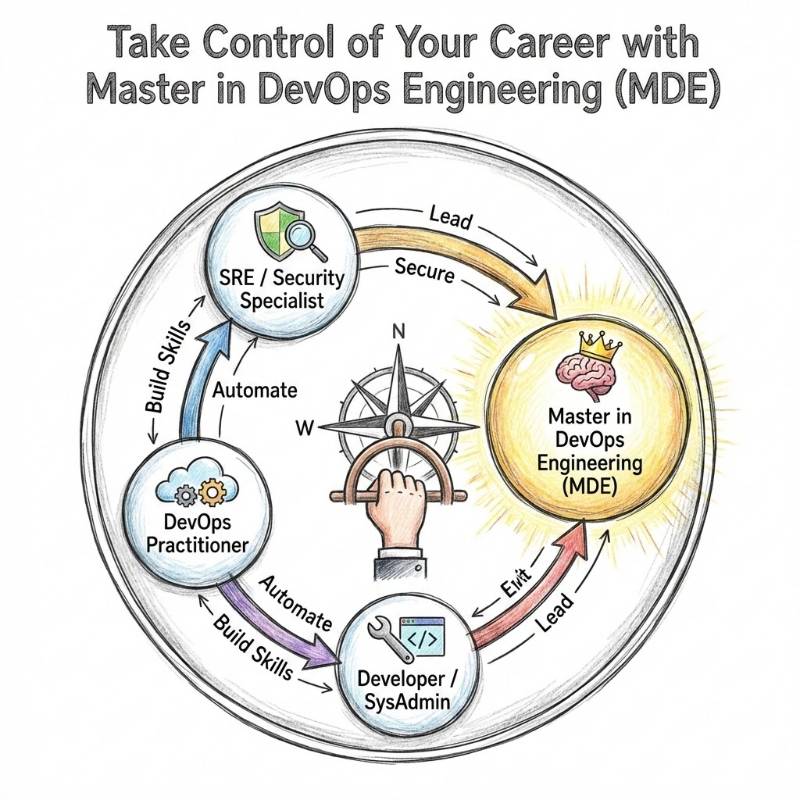
The methodology behind software creation has undergone a radical shift. In today’s high-stakes digital economy, the traditional boundaries between “the person who writes the code” and “the person who runs the server” have been dismantled. A new standard of excellence is required. This guide is curated to explain how the Master in DevOps Engineering (MDE) program serves as the definitive vehicle for this professional evolution.
Understanding the Master in DevOps Engineering (MDE) Concept
The Master in DevOps Engineering (MDE) is recognized as an advanced professional framework. It is not designed as a simple tutorial for a few software tools; instead, it is built as an exhaustive journey through the modern technical landscape. Every critical pillar—including automation, architectural design, and operational resilience—is integrated into this single program to ensure a complete mastery of the field.
The Necessity of MDE in the Modern Tech World
In an era dominated by rapid cloud adoption and complex microservices, manual processes are no longer tolerated. High-speed delivery is demanded by the market, yet stability must never be sacrificed. The MDE curriculum is developed to address this exact tension. By mastering this program, engineers are equipped to build systems that are not only fast but also secure and capable of self-correction.
The Value of Professional Validation
For any serious technologist, a certification like MDE is used to prove that a global standard of knowledge has been met. It is often observed that self-taught skills can leave significant gaps in understanding. A structured certification ensures that every aspect of the software lifecycle is mastered, making the professional an indispensable asset to any engineering team or management board.
Strategic Certification Matrix
| Learning Stage | Proficiency | Targeted User | Pre-requisites | Primary Knowledge | Suggested Sequence |
| Foundation | Entry | Developers | Linux Basics | CI/CD, Git, Docker | Phase 1 |
| Advanced | Mid-Level | Systems Leads | Foundation MDE | Kubernetes, IaC | Phase 2 |
| Specialization | Expert | SREs/Security | Advanced MDE | Monitoring, Security | Phase 3 |
| Strategy | Leadership | Tech Managers | Specialist MDE | AIOps, FinOps | Phase 4 |
Educational Provider: DevOpsSchool
Why DevOpsSchool is the Preferred Choice?
Selecting the right training partner is a decision that impacts long-term career growth. DevOpsSchool is chosen because the learning experience is rooted in reality, not just theory. The curriculum is maintained by industry veterans who have managed massive production environments. Every module is supported by real-world labs, ensuring that skills are not just memorized but are actually practiced. The community and support provided here are designed to help professionals overcome the most complex technical hurdles.
Detailed Breakdown of the MDE Track
Master in DevOps Engineering (MDE)
What defines this certification?
This is a premier, all-encompassing program where the core disciplines of modern IT—including automation, security, and cloud management—are merged into one elite track. It is tailored for those who aim to reach the top tier of the engineering hierarchy.
Who is the ideal candidate?
This program is designed for experienced software creators, infrastructure specialists, and cloud architects who wish to transition from a narrow technical role into a high-impact leadership or architectural position.
Core Competencies Gained
- Deep understanding of Continuous Delivery architectures.
- Proficiency in managing Containerized Environments at scale.
- Practical skills in Infrastructure as Code for automated provisioning.
- Expertise in Site Reliability and performance optimization.
- Knowledge of Security Integration within the DevOps flow.
Practical Capabilities After Completion
- A fully automated, secure software delivery pipeline is successfully constructed.
- Complex cloud infrastructures are managed through repeatable code templates.
- High-availability clusters are deployed and maintained with minimal human effort.
- System outages are predicted and prevented through advanced monitoring setups.
The Preparation Roadmap
- First 14 Days: Attention is focused on the cultural shifts of DevOps and the mastery of basic version control and command-line tools.
- The 30-Day Mark: Exploration is conducted into containerization technologies and the mechanics of automated build tools.
- The 60-Day Goal: The final phase is dedicated to mastering Kubernetes orchestration and large-scale infrastructure automation via Terraform.
Frequent Pitfalls to Sidestep
- Over-emphasizing tools while ignoring the underlying process and logic.
- Neglecting the security layer until the final stages of a project.
- Failing to document automated processes, leading to maintenance challenges later.
Subsequent Learning Paths
- Direct Progression: Advanced Kubernetes Security Specialist.
- Lateral Move: Site Reliability Engineering (SRE) Professional.
- Career Growth: Certified DevOps Management.
Identifying Your Ideal Learning Journey
1. The Automation Specialist (DevOps)
This journey is intended for those who find satisfaction in speed and efficiency. The focus is placed on the “Golden Pipeline,” where every manual step is replaced by code. This path ensures that software is moved from a developer’s laptop to production with zero friction.
2. The Security Guardian (DevSecOps)
In this path, security is no longer a “gate” at the end of the project but a continuous thread throughout. It is chosen by engineers who work in high-risk environments where data protection and compliance are the highest priorities.
3. The Reliability Architect (SRE)
This track is focused on the science of keeping things running. Concepts like Service Level Objectives (SLOs) and incident response are mastered. It is the perfect path for those who enjoy solving complex puzzles related to system performance and uptime.
4. The Intelligence Engineer (AIOps / MLOps)
This is the frontier where data science meets operations. AIOps involves using machine learning to manage IT systems, while MLOps focuses on the reliable deployment of AI models. This path is ideal for professionals working in data-heavy organizations.
5. The Data Lifecycle Expert (DataOps)
DataOps is chosen by those who want to fix the “fragility” of data pipelines. By applying DevOps principles to data management, it is ensured that data flows are as robust and testable as any other software application.
6. The Cloud Economist (FinOps)
As cloud budgets grow, this path has become vital. It focuses on the financial health of the technical stack. Engineers are taught how to balance the need for performance with the necessity of cost control.
Professional Role to Certification Alignment
| Current or Desired Role | Recommended Primary Track |
| DevOps Specialist | Master in DevOps Engineering (MDE) |
| Reliability Engineer | SRE Mastery Program |
| Infrastructure Lead | Platform Engineering Certification |
| Cloud Architect | Multi-Cloud Specialist Track |
| Security Architect | DevSecOps Expert Program |
| Data Platform Lead | DataOps Implementation Path |
| Cost Management Lead | FinOps Practitioner Track |
| Technical Manager | DevOps Strategy & Leadership |
Advanced Learning Recommendations
To remain at the cutting edge of the industry, the following certifications are advised after MDE completion:
- For Technical Depth: A same-track specialization in Cloud-Native Observability is suggested to master high-level monitoring.
- For Versatility: A cross-track certification in Chaos Engineering is recommended to learn how to build resilient, failure-proof systems.
- For Leadership: A Digital Transformation Architect program is advised for those moving into executive technical roles.
Premier Educational & Support Entities
DevOpsSchool
This organization is regarded as a leader in MDE training. High-quality instructors and a vast library of lab exercises are provided to ensure that every student reaches a professional level of competence.
Cotocus
A focus is maintained here on corporate enablement. Specialized workshops are delivered to help large engineering teams transition to modern DevOps and SRE models with minimal disruption.
ScmGalaxy
A massive open-source community hub is maintained by this institution. It serves as a vital resource for engineers seeking technical answers, project ideas, and certification study guides.
BestDevOps
Practical, industry-aligned training is the specialty here. The curriculum is updated frequently to reflect the very latest tools and cultural shifts in the DevOps world.
devsecopsschool.com
This platform is dedicated to the belief that security is everyone’s responsibility. Comprehensive training is provided on how to automate security within the modern CI/CD pipeline.
sreschool.com
The focus is kept strictly on the principles of reliability. Training is provided on how to manage large-scale systems without burning out the engineering team.
aiopsschool.com
The future of automated operations is explored here. Engineers are taught how to leverage AI to make IT environments smarter and more self-sufficient.
dataopsschool.com
Education is provided on how to treat data pipelines with the same rigor as code. This institution helps data teams achieve faster delivery cycles with higher quality.
finopsschool.com
This institution is focused on the intersection of cloud technology and business finance. Professional training is offered to help organizations optimize their cloud spend.
Comprehensive FAQ Section
General Inquiries
- Is the MDE program considered difficult?
The program is structured to be challenging yet manageable for those with a basic technical background. - What is the typical completion timeframe? Usually, a period of 12 to 24 weeks is required to fully absorb the material.
- Are specific technical skills required before starting?
A basic understanding of the command line and programming logic is highly recommended. - How should the certifications be sequenced?
It is advised that the core DevOps track be completed before moving into specialized areas like FinOps or AIOps. - Does this certification lead to salary increases?
A significant positive impact on market value and salary potential is frequently reported by graduates. - What career paths are opened by MDE?
Roles such as Platform Engineer, Cloud Architect, and Release Manager become highly accessible. - Is the curriculum valid internationally?
Yes, global standards and best practices are strictly followed throughout the program. - Will I learn about multiple cloud platforms?
Core concepts are taught in a way that allows them to be applied to any major cloud provider. - Is there a heavy emphasis on labs?
Yes, the majority of the program is dedicated to hands-on, practical implementation. - Is job placement assistance available?
Many partner institutions provide dedicated support for career transitions and interview prep. - Why should an Engineering Manager take this?
It provides the technical oversight needed to lead modern engineering teams effectively. - How are the final exams conducted?
Assessments are typically performance-based, requiring the completion of real-world technical tasks.
MDE Specific Inquiries
- Why is MDE different from a standard DevOps course?
It is an integrated “Master” journey that covers the entire technical ecosystem, not just a few tools. - Can someone with no experience join?
While possible, at least one year of IT exposure is suggested for the best results. - How often are the course materials refreshed?
The curriculum is updated every six months to stay ahead of industry changes. - Is security a major part of the MDE track?
Yes, the “Security as Code” philosophy is embedded in every module. - Will I master Kubernetes in this program?
Deep-dive training on container orchestration is a mandatory part of the MDE journey. - Are the classes flexible for working people?
Yes, the learning schedules are specifically designed to accommodate full-time professionals. - What kind of real-world scenarios are explored?
Scenarios include migrating legacy systems to the cloud and building automated disaster recovery. - Why must I use the official registration link?
The official URL ensures that the verified curriculum and recognized certification are obtained.
Professional Testimonials
Vikram Singh
“The technical depth provided by the MDE program was truly impressive. My ability to design complex automation pipelines was completely transformed.”
Meera Nair
“Practical confidence was gained through the intensive lab sessions. I am now able to lead cloud migration projects with a clear, structured methodology.”
Arjun Kulkarni
“A clear path for career progression was finally found in this guide. The focus on SRE and Kubernetes helped me land a senior role in a top-tier tech firm.”
Siddharth Roy
“The integration of security into the development flow was a major learning point. Our team’s deployment process is now much more robust and secure.”
Kavita Rao
“As a manager, the insights gained from this roadmap were invaluable. The communication between my development and operations teams has improved significantly.”
Final Thoughts
The decision to pursue a Master in DevOps Engineering (MDE) is a commitment to a future-proof career. As technology continues to evolve, the demand for professionals who can navigate both code and infrastructure will only grow. By choosing a structured learning path and a reputable partner like DevOpsSchool, long-term success and professional authority are guaranteed. Strategic learning is not just an option; it is a necessity for the modern engineer.
