
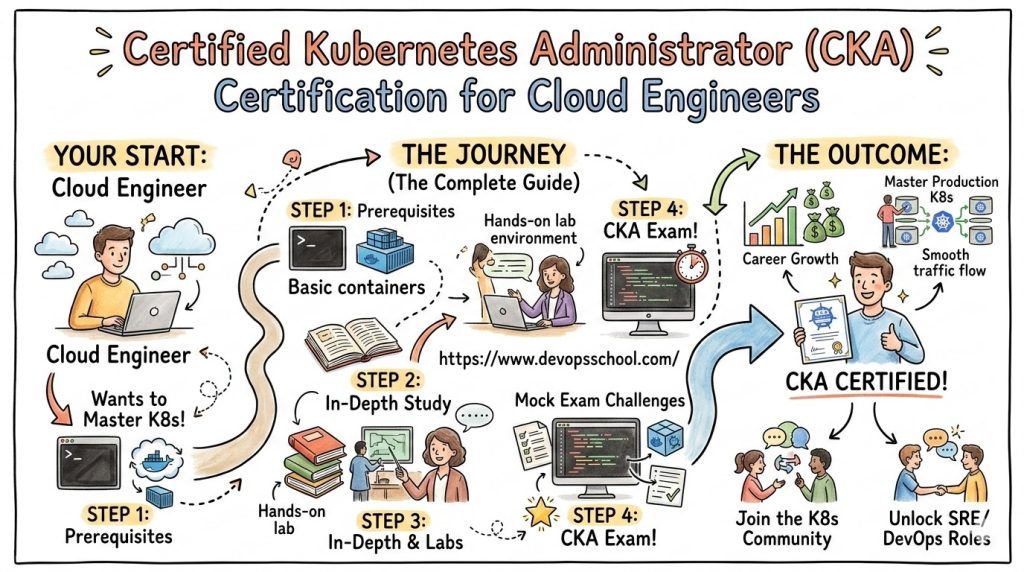
Introduction
The way software is managed and deployed has been changed by the rise of containerization. In this new era, Kubernetes is used as the primary platform for orchestrating these containers at scale. For any professional working in the cloud, the Certified Kubernetes Administrator (CKA) is considered the most critical credential to possess.
In the current job market, a high value is placed on verified technical skills. It is no longer enough to simply understand the theory of cloud computing. Practical, hands-on expertise is required to keep production environments stable and secure. For both individual engineers and engineering managers, certifications are important because a clear standard of excellence is established.
A career in DevOps or Site Reliability Engineering is often accelerated by achieving the CKA. It is viewed as a signal to employers that complex, real-world Kubernetes challenges can be handled with confidence.
Certification Overview Table
| Track | Level | Who it’s for | Prerequisites | Skills Covered | Recommended Order |
| Kubernetes Ops | Intermediate | Engineers & Admins | Linux/Networking | Cluster Setup, Storage, Security | After CKAD or direct |
Provider: DevOpsSchool
Why Choose DevOpsSchool?
When the decision to pursue a CKA is made, the quality of training becomes the most important factor. DevOpsSchool is chosen by thousands of learners globally because a deeply practical approach is followed. The lessons are not just read; they are experienced through intensive lab sessions.
Complex architectural concepts are simplified by mentors who have spent decades in the industry. Support is provided at every step, ensuring that the logic of Kubernetes is understood, not just the commands. By choosing DevOpsSchool, a commitment to high-level technical mastery is made.
Certification Deep-Dive: Certified Kubernetes Administrator (CKA)
What is this certification?
The Certified Kubernetes Administrator (CKA) is a performance-based exam. The ability to install, configure, and manage production-grade Kubernetes clusters is tested in a live command-line environment.
Who should take this certification?
- Software engineers who are moving into platform roles.
- DevOps and Cloud engineers responsible for infrastructure.
- Site Reliability Engineers (SRE) focused on system uptime.
- Managers who need to understand the technical depth of their teams.
Skills you will gain
- Kubernetes clusters are installed and configured using
kubeadm. - Underlying infrastructure and networking are managed effectively.
- Application logs are analyzed and cluster-wide issues are resolved.
- Security measures and role-based access (RBAC) are implemented.
- Storage solutions and persistent volumes are integrated into workloads.
Real-world projects you should be able to do after this certification
- A highly available Kubernetes cluster can be built from the ground up.
- Traffic routing and load balancing can be configured using Ingress.
- Automated scaling for applications based on CPU usage can be set up.
- Cluster upgrades and maintenance tasks can be performed without downtime.
- Secure secrets management for sensitive data can be established.
Preparation plan
7–14 days plan
This fast track is intended for those with existing Kubernetes experience. Most of the time is spent on mock exams. Speed and accuracy in the terminal are prioritized. The official documentation is used as the sole reference during practice sessions.
30 days plan
A structured study routine is followed. The first two weeks are used to master Cluster Architecture and Installation. The third week is dedicated to Networking and Storage. The final week is spent solving complex troubleshooting scenarios repeatedly.
60 days plan
A steady learning pace is maintained for beginners. The first month is focused on Linux command-line mastery and container fundamentals. The second month is entirely devoted to the CKA syllabus, with a heavy emphasis on hands-on lab exercises.
Common mistakes to avoid
- A reliance on GUI tools is maintained instead of mastering the
kubectlCLI. - The official Kubernetes documentation is not used enough during preparation.
- Time management is ignored, leading to unfinished tasks during the exam.
- Basic networking concepts like DNS and CNI are not fully understood.
Best next certification after this
- Same track: Certified Kubernetes Security Specialist (CKS).
- Cross-track: AWS Certified Solutions Architect – Associate.
- Leadership / management: DevOps Leader (DOL).
Choose Your Learning Path
1. DevOps Path
The automation of software delivery is the focus here. Kubernetes is utilized to build robust CI/CD pipelines, ensuring that code is moved from development to production with minimal manual intervention.
2. DevSecOps Path
Security is moved to the forefront in this path. Once the CKA is completed, the focus is shifted to hardening clusters and ensuring that container images are free of vulnerabilities.
3. Site Reliability Engineering (SRE) Path
Reliability and performance are prioritized. Kubernetes skills are used to build self-healing systems that can handle massive traffic spikes without human intervention.
4. AIOps / MLOps Path
Machine learning models are deployed and managed at scale. Kubernetes is leveraged to provide the compute power needed for AI workloads while keeping costs under control.
5. DataOps Path
Data pipelines are orchestrated using containerized environments. High availability for databases and data processing engines is ensured through advanced Kubernetes management.
6. FinOps Path
Cloud spending is optimized. Kubernetes resource quotas and limits are used to ensure that infrastructure is utilized efficiently and budget targets are met.
Role → Recommended Certifications Mapping
The following certifications are recommended based on specific career roles:
- DevOps Engineer: CKA + Jenkins + Terraform.
- Site Reliability Engineer (SRE): CKA + Prometheus + Grafana.
- Platform Engineer: CKA + Helm + ArgoCD.
- Cloud Engineer: CKA + AWS/Azure/GCP Certifications.
- Security Engineer: CKA + CKS + Cloud Security certs.
- Data Engineer: CKA + Spark + Big Data tools.
- FinOps Practitioner: CKA + FinOps Certified Practitioner.
- Engineering Manager: CKA + Agile/Scrum Master.
Next Certifications to Take
A long-term learning strategy is encouraged for every professional:
- For the CKA Holder:
- Same-track: The Certified Kubernetes Security Specialist (CKS) is taken to master cluster defense.
- Cross-track: The HashiCorp Certified: Terraform Associate is used to master infrastructure as code.
- Leadership-focused: The DevOps Leader (DOL) is pursued to move into strategic management roles.
Training & Certification Support Institutions
Expert support is provided by the following institutions:
- DevOpsSchool: Intensive, lab-heavy training is delivered. Real-world scenarios are used to prepare students for the CKA exam.
- Cotocus: Professional consulting and high-end technical training are provided for corporate teams and individuals.
- ScmGalaxy: A massive community platform where technical guides, blogs, and troubleshooting tips are shared freely.
- BestDevOps: Focused training programs are offered for those looking to master specific DevOps tools quickly.
- devsecopsschool.com: Education is focused on the integration of security into every part of the DevOps lifecycle.
- sreschool.com: Training is provided on building reliable, scalable, and observable systems using modern tools.
- aiopsschool.com: The future of operations is explored through AI-driven automation and monitoring.
- dataopsschool.com: Mastering the orchestration of data workflows in a cloud-native environment is the goal here.
- finopsschool.com: Financial accountability in the cloud is taught to help organizations manage their cloud spend.
FAQs Section
General Career FAQs
- Is the CKA exam difficult?
It is considered a hard exam because it is not multiple-choice; it is 100% practical. - How long should I study for the CKA?
A period of 6 to 10 weeks is recommended for most learners. - What are the CKA prerequisites?
There are no official prerequisites, but Linux knowledge is a must. - Should I do CKAD before CKA?
It is often recommended to start with CKAD to get used to the exam format. - What is the salary impact of CKA?
A significant increase in salary is often reported after becoming CKA certified. - Does CKA help in getting remote jobs?
Yes, it is a globally recognized proof of skill that is highly valued by remote employers. - What is the exam duration?
The exam is 2 hours long. - How long is the certificate valid?
The CKA certificate is valid for 3 years. - Can I use a notepad during the exam?
A digital notepad is provided within the exam environment for taking notes. - What is the passing score?
A score of 66% is required to pass. - How many attempts do I get?
One free retake is included with the exam purchase. - Is CKA better than AWS certifications?
They serve different purposes; CKA is focused on orchestration, while AWS is focused on cloud services.
CKA Specific FAQs
- Is YAML knowledge required for CKA?
Yes, the ability to read and write YAML files is essential for the exam. - What version of Kubernetes is used?
The exam version is updated frequently to match the current stable release. - Are aliases allowed?
Yes, setting up aliases likealias k=kubectlis encouraged to save time. - Is the exam proctored?
Yes, the exam is proctored live via a webcam and screen share. - What is the weight of Troubleshooting?
Troubleshooting usually accounts for 30% of the total exam score. - Can I use my own laptop?
Yes, as long as it meets the technical requirements and has a stable connection. - How are the questions structured?
A series of tasks are given, and they must be solved in different Kubernetes clusters. - Is
kubeadmused in the exam?
Yes,kubeadmis the standard tool for cluster lifecycle tasks in the CKA.
Testimonials
Zoya
“Skill improvement was seen within weeks of starting the CKA training. The ability to manage production clusters was gained, and my daily tasks became much easier to handle.”
Kabir
“Real-world application was the focus of my learning journey. My confidence in using Kubernetes was boosted, and I was able to lead a major cluster migration project at work.”
Ishita
“Career clarity was achieved through this certification. The path from a general developer to a specialized DevOps engineer was made clear and attainable.”
Aryan
“Confidence growth was the most important outcome for me. Passing the CKA proved that my technical skills were at an industry-leading level.”
Meera
“Skill improvement was noticed by my manager immediately. The efficiency of our deployment pipelines was increased, and our system downtime was reduced.”
Conclusion
The importance of the Certified Kubernetes Administrator (CKA) certification cannot be overstated in today’s cloud-native world. It is a vital tool for career growth and technical excellence. Long-term benefits are gained when a strategic learning plan is followed.
With the right training from institutions like DevOpsSchool, the challenges of Kubernetes are overcome. Strategic learning and constant practice are encouraged for anyone looking to reach the top of the engineering field.

