
Introduction
Machine Learning is no longer just a research project. It is now a core part of how modern software works. However, moving a model from a laptop to a live production environment is difficult. This is where MLOps comes in. Having spent over two decades in the tech industry, I have seen many trends come and go, but the shift toward automated Machine Learning operations is here to stay. This guide is designed to help you understand the MLOps Foundation Certification and how it can shape your career.
What is MLOps Foundation Certification?
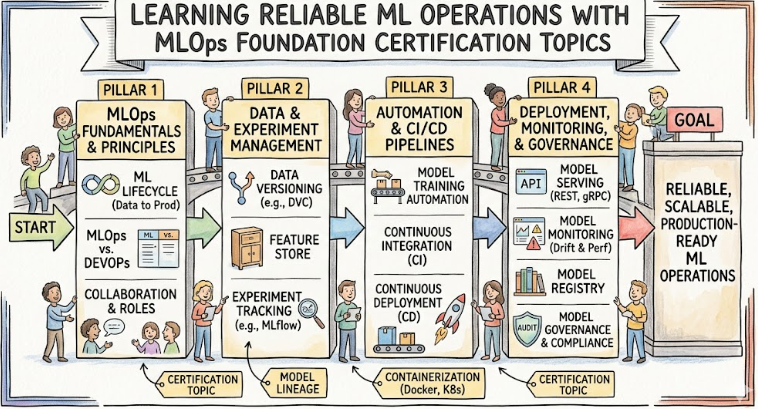
The MLOps Foundation Certification is a professional program designed to teach the basics of managing Machine Learning lifecycles. It bridges the gap between data science and traditional software engineering. This certification focuses on the tools and processes needed to deploy, monitor, and scale machine learning models reliably. It is not just about writing code; it is about building a factory that produces high-quality AI models consistently.
Why it matters today?
In the current market, companies are struggling to get value from their AI investments. Many models are built but never reach the customer because the deployment process is broken. MLOps solves this by bringing discipline to the chaos. Organizations now look for engineers who understand both the “Dev” and the “ML” side of things. If you want to remain relevant in a world driven by AI, understanding these foundational principles is a mechanical necessity.
Why MLOps Foundation Certification certifications are important?
Certifications serve as a roadmap for your learning journey. They ensure that you are not just learning random tools but are following a structured path that aligns with industry standards. For an engineer, a certification provides:
- Validation: It proves to employers that you have a verified level of knowledge.
- Standardization: It ensures you speak the same technical language as global teams.
- Efficiency: It helps you learn the most important topics quickly without getting lost in fluff.
Why choose AIOps School?
Choosing the right training partner is vital for career growth. AIOps School is selected by many professionals because their curriculum is built by industry veterans. The focus is placed on practical skills rather than just theory. Their labs and study materials are designed to mimic real-world production issues, which prepares you for actual job challenges. The learning environment is supportive, making it easier for working professionals to balance study with their daily jobs.
What is this certification?
This is an entry-level program that introduces the core concepts of Machine Learning Operations. It covers the basic workflow of taking a model from development to production using automation.
Who should take this certification?
This is ideal for Software Engineers, DevOps Engineers, and Data Scientists who want to understand how to operationalize AI. It is also highly recommended for managers who need to oversee AI-driven projects.
Certification Overview Table
| Track | Level | Who it’s for | Prerequisites | Skills Covered | Recommended Order |
| MLOps | Foundation | Engineers & Managers | Basic IT knowledge | Model versioning, CI/CD for ML, Monitoring | First |
Skills you will gain
- Understanding the ML Lifecycle from start to finish.
- Building automated pipelines for data and models.
- Learning how to track versions of datasets and experiments.
- Monitoring model performance to detect “drift” or accuracy loss.
- Integrating security into the Machine Learning workflow.
Real-world projects you should be able to do after this certification
- Set up an automated pipeline that retrains a model when new data arrives.
- Create a monitoring dashboard that alerts the team if a model starts giving wrong predictions.
- Package a machine learning model into a container for easy deployment across different clouds.
- Implement a version control system specifically for large data files.
Preparation Plan
7–14 Days Plan (The Fast Track)
- Spend 2 hours daily watching core video modules.
- Focus on definitions and the high-level MLOps workflow.
- Take two practice exams to identify weak spots.
30 Days Plan (The Balanced Track)
- Dedicate one week to each major pillar: Data, Model, Code, and Monitoring.
- Complete all hands-on lab exercises provided by the school.
- Review case studies of successful MLOps implementations.
60 Days Plan (The Deep Dive)
- Slowly work through each module, spending extra time on automation tools.
- Build a personal project alongside the course to apply what is learned.
- Participate in community discussions and webinars to clear doubts.
Common mistakes to avoid
- Focusing only on tools: Do not just learn the software; learn the “why” behind the process.
- Ignoring Data: Remember that MLOps is as much about data management as it is about the model.
- Skipping the Basics: Don’t try to learn advanced automation before you understand the manual workflow.
Best next certification after this
- Same track: MLOps Professional Certification.
- Cross-track: AIOps Foundation Certification.
- Leadership / management: AI Strategy and Governance for Managers.
Choose Your Learning Path
1. DevOps Path
Best for engineers who already manage servers and CI/CD. The focus is shifted from managing applications to managing model artifacts.
2. DevSecOps Path
Best for security-focused professionals. This path ensures that AI models are not just fast, but safe from adversarial attacks and data leaks.
3. Site Reliability Engineering (SRE) Path
Best for those responsible for uptime. It teaches how to maintain the reliability of ML systems even when they are processing massive amounts of live data.
4. AIOps / MLOps Path
This is the core path for AI enthusiasts. It combines the best of operational excellence with the specific needs of artificial intelligence.
5. DataOps Path
Best for data engineers. It focuses on the “plumbing” of data—making sure high-quality data is always available for the models to learn from.
6. FinOps Path
Best for those managing cloud costs. Running AI models can be very expensive; this path teaches how to optimize those costs effectively.
Role → Recommended Certifications Mapping
| Role | Recommended Certification | Primary Goal |
| DevOps Engineer | MLOps Foundation | Automate ML workflows |
| Site Reliability Engineer (SRE) | AIOps Foundation | Use AI to manage uptime |
| Platform Engineer | MLOps Foundation | Build AI platforms |
| Cloud Engineer | Cloud Architect (AI focus) | Deploy AI on cloud |
| Security Engineer | DevSecOps Foundation | Secure the ML pipeline |
| Data Engineer | DataOps Foundation | Manage data flow |
| FinOps Practitioner | FinOps Certified | Control AI cloud costs |
| Engineering Manager | AI Leadership | Manage AI teams |
Next Certifications to Take
One Same-Track Certification
The MLOps Professional Certification is the logical next step. It dives deeper into complex architectures and multi-cloud deployments.
One Cross-Track Certification
AIOps Foundation is a great choice. It teaches you how to use artificial intelligence to improve traditional IT operations and troubleshooting.
One Leadership-Focused Certification
Certified Engineering Manager (AI focus) is recommended. It prepares you to lead technical teams while understanding the business impact of AI projects.
Training & Certification Support Institutions
DevOpsSchool
This institution is known for its wide range of technical courses. Extensive support is provided to students through live sessions and recorded content. They focus heavily on practical tool knowledge.
Cotocus
Cotocus provides specialized training in modern cloud technologies. They are recognized for their corporate training programs and hands-on approach to complex engineering problems.
ScmGalaxy
This community-driven platform offers a wealth of resources for software configuration management. It is a great place to find tutorials, articles, and expert advice on DevOps and MLOps.
BestDevOps
BestDevOps focuses on career-oriented training. Their programs are designed to help engineers move from junior to senior roles by mastering automation and orchestration.
devsecopsschool.com
This school focuses purely on the intersection of security and operations. It is a top choice for anyone looking to specialize in building secure software delivery pipelines.
sreschool.com
Reliability is the core focus here. This school teaches the principles of Site Reliability Engineering as practiced by the world’s largest tech companies.
aiopsschool.com
This is the go-to destination for AI-related operations. Their certifications are highly respected and are designed to bridge the gap between AI research and IT operations.
dataopsschool.com
This institution focuses on the data lifecycle. They teach how to manage data as a product, ensuring it is clean, accessible, and secure for all business needs.
finopsschool.com
Cost management in the cloud is the specialty here. They provide the frameworks needed to balance speed, cost, and quality in modern cloud environments.
FAQs Section
1. What is the difficulty level of the MLOps Foundation exam?
The exam is designed to be foundational. It is challenging but fair for anyone who has followed the course material and completed the labs.
2. How much time is required to prepare?
Most working professionals find that 30 to 45 days is enough time to feel confident if they study for an hour or two each day.
3. Are there any strict prerequisites?
There are no strict technical prerequisites, but a basic understanding of software development and Linux commands is very helpful.
4. What is the recommended certification sequence?
It is suggested to start with DevOps Foundation, move to MLOps Foundation, and then proceed to specialized professional tracks.
5. What is the career value of this certification?
This certification makes you stand out in a crowded market. It shows you can handle the most modern type of engineering workload: AI operations.
6. Which job roles can I apply for?
You can target roles like MLOps Engineer, DevOps Engineer (ML focus), Platform Engineer, or Data Operations Specialist.
7. Is there growth in this field?
Yes, the demand for MLOps professionals is growing much faster than traditional software roles as more companies adopt AI.
8. Does this certification help in salary hikes?
Certified professionals often report better salary packages because they possess a niche skill set that is in high demand.
9. Is the exam online or offline?
The exam is typically conducted online, allowing you to take it from the comfort of your home or office.
10. How long is the certification valid?
Most certifications in this field are valid for two to three years, after which a renewal or advanced certification is recommended.
11. Is there a community for support?
Yes, students gain access to forums and groups where they can ask questions and network with other professionals.
12. Does it cover specific tools like Kubernetes?
While it focuses on principles, the course does introduce how tools like Kubernetes and Docker are used in the MLOps ecosystem.
Additional MLOps Foundation FAQs
1. Does the MLOps Foundation Certification cover coding?
Basic scripting knowledge is helpful, but the certification focuses more on the workflow and the architecture of the systems.
2. Can a manager take this course?
Yes, it is highly recommended for managers so they can understand the timelines and resources needed for AI projects.
3. Is cloud knowledge required?
A general understanding of how the cloud works is beneficial, as most MLOps tools are cloud-based.
4. What makes MLOps different from DevOps?
DevOps focuses on software code, while MLOps focuses on the combination of code, data, and machine learning models.
5. How is the exam structured?
The exam usually consists of multiple-choice questions that test both theoretical knowledge and scenario-based problem-solving.
6. Are labs included in the training?
Yes, training through AIOps School includes hands-on labs to ensure you can actually use the tools discussed.
7. Will I learn about specific ML frameworks like TensorFlow?
The course teaches you how to manage these frameworks in production rather than how to build the models themselves.
8. Is this certification recognized globally?
Yes, the principles taught are based on global industry standards used by top tech firms worldwide.
Testimonials
DevOps Engineer:
“This program gave me the exact roadmap I needed. I moved from managing standard apps to managing AI models in just three months. My confidence has doubled.”
SRE:
The focus on monitoring model drift was a game-changer for me. I can now ensure our AI systems are reliable and not just ‘running’ on the server.
Cloud Engineer:
I finally understand how to architect cloud environments specifically for data science teams. This has made me a much more valuable asset to my company.
Security Engineer:
Learning how to secure the data pipeline was my biggest takeaway. I feel much better about our AI deployments now that I know the risks.
Engineering Manager:
This certification helped me set realistic goals for my team. We stopped treating AI like magic and started treating it like a proper engineering discipline.
Conclusion
The MLOps Foundation Certification is an essential step for any modern engineer. It provides the structure and knowledge needed to excel in the age of Artificial Intelligence. By earning this certification, you are not just adding a line to your resume; you are future-proofing your career. The long-term benefits include higher pay, better job security, and the ability to work on the most exciting projects in the tech world. Start your journey today and become a leader in the next generation of software engineering.

