
Introduction
The landscape of enterprise IT is observed to be shifting toward a state of constant, intelligent monitoring. For many years, system health was maintained through manual intervention and a reactive approach to failures. However, as digital services become more complex and decentralized, traditional methods are found to be inadequate. The need for a more proactive and automated approach is recognized across the industry. This has led to the emergence of the Artificial Intelligence for IT Operations (AIOps) framework. A clear path for professionals to master this new domain is provided by the Certified AIOps Manager program. This guide is created to explain the role, the certification process, and the long-term career benefits for engineering leaders.
What is Certified AIOps Manager
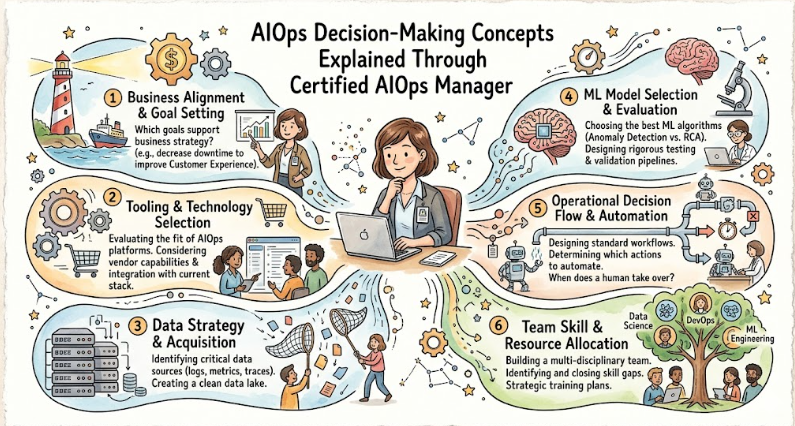
A Certified AIOps Manager is defined as a leader who oversees the implementation of machine learning and data-driven automation within IT teams. The role is focused on building “self-healing” environments where problems are identified and resolved before they impact the user. It is not merely a technical job; it is a strategic position where the focus is placed on the governance of AI tools and the alignment of automation with business goals. By holding this title, a professional is validated as being capable of managing the lifecycle of AI models and ensuring that operational data is used to drive meaningful insights.
Why it matters today?
The volume of data generated by modern cloud-native applications is seen as being too vast for human processing. Every minute, millions of logs and alerts are produced, creating a situation where critical issues are often buried under a sea of irrelevant information. This “alert fatigue” is known to cause delays in recovery and significant financial loss for businesses. An intelligent system is required to filter this noise and provide a clear picture of system health. Without a skilled manager to lead these AI initiatives, companies are often found to be struggling with tools that do not deliver on their promises. The transition to AIOps is seen as a necessity for any organization that values speed and reliability.
Why Certified AIOps Manager certifications are important
A formal certification is recognized as a vital proof of expertise in a field that is still evolving. it provides a structured way for professionals to learn the best practices and methodologies that have been proven to work in high-scale environments. For the individual, it offers a competitive edge and the ability to command higher salaries in the global market. For the organization, it ensures that the leadership is equipped with the right knowledge to manage complex AI projects safely. Confidence is built within the team when a certified expert is responsible for the automation strategy, as the risks associated with AI adoption are carefully managed.
Why Choose AIOps School?
The decision to choose AIOps School is often based on its specialized focus on the management side of automation. The curriculum is designed to be highly practical, ensuring that the lessons can be applied to real-world business challenges immediately. Expert mentors are provided to guide students through the complexities of AI governance and data strategy. The school is also known for maintaining a strong network of professionals, which provides ongoing support and learning opportunities long after the course is finished. A focus is maintained on keeping the content current with the latest industry shifts, making it a preferred choice for aspiring leaders.
Certification Deep-Dive
What is this certification?
This is a management-focused credential that validates the ability to lead and govern AI-driven operations. It focuses on the strategic implementation of machine learning to improve system reliability and team efficiency.
Who should take this certification?
This program is intended for Senior DevOps Engineers, SRE Leads, and IT Managers who are responsible for large-scale infrastructure. It is also suitable for architects who wish to specialize in the governance of intelligent automation.
Certification Overview Table
| Track | Level | Who it’s for | Prerequisites | Skills Covered | Recommended Order |
| AIOps/MLOps | Manager | Engineering Leads | Operations Basics | AI Governance, Data Ops | 1 |
| SRE | Advanced | Reliability Leads | Monitoring Exp | Error Budgets, SLIs/SLOs | 2 |
| DevOps | Professional | Software Engineers | Coding Skills | CI/CD, Infrastructure as Code | 3 |
| DevSecOps | Specialist | Security Leads | Security Basics | Automated Threat Detection | 4 |
| DataOps | Specialist | Data Engineers | SQL/ETL Knowledge | Pipeline Automation | 5 |
| FinOps | Management | Finance/Ops Leads | Cloud Cost Basics | Cloud Optimization | 6 |
Skills you will gain
- The creation of a comprehensive roadmap for AI adoption in operations is mastered.
- Knowledge of data normalization and quality control for AI models is acquired.
- Techniques for reducing operational noise and improving alert quality are learned.
- The coordination of tasks between technical data science teams and operations is managed.
- Advanced strategies for predictive maintenance and proactive incident response are implemented.
- A deep understanding of the ethical and regulatory aspects of AI in IT is developed.
Real-world projects you should be able to do after this certification
- A centralized observability dashboard using AI-driven insights is designed.
- A project to automate root cause analysis for a microservices platform is led.
- A predictive scaling model for a high-traffic cloud environment is implemented.
- A governance framework for the use of AI in infrastructure management is created.
- A cost-benefit analysis of AI automation projects is conducted for senior leadership.
Preparation Plan
7–14 Days Plan
The core modules of the AIOps framework are reviewed daily. Focus is placed on understanding the different types of AI models and their roles in operations. Practice tests are taken to identify any gaps in understanding.
30 Days Plan
One hour of theory is combined with one hour of hands-on lab work every day. Real-world case studies are analyzed to understand how AI management works in different industries. Progress is tracked through weekly assessments.
60 Days Plan
A thorough deep dive into every topic, including data governance and AI ethics, is conducted. Several complex AIOps projects are built from scratch to gain practical experience. Study groups are joined to discuss complex management scenarios.
Common mistakes to avoid
- Relying on AI tools without a clear data strategy is a common error.
- The human and cultural aspects of moving a team toward AI are often overlooked.
- Attempting to automate everything at once without a phased plan is discouraged.
- The importance of data quality is frequently underestimated by those new to the field.
Best next certification after this
- Same track: Certified MLOps Engineer.
- Cross-track: Site Reliability Engineering (SRE) Master.
- Leadership / management: Strategic Technology Leader.
Choose Your Learning Path
DevOps Path
This path is chosen by those who want to master the art of delivery and continuous improvement. It is best for engineers who wish to understand the full lifecycle of a digital product from start to finish.
DevSecOps Path
This track is recommended for those who prioritize security in automated environments. It is best for professionals who want to ensure that protection is built directly into the software development cycle.
Site Reliability Engineering (SRE) Path
This is a path focused on the health, scalability, and uptime of critical systems. It is best for engineers who are tasked with maintaining the most reliable platforms for their users.
AIOps / MLOps Path
This is a highly specialized path for those who want to work with machine intelligence. It is best for leaders who wish to drive their organizations toward a future of autonomous and predictive management.
DataOps Path
This path is designed for those who manage the flow and quality of data. It is best for data engineers who want to apply operational discipline to their data pipelines.
FinOps Path
This track is selected by those who manage the economics of cloud technology. It is best for leaders who need to align cloud spending with actual business value and financial goals.
Role → Recommended Certifications Mapping
| Role | Primary Recommendation | Secondary Recommendation |
| DevOps Engineer | DevOps Master | AIOps Foundation |
| Site Reliability Engineer | SRE Professional | Cloud Architect |
| Platform Engineer | Certified AIOps Manager | Kubernetes Specialist |
| Cloud Engineer | Cloud Architect (AWS/Azure) | FinOps Certified |
| Security Engineer | DevSecOps Specialist | Security Architect |
| Data Engineer | DataOps Professional | MLOps Specialist |
| FinOps Practitioner | FinOps Certified | Business Analyst |
| Engineering Manager | Certified AIOps Manager | DevOps Leader |
Next Certifications to Take
Same-Track Certification
A deeper study into machine learning operations is highly recommended for those who have completed the manager level. This ensures that the technical side of AI model management is fully understood in an operational context.
Cross-Track Certification
A certification in Site Reliability Engineering is suggested to provide a balanced view of system health. The combination of reliability principles and AI-driven insights creates a very strong leadership profile.
Leadership-Focused Certification
The DevOps Leader (DOL) certification is recommended for those who want to drive cultural transformation. It provides the skills needed to manage the people and processes involved in technical shifts.
Training & Certification Support Institutions
DevOpsSchool
This institution is recognized for providing high-quality training across all modern engineering disciplines. It is often the preferred choice for those seeking a strong foundation in automated operations.
Cotocus
Specialized consulting and training services are provided by this organization to help companies modernize their infrastructure. A focus is maintained on helping teams transition to cloud-native technologies effectively.
ScmGalaxy
A vast repository of resources, including tutorials and guides, is offered by this platform for the engineering community. It is a valuable site for staying updated on the latest technical trends.
BestDevOps
Curated learning paths for the most significant industry certifications are provided here. It is designed to help professionals pass their exams and gain practical, job-ready skills.
devsecopsschool.com
This school is dedicated to the integration of security into the development lifecycle. It provides the deep technical knowledge required to protect automated pipelines from emerging threats.
sreschool.com
The principles of system reliability and observability are taught at this specialized institution. It is a highly recommended resource for those responsible for the uptime of large-scale platforms.
aiopsschool.com
This is the premier school for learning about the application of AI in IT operations. The Certified AIOps Manager program is its flagship offering for aspiring technical leaders.
dataopsschool.com
Training for the management and automation of data pipelines is offered here. It is an essential resource for data professionals who wish to adopt operational best practices.
finopsschool.com
The financial aspects of cloud management are explored in depth at this institution. It helps leaders align their technology spending with organizational business goals.
FAQs Section
1. What is the difficulty level of the Certified AIOps Manager program?
The Certified AIOps Manager program is generally considered intermediate to advanced because it covers both management strategy and technical AIOps concepts. Learners should have a basic understanding of IT operations, automation, monitoring, and AI-driven operations practices.
2. How much time is required to prepare for this certification?
Most working professionals may need around four to eight weeks of consistent study to prepare well for the certification. The actual preparation time can vary based on prior experience, learning speed, and daily study schedule.
3. Are there any prerequisites for enrolling in this course?
A basic understanding of IT operations, infrastructure, monitoring, and automation is usually helpful before joining this course. Some experience in a lead, managerial, or technical decision-making role can make the learning process easier.
4. In what sequence should these certifications be pursued?
It is usually better to begin with a foundational DevOps, SRE, or AIOps course before moving to the Certified AIOps Manager level. This sequence helps learners build strong technical basics before studying management-level AIOps concepts.
5. What is the career value of being a Certified AIOps Manager?
This certification can help professionals understand how to lead AIOps adoption, automation planning, incident management, and intelligent IT operations. It can support career growth for those aiming for leadership, management, and digital operations roles.
6. What job roles can be applied for after achieving this certification?
After earning this certification, professionals may apply for roles such as AIOps Lead, IT Operations Manager, Engineering Manager, Automation Manager, Platform Manager, and Systems Architect. These roles usually require both technical understanding and strong operational decision-making skills.
7. Is the certification exam available globally?
Yes, the certification exam is generally available through an online assessment platform. Learners from India and other global locations can usually access the exam remotely, depending on the certification provider’s process.
8. How long does the certification remain valid?
The certification is generally valid for two years. After that, learners may need renewal, re-certification, or continuing education to keep the credential active.
9. Is the training delivered through live sessions?
The training usually includes a mix of live instructor-led sessions and self-paced recorded learning materials. This gives learners the benefit of trainer interaction as well as flexible revision.
10. Are lab environments provided for hands-on practice?
Yes, cloud-based lab environments are usually provided for hands-on practice. These labs help learners work with real AIOps tools, monitoring systems, automation workflows, and operational use cases.
11. What is the passing score for the certification?
A minimum score of around 70% is generally required to pass the final assessment and receive the official certificate. Learners should still check the latest exam policy from the official course provider.
12. Is job assistance provided after the course?
Many training providers include support such as resume guidance, interview preparation, and career mentoring after the course. This support can help learners present their AIOps management skills more clearly during job applications.
Additional FAQs specifically focused on Certified AIOps Manager
1. Is the focus of the course more on tools or strategy?
The curriculum is balanced, but a strong emphasis is placed on the strategic governance and management of AI in operations.
2. Can a manager without a data science background take this?
Yes, the program is designed to be accessible to IT leaders, with the necessary AI and data concepts taught as part of the course.
3. Are industry-specific AI tools used during the training?
The principles are taught in a tool-agnostic way, although popular industry software is used for practical demonstrations.
4. Are real-world case studies analyzed during the sessions?
Case studies from successful global companies are analyzed to illustrate how AIOps has improved their operational efficiency.
5. Is the certificate recognized by international employers?
The certification is highly respected by global organizations that are looking for leaders to drive their digital transformation.
6. How is the final examination structured?
The exam typically consists of multiple-choice questions that test both theoretical knowledge and situational management skills.
7. Is there a networking community for certified managers?
An alumni group is maintained where certified professionals can connect and share insights on industry advancements.
8. How often is the course material updated?
The curriculum is reviewed and updated every few months to ensure it reflects the latest trends in AI and operations.
Testimonials
Nikhil
A very clear understanding of how to manage an AI transformation was gained through this course. The transition from reactive to proactive management was handled much more effectively.
Anjali
The improvement in our daily system oversight was seen almost immediately. The ability to filter out monitoring noise has allowed the team to focus on critical business issues.
Suresh
Career clarity was the most significant outcome for me. The path toward becoming a senior technical leader became much more defined after completing this management certification.
Meera
A great deal of confidence was built during the sessions on AI strategy. I now feel fully prepared to lead large-scale automation projects for my current organization.
Rohan
The practical labs were the most valuable part of the journey. Working on real-world scenarios helped me understand how to apply the management principles at my job.
Conclusion
The achievement of the Certified AIOps Manager status is considered a major milestone for any aspiring technical lead. A bridge is formed between traditional engineering oversight and the advanced world of machine intelligence. Greater visibility within the global job market is gained when these specialized skills are validated by a recognized program. The complexities of automated infrastructure are managed with much more ease when a structured learning approach is followed. A foundation for long-term professional growth is laid by those who decide to master the governance of AI today. It is believed that the most resilient career paths are built through constant upskilling and a focus on emerging intelligent workflows. By prioritizing this certification, a commitment to excellence and a forward-thinking mindset are clearly demonstrated to the entire industry.

