
Introduction
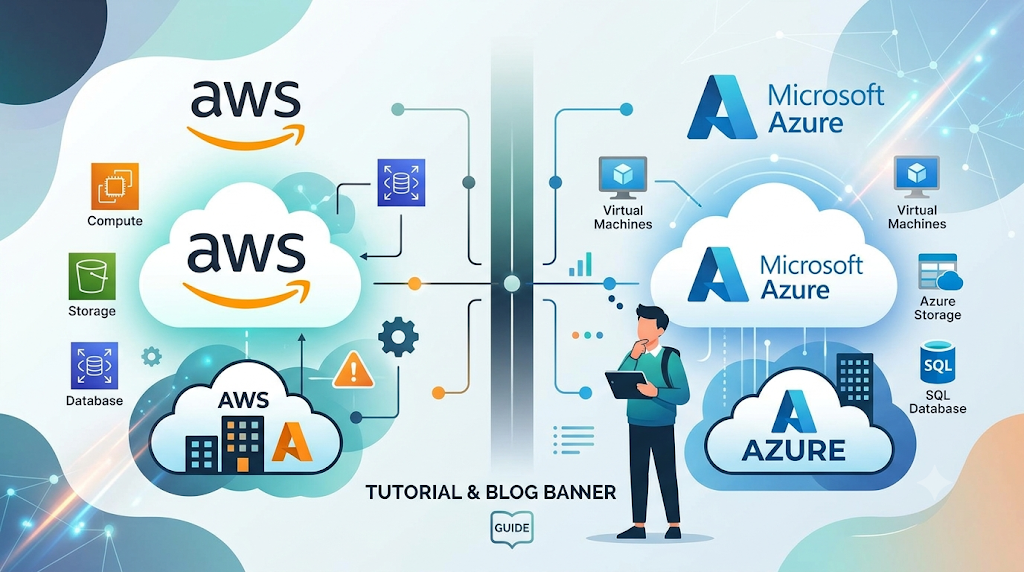
Cloud computing is no longer a futuristic technology. Almost every modern business—from small local shops to massive banks—runs its digital systems on cloud platforms. Instead of buying physical computers and hard drives, companies rent computer power and storage over the internet.
Because of this massive shift, cloud computing skills are among the most valuable assets on a resume. But for anyone looking to break into the industry, a major roadblock appears immediately: Should I learn AWS or Azure first?
Choosing the wrong platform can feel like wasting months of study time. Beginners often get overwhelmed by confusing technical terms, conflicting advice from online forums, and the sheer number of certifications available.
This guide cuts through the noise. It compares AWS and Azure in plain English, examines their market positions, looks at real-world job requirements, and gives you a clear decision framework to pick the right starting point for your career.
What Is Cloud Computing?
Before comparing platforms, let’s look at the foundation. Cloud computing is the delivery of computing services—including data storage, servers, databases, networking, and software—over the internet (“the cloud”).
Think of it like renting a fully equipped apartment instead of building a house from scratch.
- Traditional IT: A company buys physical servers, puts them in a room, plugs them into electricity, installs air conditioning, and hires people to fix them when they break. This requires a lot of upfront money and maintenance.
- Cloud Computing: A company logs into a provider like Amazon or Microsoft, clicks a few buttons, and gets a powerful virtual server in seconds. They pay only for what they use.
What Is AWS? (Amazon Web Services)
AWS is the cloud computing platform provided by retail giant Amazon. Launched in 2006, it is the undisputed pioneer and market leader in the cloud industry.
Why AWS Matters
Because AWS entered the market early, it captured a massive share of the global market. Thousands of startups, enterprises, and government agencies run their infrastructure on AWS. For a job seeker, this market dominance translates into a higher volume of job openings globally.
Key Characteristics of AWS
- Ecosystem Maturity: AWS offers the widest variety of tools, services, and pre-built solutions. If you encounter a rare technical problem on AWS, thousands of other developers have already solved it online.
- Documentation and Community: The learning resources, tutorials, and community forums for AWS are vast and easily accessible for beginners.
- Developer Popularity: Many modern tech startups and cloud-native companies build their entire stack on AWS from day one.
What Is Azure? (Microsoft Azure)
Azure is Microsoft’s cloud computing platform, launched a bit later than AWS in 2010.
Why Azure Matters
Microsoft has spent decades building software, operating systems (Windows), and productivity tools (Office 365, Active Directory) used by corporate offices worldwide. Azure was designed to integrate smoothly with these existing enterprise tools.
Key Characteristics of Azure
- Enterprise Integration: If a large traditional corporation already uses Microsoft products, adopting Azure is a natural business decision.
- Hybrid Cloud Strength: Azure excels at hybrid cloud (combining a company’s private on-site servers with public cloud servers). This makes it very popular in banking, healthcare, and government sectors.
- Strong Job Market in Corporate IT: While startups often lean toward AWS, traditional enterprises heavily favor Azure.
AWS vs Azure: Key Differences at a Glance
| Feature | Amazon Web Services (AWS) | Microsoft Azure |
| Market Share | The largest market share globally; highest overall number of cloud jobs. | Strong second place; dominant in large corporate and enterprise environments. |
| Target Environment | Popular among web-scale startups, tech companies, and general enterprises. | Preferred by traditional companies deeply invested in the Microsoft software ecosystem. |
| Learning Curve | Broad ecosystem with many specialized services; straightforward certification paths. | Integrates well with Windows environments; strong focus on identity management and hybrid setups. |
| Core Philosophy | Innovation-first, vast array of modular building blocks. | Integration-first, smooth bridge between old corporate systems and new cloud apps. |
Why Does Your Starting Choice Matter? (And Why It Doesn’t)
Why It Matters
Learning your first cloud platform takes time and effort. You need to understand how virtual servers, networking, security groups, and storage buckets work. Picking the platform with better alignment to your local job market ensures you find a job faster.
Why It Doesn’t Matter (The Good News)
Cloud computing is built on universal concepts. A virtual server is a virtual server, whether Amazon calls it an EC2 instance or Microsoft calls it a Virtual Machine.
If you learn how networking, security, and data storage work on AWS, transferring those skills to Azure takes only a few weeks of adjustment. You are not locking yourself into a permanent career cage by picking one over the other.
Real-World Practical Considerations
When choosing which skill to learn first, consider these practical real-world factors:
1. Local Job Market Demand
Check job boards (like LinkedIn or Indeed) in your city or region. Search for “AWS engineer” versus “Azure engineer.” Whichever term shows significantly more local results is often the safer bet for your first job hunt.
2. Your Background
- If you come from a traditional corporate IT background managing Windows servers and Active Directory, Azure will feel familiar.
- If you come from a software development, Linux, or web startup background, AWS will feel right at home.
3. Cost and Free Tiers
Both platforms offer generous free tiers for beginners to spin up basic resources without spending money. Always set up billing alerts so you never accidentally leave a paid server running.
Common Mistakes Beginners Make
- Mistake 1: Trying to learn both at the same time.
- Why they do it: They want to be “twice as marketable.”
- Why it causes problems: It creates massive confusion. The terminology differs between platforms (e.g., AWS S3 vs Azure Blob Storage).
- What to do instead: Master one platform completely before touching the other.
- Mistake 2: Collecting certificates without building projects.
- Why they do it: Passing multiple multiple-choice exams feels satisfying.
- Why it causes problems: Employers test practical troubleshooting skills, not just exam theory.
- What to do instead: Build real projects (like hosting a static website or setting up a secure database) alongside your study.
- Mistake 3: Ignoring the fundamentals of networking and Linux.
- Why they do it: They jump straight into advanced cloud tools.
- Why it causes problems: Cloud computing is fundamentally networking and operating systems hosted remotely. Without basics like IP addresses and DNS, cloud concepts make little sense.
Risks and Limitations
Learning cloud computing comes with a few operational risks:
- Accidental Billing Charges: Leaving cloud resources running unattended can result in surprise credit card bills. Mitigation: Always delete or stop test resources and set up budget alerts immediately.
- Platform Shifts: Cloud features update rapidly. A specific dashboard layout you learn today might change layout next year. Mitigation: Focus on learning the core architectural concepts rather than memorizing button clicks in the user interface.
Decision-Making Framework
Use this simple step-by-step framework to make your final choice:
- Step 1: Search local job boards for cloud roles to see which platform dominates your regional market.
- Step 2: Look at your target industry (Startups/SaaS vs. traditional corporate/banking).
- Step 3: Choose AWS if you want the highest volume of general openings and startup opportunities.
- Step 4: Choose Azure if you want to work in traditional corporate IT environments heavily tied to Microsoft infrastructure.
- Step 5: Commit to that single platform for at least 3 to 6 months until you earn your first foundational certification (such as AWS Certified Cloud Practitioner or Azure Fundamentals).
Checklist for Starting Your Cloud Journey
- Research local job openings for AWS and Azure in your area.
- Select your primary cloud platform based on market demand.
- Sign up for a free-tier account on your chosen platform.
- Set up a strict budget alert to prevent unexpected charges.
- Enroll in a reputable beginner course focused on the foundational certification.
- Build at least one small hands-on project (e.g., deploy a simple website in the cloud).
Key Terms
- Virtual Machine (VM): A software-based computer that runs inside physical cloud hardware.
- Cloud Region: A physical geographical location where a cloud provider houses its data centers.
- Scalability: The ability of a system to handle growing amounts of work by adding resources.
- High Availability: A system design that ensures continuous operation even if a component fails.
- Hybrid Cloud: An IT setup that combines private on-site servers with public cloud services.
- Free Tier: A limited, free allocation of cloud resources provided to new users for learning purposes.
FAQs
Q1: Do I need to know how to code before learning AWS or Azure?
Advanced programming is not required for foundational cloud roles, but knowing basic scripting (like Python or Bash) and command-line interfaces will make your life much easier as you advance.
Q2: Which certification should I take first?
For AWS, start with the AWS Certified Cloud Practitioner. For Azure, start with Microsoft Certified: Azure Fundamentals (AZ-900). These require no prior technical experience.
Q3: Is it difficult to switch from AWS to Azure later?
Not at all. The underlying principles—such as compute, storage, networking, and security—are identical. Once you understand how one cloud works, translating it to the other is mostly learning new names for the same tools.
Q4: Can I learn cloud computing for free?
Yes. Both Amazon and Microsoft offer hundreds of hours of free training videos, documentation, and limited free-tier usage accounts to practice hands-on.
Q5: Which cloud platform pays better?
Salaries depend more on your overall experience, role (e.g., Cloud Architect vs. Support Engineer), and location than the specific platform. Both AWS and Azure professionals command high, competitive salaries.
Conclusion
Choosing between AWS and Azure does not have to be stressful. While AWS currently holds the crown for total market share and sheer job volume, Azure remains a powerhouse in traditional corporate environments. Pick the platform that best matches the job market in your region, master the core fundamentals, and build real hands-on projects. Once you understand one cloud platform deeply, expanding your skills to the other becomes a straightforward step in your tech career.

