
Introduction
Every student or parent has faced this problem at some point. You want to find a good tutor, but you don’t know where to start. You want to compare coaching institutes, but the information is scattered across different websites and social media pages. You want to check which college offers the right course, but each college website looks different and shows different details.
Education information is spread out. A parent looking for a tutor might check one website. A student comparing colleges might check another. Someone preparing for a competitive exam might search a third place for the exam pattern and dates. This takes time and can get confusing.
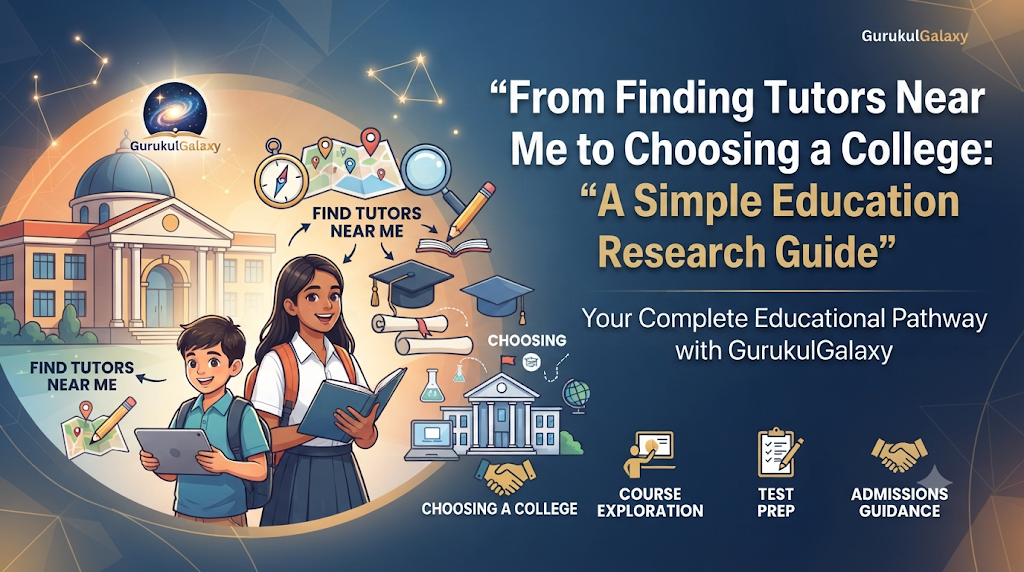
In this article, we will look at GurukulGalaxy, an education discovery platform, and understand what it covers. We will also go through a simple process for researching tutors, institutions, courses, and exams, along with common mistakes to avoid and a real-life example of how this research usually works.
What Is GurukulGalaxy?
GurukulGalaxy is an education discovery platform. In simple words, it is a place where different types of education-related information are brought together in one location.
The platform is built for many kinds of users, including students, parents, tutors, teachers, and anyone else who is trying to find or compare education options. Instead of looking in one place for tutors and another place for college information, users can search across different education categories on the same platform.
The main areas covered on GurukulGalaxy include:
- Tutors and gurus (teachers, mentors, and trainers)
- Schools, colleges, coaching institutes, and other institutions
- Courses offered by different institutions and professionals
- Exam guides for entrance exams, board exams, and other education-related exams
The platform allows users to search across these categories based on details like subject, location, and other relevant information.
Why Does GurukulGalaxy Matter for Education Research?
Education decisions usually involve more than one type of research. A student who has just finished Class 12 may need to look at colleges, compare courses, and also check competitive exams at the same time. A parent looking for extra academic support for their child may need to research tutors as well as coaching institutes in their area.
When these categories exist in separate places, research becomes slower. You might visit one page to check a tutor’s subject and experience, then open another tab to compare course details for a college, then search again for exam eligibility and dates.
Having tutors, institutions, courses, and exam information organised within one education discovery environment can make this research simpler. It does not mean the decision is made for you. It simply means the information you need is easier to locate and compare in one place.
This is not about one platform being better than another. It is about how organising education information by category can support the research process that most students and parents already go through.
What Can You Find on GurukulGalaxy?
Tutors and Gurus
GurukulGalaxy includes a guru directory where learners can look through profiles of teachers, tutors, mentors, and trainers. Users can typically look at details such as subject, teaching experience, type of teaching, city, and area of specialisation. This is useful for anyone who wants to see teaching profiles before deciding who might be a good fit for their learning needs.
Institutions
The platform also includes profiles of schools, colleges, coaching institutes, and other education institutions. Users can look through these profiles to understand what each institution offers and compare the available options based on their own requirements.
Courses
Course information is another part of the platform. Users can explore details such as course name, subject or field, learning format, duration, and the institution offering the course. This makes it possible to compare similar courses across different institutions before deciding which one matches your interest and goals.
Exam Guides
GurukulGalaxy also provides exam guides. These guides typically cover details such as eligibility criteria, exam pattern, important dates, and preparation-related information for entrance exams, board exams, and other education-related tests.
Finding Tutors Online
Many students today prefer to find tutors online instead of only searching within their immediate neighbourhood. When you want to find tutors online, it helps to be clear about a few things first: the subject you need help with, your current learning level, and whether you prefer one-on-one sessions or group classes.
Looking at a tutor’s experience and teaching background is useful before making a decision. Online tutoring also gives you the flexibility to consider tutors who are not necessarily based in your city, which widens your options.
Online Tutors in India
There are many online tutors in India covering subjects from school-level topics to competitive exam coaching to skill-based learning. When comparing online tutors, it helps to check what subject or exam they specialise in, how they conduct their classes, and whether their teaching style suits how you learn best.
Since online tutors can be based anywhere, students get access to a wider pool of subject experts than they might find locally.
Finding Tutors Near Me
Some students and parents still prefer in-person learning, which is why searching to find tutors near me remains common. In this case, location becomes an important factor, along with the tutor’s subject, experience, and availability for the days and times that work for you.
It is worth checking a tutor’s teaching approach and whether their schedule matches your requirements before committing to regular classes.
Coaching Institutes
Choosing between coaching institutes near me involves more than just checking which one is closest to home. Students should look at the subjects or exams the institute focuses on, the experience of the faculty, the batch size, the fee structure, and the class schedule.
When researching the best coaching institutes in India for a specific exam or subject, it helps to compare a few options rather than choosing the first one you come across. Checking details like study material, doubt-clearing support, and mock test facilities can also guide your decision.
College Search and Course Comparison
A college search in India usually starts with a subject or career interest. From there, students can look at which colleges offer the relevant course, what the eligibility requirements are, the course duration, and the fee structure.
To compare colleges and courses properly, it helps to look beyond just the college name. Checking the curriculum, the learning format, the location, and possible career paths after the course can give a clearer picture of whether a college and course are the right fit.
Competitive Exams
Competitive exams in India cover a wide range of fields, from engineering and medical entrance exams to management, government, and other professional exams. Each exam usually has its own eligibility criteria, exam pattern, and important dates.
Competitive exam preparation works best when students first understand the syllabus and exam pattern before jumping into practice questions. Many students look into competitive exams after 12th as their next step, which makes it important to research eligibility and exam dates early, rather than close to the application deadline.
How to Use Education Information for Better Research
Step 1: Identify Your Education Need
Start by being clear about what you are looking for. Is it a tutor for a specific subject, a coaching institute, a college and course, or information about a competitive exam? Each of these needs a slightly different type of research.
Step 2: Search Relevant Options
Once you know your need, search for options based on relevant details such as subject, location, course name, or exam name. Try to look at more than one option instead of settling on the first result.
Step 3: Check Important Details
Look closely at details that matter for your decision. For a tutor, this could be experience and teaching subject. For a college, it could be eligibility and course details. For an exam, it could be the pattern and important dates.
Step 4: Compare Suitable Options
Once you have gathered details on a few options, compare them side by side. This helps you see the differences clearly instead of relying on a general impression.
Step 5: Make an Informed Decision
After comparing your options, make your decision based on the information you have collected, rather than on assumptions or incomplete details.
Common Mistakes to Avoid
1. Choosing a tutor only because of low fees
A lower fee does not always mean the teaching quality matches your needs. Check the tutor’s subject knowledge and teaching experience as well.
2. Choosing a coaching institute only because it is nearby
Distance matters, but it should not be the only factor. Also check the faculty, study material, and past teaching focus of the institute.
3. Selecting a college without checking the course
A well-known college name does not guarantee that a specific course is strong there. Always check course details separately from the college’s overall reputation.
4. Ignoring eligibility requirements
Applying for a course or exam without confirming eligibility can waste time and effort. Always check this before moving forward.
5. Comparing only fees
Fees are important, but comparing only cost can lead to overlooking quality, faculty experience, or course content.
6. Depending only on advertisements
Advertisements often highlight only the positives. Try to look at actual course or institute details before deciding.
7. Starting exam preparation without understanding the syllabus
Jumping straight into practice questions without knowing the syllabus and exam pattern can lead to wasted preparation time.
Real-Life Example
Consider a student named Priya who has just completed Class 12 and is unsure about her next step. She is interested in commerce but is also considering a competitive exam for a professional course.
Priya first identifies her field of interest, which is commerce with an interest in finance. She then searches for colleges offering relevant courses in her preferred cities. While doing this, she also checks competitive exams related to commerce and finance fields to understand if they fit her plans.
She compares two or three colleges based on course structure, eligibility, and fees. At the same time, she looks into the exam pattern and important dates for the competitive exam she is considering. After gathering all this information, Priya discusses it with her parents and makes a decision based on the course details, eligibility, and exam timeline she has researched.
This example shows how tutors, courses, colleges, and exams often need to be researched together rather than one at a time.
Useful Comparison Tables
Table 1: What to Check Based on Your Education Need
| Education Need | What to Check |
|---|---|
| Tutor | Subject, experience, teaching location, availability |
| Coaching Institute | Subject/exam focus, faculty experience, fees, schedule |
| College | Course offered, eligibility, fees, location |
| Course | Duration, curriculum, learning format |
| Competitive Exam | Eligibility, exam pattern, important dates, preparation resources |
Table 2: Research Approach by User Type
| User Type | Common Research Focus |
|---|---|
| Student | Tutors, courses, exam preparation |
| Parent | Institutions, coaching institutes, tutor background |
| Learner (working professional) | Skill-based courses, online tutors |
| Tutor/Teacher | Institution profiles, course-related information |
Frequently Asked Questions
1. What is GurukulGalaxy?
GurukulGalaxy is an education discovery platform that brings together information on tutors, institutions, courses, and exams in one place.
2. Who can use GurukulGalaxy?
The platform is designed for students, parents, learners, tutors, teachers, and anyone researching education options.
3. How can students find tutors online?
Students can look through tutor profiles based on subject, teaching experience, and teaching format to find a suitable match.
4. Can students search for tutors by location?
Yes, location is one of the details users can consider when searching for tutors, along with subject and experience.
5. What should students check before choosing a coaching institute?
Students should check the subject or exam focus, faculty experience, fee structure, and class schedule before choosing a coaching institute.
6. How can students compare colleges and courses?
Students can compare colleges by looking at course details, eligibility criteria, fees, and location side by side.
7. What information is useful when researching competitive exams?
Useful information includes eligibility criteria, exam pattern, important dates, and preparation-related guidance.
8. What are competitive exams after 12th?
These are entrance exams that students can appear for after completing Class 12, often related to fields like engineering, medicine, commerce, or other professional courses.
9. How should students prepare for competitive exams?
Students should first understand the syllabus and exam pattern before starting focused preparation and practice.
10. What should students consider before choosing an education option?
Students should consider subject or course details, eligibility, location, fees, and how well the option matches their learning needs and goals.
Conclusion
Researching tutors, coaching institutes, colleges, courses, and competitive exams usually takes time, mainly because the information is often spread across different sources. Having these categories organised together, as seen on GurukulGalaxy, can make it a little easier to search and compare options in one place.
In this article, we looked at what an education discovery platform covers, including tutors and gurus, institutions, courses, and exam guides. We also went through a simple step-by-step approach for researching education options, common mistakes to avoid, and a real-life example of how this research typically comes together.
Whatever the education decision, taking time to research and compare available options remains one of the most useful steps a student or parent can take.

