
Introduction
Machine Learning is no longer just a research experiment. It has moved into the heart of business operations. However, moving a model from a laptop to a live production environment is very difficult. This is where MLOps comes in. It bridges the gap between data science and traditional operations. For a professional, mastering this field is the key to staying relevant.
This guide is designed to help you understand the path to becoming a Certified MLOps Professional. Whether you are an engineer in India or working globally, this certification provides the structure needed to handle machine learning at scale. It focuses on the practical side of managing models, ensuring they stay accurate and reliable over time.
What is Certified MLOps Professional
The Certified MLOps Professional is a specialized program focused on the lifecycle of machine learning. It is not just about writing code. It is about building a system that can deploy, monitor, and manage models automatically. This certification teaches you how to treat machine learning models like software, using the best practices of automation and continuous integration.
Why it matters today?
In the current market, companies are struggling with “model rot” and slow deployment cycles. A model that worked yesterday might fail today because of new data. MLOps matters because it provides the tools to catch these issues early. It ensures that businesses get real value from their AI investments. Without these skills, most AI projects never make it out of the testing phase.
Why Certified MLOps Professional certifications are important
A certification serves as a verified proof of your skills. It shows employers that you understand the complex intersection of data, code, and infrastructure. It provides a standard language for teams to communicate. Most importantly, it gives you a structured learning path so you don’t get lost in the vast world of AI tools.
Why choose AIOps School?
AIOps School is chosen by professionals because it focuses on the reality of the industry. The curriculum is built by experts who have spent decades managing large-scale systems. Instead of just theoretical knowledge, the focus is kept on what actually happens in a production environment. The training is updated frequently to match the changing landscape of AI and automation.
Certification Deep-Dive: Certified MLOps Professional
What is this certification?
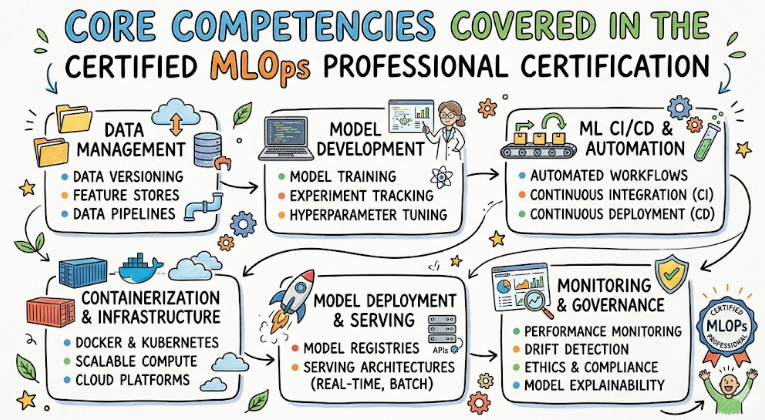
This is a professional-level credential that validates your ability to design and implement automated machine learning pipelines. It covers the entire journey from data ingestion to model monitoring in a live environment.
Who should take this certification?
This program is designed for Software Engineers, DevOps Professionals, Data Engineers, and Cloud Architects. It is also highly valuable for Engineering Managers who need to lead AI-driven teams.
Certification Overview Table
| Track | Level | Who it’s for | Prerequisites | Skills Covered | Recommended Order |
| MLOps | Professional | Engineers & Architects | Basic Cloud & Python | CI/CD for ML, Monitoring, Data Versioning | Core MLOps first |
Skills you will gain
- Automating the deployment of machine learning models.
- Implementing version control for both code and large datasets.
- Setting up real-time monitoring to detect model performance drop.
- Building scalable infrastructure using containers and orchestrators.
- Managing the security and compliance of AI systems.
Real-world projects you should be able to do
- Create a fully automated pipeline that retrains a model when new data arrives.
- Deploy a model as a scalable microservice using Kubernetes.
- Build a dashboard that alerts the team when a model starts giving biased results.
- Design a storage system that tracks every version of data used for training.
Preparation Plan
7–14 Days Plan (The Sprint)
Focus entirely on the core concepts of MLOps. Review the official documentation daily. Practice setting up a basic CI/CD pipeline for a small Python model. Memorize the key terminology and lifecycle stages.
30 Days Plan (The Standard)
The first two weeks should be spent on theory and cloud basics. The third week must be dedicated to hands-on labs involving data versioning. Use the final week for mock exams and reviewing complex monitoring scenarios.
60 Days Plan (The Deep Dive)
Spend the first month learning the integration between DevOps tools and ML frameworks. The second month should be focused on advanced topics like security, scaling, and cost optimization. Complete at least three full-scale projects during this time.
Common mistakes to avoid
- Ignoring the data side and focusing only on the code.
- Not practicing with real cloud environments.
- Skipping the monitoring and logging section.
- Underestimating the importance of security in AI.
Best next certification after this
- Same track: Certified AIOps Architect.
- Cross-track: Certified DevSecOps Professional.
- Leadership / management: Certified Engineering Manager.
Choose Your Learning Path
1. DevOps Path
This is best for those who already know automation but need to learn how ML models behave differently than standard code. It focuses on the “Continuous” part of the cycle.
2. DevSecOps Path
This path is ideal for security-minded engineers. It teaches how to keep models safe from attacks and how to ensure data privacy during the training process.
3. Site Reliability Engineering (SRE) Path
Best for those who care about uptime and performance. It focuses on how to keep machine learning services running at 99.9% availability.
4. AIOps / MLOps Path
This is the core path for AI enthusiasts. It covers the deep integration of artificial intelligence into the standard IT operations workflow.
5. DataOps Path
Best for engineers who love data pipelines. It focuses on how to deliver high-quality data to the machine learning models at the right time.
6. FinOps Path
Ideal for those who want to manage the high costs of AI. It teaches how to run machine learning models without breaking the company’s budget.
Role → Recommended Certifications Mapping
| Role | Recommended Certification |
| DevOps Engineer | Certified MLOps Professional |
| SRE | Certified AIOps Professional |
| Platform Engineer | Certified Kubernetes Professional |
| Cloud Engineer | Certified Cloud Ops Specialist |
| Security Engineer | Certified DevSecOps Professional |
| Data Engineer | Certified DataOps Professional |
| FinOps Practitioner | Certified FinOps Specialist |
| Engineering Manager | Certified Engineering Leadership |
Next Certifications to Take
Same-Track Certification
Data is the fuel for machine learning. This certification helps you master the flow of data so that your MLOps pipelines never run dry.
Cross-Track Certification
As models become more important, they become targets. Learning how to bake security into the pipeline is a natural next step for any MLOps expert.
Leadership-Focused Certification
For those moving into leadership, this certification teaches how to manage the people and the budgets behind complex technical projects.
Training & Certification Support Institutions
DevOpsSchool
This institution is known for its wide range of technical courses. They provide deep hands-on labs and help students understand the full lifecycle of software. Support is provided for those looking to transition into high-paying engineering roles.
Cotocus
This group focuses on specialized consulting and training. They work closely with corporate teams to upgrade their skills in modern cloud technologies. Their approach is very practical and project-oriented.
ScmGalaxy
A long-standing community and training platform for configuration management. They offer a wealth of free resources and structured programs for those interested in automation and supply chain security.
BestDevOps
This portal serves as a hub for the latest trends in the DevOps world. They provide clear guidance on which tools to learn and offer support for various professional certifications.
devsecopsschool.com
This site is dedicated to the intersection of security and operations. It is a great resource for learning how to automate security checks within a modern delivery pipeline.
sreschool.com
A specialized school for reliability engineering. It teaches how to manage large-scale systems and ensure they remain stable under heavy loads.
aiopsschool.com
The primary source for certifications like the Certified MLOps Professional. It bridges the gap between traditional IT operations and the new world of artificial intelligence.
dataopsschool.com
This institution focuses on the data lifecycle. It is essential for anyone who wants to learn how to manage data as a product with high quality and speed.
finopsschool.com
A dedicated platform for learning cloud financial management. It helps engineers understand the cost impact of their technical decisions and how to optimize them.
FAQs Section
1. What is the difficulty level of this program?
The level is considered moderate to advanced. It requires a good understanding of both software development and basic system administration.
2. How much time is required to complete the certification?
Most professionals find that 4 to 8 weeks of consistent study is enough to be fully prepared for the exam.
3. Are there any prerequisites?
There are no strict legal requirements, but having a basic knowledge of Python and cloud computing is highly recommended.
4. What is the best sequence for these certifications?
It is usually best to start with a standard DevOps or Cloud certification before moving into a specialized field like MLOps.
5. How much career value does this certification add?
It adds significant value, as MLOps is currently one of the highest-paying roles in the technology sector globally.
6. Which job roles can I apply for?
You can apply for roles like MLOps Engineer, ML Infrastructure Engineer, or Senior DevOps Architect.
7. Is the exam conducted online?
Yes, the certification process is handled through a secure online platform.
8. Does the certification expire?
Most professional certifications require a renewal or continuing education after a period of two to three years.
9. Will this help me get a job in India?
Yes, the Indian market has a high demand for MLOps skills as more companies move their AI projects into production.
10. Do I need to be a Data Scientist?
No, this is an operations and engineering role. You need to understand how to manage models, not necessarily how to build the math inside them.
11. Is there a community for support?
Yes, the provider offers access to a community of learners and experts who share knowledge.
12. Can an Engineering Manager benefit from this?
Absolutely. It helps managers understand the timelines and technical hurdles involved in AI projects.
Additional FAQs: Certified MLOps Professional
1. How does this certification differ from a standard Data Science course?
This program focuses on the engineering and “plumbing” of AI systems rather than the statistical modeling side.
2. What tools are covered in the curriculum?
The curriculum covers tools for versioning, containerization, monitoring, and automated deployment pipelines.
3. Is hands-on experience included?
The certification path strongly encourages and tests your ability to handle real-world scenarios through practical examples.
4. Can I take the exam without training?
If you have years of direct MLOps experience, you may attempt it, but the training is recommended to cover all the specific domains.
5. What is the passing score?
The passing criteria are set to ensure that only those with a high level of competency receive the credential.
6. Does it cover multi-cloud environments?
Yes, the principles taught are designed to work across different cloud providers like AWS, Azure, and Google Cloud.
7. How do I verify my certification after passing?
A digital certificate and a verification link are provided by aiopsschool.com for use on resumes and LinkedIn.
8. Is there a focus on ethical AI?
Yes, the monitoring and compliance sections touch upon the importance of fairness and transparency in automated models.
Testimonials
- Aman: The clarity I gained regarding model versioning was amazing. I can now manage our production models with much higher confidence than before
- Sarah: This certification helped me bridge the gap between our data science team and my SRE team. We finally speak the same language.
- Vikram: I was able to implement a full CI/CD pipeline for our machine learning projects within a month of completing the course. The skill improvement is real.
- Janet: As a security engineer, learning how to protect our AI assets was a game changer for my career. It gave me a very clear path forward.
- Marcus: My confidence in leading AI-driven projects has grown immensely. I now understand the technical risks and how to manage them effectively.
Conclusion
The pursuit of the Certified MLOps Professional credential serves as a transformative milestone for technical experts aiming to command leadership roles within the rapidly shifting landscape of modern technology. As artificial intelligence moves from experimental phases into the core of global business operations, the industry is witnessing an urgent and massive demand for proficient engineers who possess the specialized knowledge required to build, deploy, and maintain these complex systems at scale. By committing to a rigorous and structured learning curriculum, you are not merely acquiring a new set of skills, but are strategically insulating your career against the fluctuations of the job market and ensuring your relevance in a future dominated by automated intelligence. This certification acts as a bridge between traditional software engineering and the sophisticated world of data science, providing you with the technical authority to manage model lifecycles, optimize cloud infrastructure, and ensure system reliability. Ultimately, making the decision to engage in this high-level strategic planning today will pave the way for a more stable, prestigious, and financially rewarding professional journey for many years to come.

