
Introduction
Data-driven decisions are considered the backbone of modern enterprise success. However, the gap between data collection and actionable insights is often found to be wide. To bridge this gap, the principles of DataOps are being adopted by leading organizations globally. Among the various professional paths, the CDOA – Certified DataOps Architect program is recognized as a premier standard for those who wish to master the orchestration of data flows.
Understanding CDOA – Certified DataOps Architect
The CDOA – Certified DataOps Architect is a professional designation designed for experts who oversee the design and management of data pipelines. It is focused on the integration of automated data delivery with agile development practices. By obtaining this certification, a deep understanding of how to reduce the cycle time of data analytics is demonstrated. The architecture of data systems is handled in a way that ensures high quality and continuous reliability.
Why DataOps Matters in the Modern Industry?
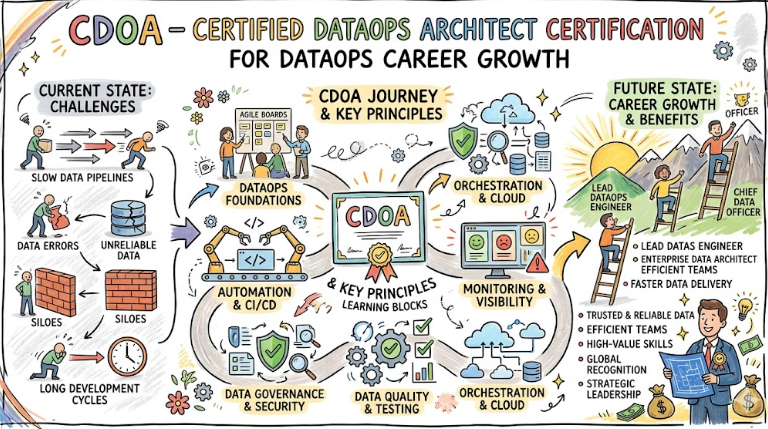
In many traditional setups, data silos are frequently encountered, leading to delays and inaccuracies. DataOps is utilized to bring a cultural and technical shift, similar to how DevOps transformed software development.
- Speed of Insight: Rapid delivery of data is enabled through automation.
- Data Quality: Constant monitoring is applied to ensure data remains trustworthy.
- Collaboration: The walls between data engineers, data scientists, and operations are broken down.
- Scalability: Complex data environments are managed with greater ease using architected frameworks.
The Importance of CDOA – Certified DataOps Architect Certifications
The demand for skilled architects who can handle complex data landscapes is seen to be rising. Certifications like the CDOA are considered vital for several reasons:
- Standardized Knowledge: A common language and methodology are provided for teams.
- Professional Validation: Skills in data orchestration are formally recognized by industry leaders.
- Career Advancement: New doors are opened for high-level roles in engineering management and platform architecture.
- Global Recognition: The standards taught are applicable in both Indian and international markets.
Why Choose DataOpsSchool?
When professional growth is sought, the choice of a training provider is crucial. DataOpsSchool is chosen by many for the following reasons:
- Industry-Aligned Curriculum: The courses are designed based on current market needs and real-world challenges.
- Expert Mentorship: Guidance is provided by professionals who possess extensive experience in data ecosystems.
- Practical Focus: Theoretical knowledge is balanced with hands-on labs and project-based learning.
- Comprehensive Resources: A wide range of study materials and community support is offered to every learner.
Certification Deep-Dive: CDOA – Certified DataOps Architect
What is this certification?
The CDOA is an advanced-level program where the focus is placed on designing, building, and maintaining automated data architectures. It is intended to validate the ability to implement DataOps methodologies across an entire organization.
Who should take this certification?
This path is ideal for Data Engineers, Cloud Architects, DevOps Professionals, and Engineering Managers who are responsible for data lifecycle management and pipeline efficiency.
Certification Overview Table
| Track | Level | Who it’s for | Prerequisites | Skills Covered | Recommended Order |
| DataOps Foundation | Associate | Beginners in Data | Basic IT knowledge | Core DataOps concepts | 1 |
| DataOps Professional | Professional | Data Engineers | Foundation Cert | Pipeline automation | 2 |
| DataOps Expert | Expert | Senior Engineers | Professional Cert | Orchestration & Tools | 3 |
| CDOA Architect | Architect | Solution Architects | Expert level skills | Enterprise Architecture | 4 |
| DataOps Leader | Management | Team Leads | Experience in Ops | Strategy & Governance | 5 |
Skills You Will Gain
- Pipeline Automation: Automated workflows for data movement are created.
- Data Orchestration: Complex sequences of data tasks are managed efficiently.
- Quality Control: Automated testing is implemented within data pipelines.
- CI/CD for Data: Continuous integration and delivery practices are applied to data sets.
- Monitoring & Alerting: Observability is established across the data lifecycle.
- Governance: Security and compliance standards are integrated into the architecture.
Real-World Projects Post-Certification
- End-to-End Pipeline Design: A fully automated data ingestion system is built from scratch.
- Data Lake Management: Large-scale storage solutions are architected for high performance.
- Automated Quality Framework: A system is developed to detect and fix data errors automatically.
- Cloud Migration Strategy: Legacy data systems are successfully moved to modern cloud environments.
- SLA Optimization: Data delivery times are significantly reduced to meet business agreements.
Preparation Plan
7–14 Days Plan (The Intensive Review)
- The official exam objectives are reviewed daily.
- Foundational concepts of DataOps are refreshed.
- Practice questions are solved to identify weak areas.
30 Days Plan (The Balanced Approach)
- Week 1: Core principles and the DataOps manifesto are studied.
- Week 2: Technical tools and orchestration methods are explored.
- Week 3: Real-world case studies and architecture patterns are analyzed.
- Week 4: Mock exams are taken and final revisions are completed.
60 Days Plan (The Deep Dive)
- Month 1: Theoretical concepts and toolsets are mastered through hands-on practice.
- Month 2: Complex architecture scenarios are simulated, and advanced troubleshooting is practiced.
Common Mistakes to Avoid
- Ignoring the Culture: It is often forgotten that DataOps is as much about people as it is about tools.
- Skipping Foundations: Advanced tools are sometimes used without a solid understanding of the underlying principles.
- Lack of Practice: Theoretical knowledge is prioritized over practical, hands-on lab work.
- Ignoring Monitoring: The importance of observability in the data pipeline is frequently overlooked.
Best Next Certification After This
- Same Track: DataOps Leader Certification.
- Cross-Track: Certified DevSecOps Professional.
- Leadership / Management: Engineering Management Professional.
Choose Your Learning Path
1. DevOps Path
This path is chosen by those moving from software operations to data operations. The focus is placed on extending CI/CD practices to data environments.
2. DevSecOps Path
Security is integrated into every stage of the data lifecycle. This path is ideal for professionals focused on data privacy and compliance.
3. Site Reliability Engineering (SRE) Path
Reliability and uptime of data platforms are prioritized. Error budgets and monitoring for data systems are mastered here.
4. AIOps / MLOps Path
Data pipelines are architected specifically to support machine learning models and artificial intelligence workflows.
5. DataOps Path
The primary focus remains on the efficiency, quality, and speed of data delivery within the organization.
6. FinOps Path
Cost optimization of data infrastructure in the cloud is studied. This path ensures that data operations remain financially sustainable.
Role → Recommended Certifications Mapping
| Role | Recommended Certification | Key Benefit |
| DevOps Engineer | DataOps Professional | Skills in data automation are added. |
| SRE | Certified AIOps Engineer | Monitoring and automation are enhanced. |
| Platform Engineer | CDOA Architect | Enterprise data platforms are mastered. |
| Cloud Engineer | Cloud Data Specialist | Cloud-native data tools are understood. |
| Security Engineer | DevSecOps Architect | Data security is fortified. |
| Data Engineer | CDOA Architect | Professional growth to architecture level. |
| FinOps Practitioner | FinOps Professional | Data cloud costs are controlled. |
| Engineering Manager | DataOps Leader | Strategic data oversight is gained. |
Next Certifications to Take
Same-Track Certification
The DataOps Leader program is recommended for those who have completed the architect level. Strategic planning and team management skills are developed in this course.
Cross-Track Certification
A transition into AIOps is often seen as a logical step. The integration of AI into operational workflows is explored to further enhance system intelligence.
Leadership-Focused Certification
An Engineering Management certification is suggested for those moving into executive roles. The focus is shifted from technical execution to organizational leadership and business value.
Training & Certification Support Institutions
DevOpsSchool
Extensive training programs in DevOps and related technologies are provided here. A hands-on approach is maintained to ensure that learners are industry-ready.
Cotocus
A wide range of technical certifications and corporate training solutions are offered. The curriculum is regularly updated to reflect the latest industry trends.
ScmGalaxy
This community-driven platform is recognized for its deep technical resources and certification support. A focus on software configuration and operations is maintained.
BestDevOps
Specialized training in automation and cloud technologies is delivered. The needs of working professionals are prioritized through flexible learning schedules.
devsecopsschool.com
A dedicated focus on the intersection of security and operations is provided. The skills needed to protect modern software pipelines are taught here.
sreschool.com
Reliability engineering principles are the core focus of this institution. Systems are taught to be scalable, reliable, and efficient.
aiopsschool.com
The application of artificial intelligence to IT operations is explored. Advanced automation techniques are mastered by students here.
dataopsschool.com
This is the primary destination for everything related to DataOps. A comprehensive learning path from foundation to architect level is provided.
finopsschool.com
The financial management of cloud resources is taught. Tools and strategies to reduce cloud waste are provided to practitioners.
FAQs Section
1. What is the difficulty level of the CDOA exam?
The exam is considered to be of an intermediate to advanced level. A solid grasp of both data engineering and operational principles is required.
2. How much time is required for preparation?
Approximately 30 to 60 days are usually spent by most candidates, depending on their existing background in data systems.
3. Are there any strict prerequisites for CDOA?
While not mandatory for all, a basic understanding of cloud infrastructure and data pipelines is highly recommended.
4. What is the recommended certification sequence?
The Foundation level is typically cleared first, followed by Professional and Expert tracks before the Architect level is attempted.
5. How is the career value of this certification measured?
Value is seen through increased salary potential and access to high-level roles in data-driven organizations.
6. Which job roles are most suited for CDOA holders?
Roles such as Data Architect, Lead Data Engineer, and Platform Architect are commonly filled by certified professionals.
7. Is the certification recognized globally?
Yes, the standards are aligned with global industry practices and are recognized by multinational corporations.
8. How long does the certification remain valid?
The certification is typically valid for two to three years, after which renewal or advanced certification is encouraged.
9. Can an Engineering Manager benefit from CDOA?
Yes, technical oversight and better decision-making capabilities are gained by managers through this program.
10. Are practical labs included in the training?
Extensive hands-on labs are provided by support institutions like DataOpsSchool to ensure practical mastery.
11. Does this certification help in cloud migration projects?
The skills gained are directly applied to architecting and moving data pipelines to cloud environments.
12. What is the growth prospect for DataOps professionals?
The field is expected to grow significantly as more companies prioritize data-driven operations over traditional methods.
CDOA – Certified DataOps Architect Specific FAQs
1. What makes the CDOA different from standard Data Engineering certs?
The focus is placed on the “Ops” part—automation, orchestration, and continuous delivery—rather than just data transformation.
2. Is coding required for the CDOA certification?
A basic understanding of scripting and automation tools is found to be necessary for the practical sections.
3. How does CDOA integrate with Agile methodologies?
Agile principles are applied to data workflows to ensure faster feedback loops and iterative improvements.
4. Can this certification be completed online?
Yes, both the training and the examination are offered in an online format for global accessibility.
5. Are real-world case studies part of the curriculum?
Multiple case studies from various industries are analyzed to provide a broad perspective on data challenges.
6. Is there a community for CDOA certified professionals?
An active alumni network is maintained by DataOpsSchool for ongoing networking and support.
7. How does CDOA address data security?
Security-by-design is taught as a fundamental part of the data architecture process.
8. What tools are typically covered in the CDOA path?
A variety of orchestration, monitoring, and pipeline tools are explored within the training modules.
Testimonials
Aarav
A complete shift in my understanding of data pipelines was experienced. The CDOA program provided the clarity needed to handle complex enterprise architectures with confidence.
Deepika
The focus on real-world application was found to be incredibly helpful. Automation skills were gained that were immediately applied to my current projects.
Rohan
Career growth was accelerated after completing this certification. The transition from a developer role to an architect position was made much smoother.
Meera
The curriculum at DataOpsSchool was found to be very comprehensive. Complex concepts were explained in a way that was easy to grasp and implement.
Vikram
New levels of efficiency were achieved by my team after the principles of DataOps were implemented. This certification is highly recommended for any engineering lead.
Conclusion
The importance of the CDOA – Certified DataOps Architect certification cannot be in today’s data-heavy environment. As organizations strive for faster and more reliable data insights, the role of the architect becomes central to success. Long-term career benefits, including higher roles and global opportunities, are achieved through strategic learning. By choosing a path with DataOpsSchool, a solid foundation is built for a future where data and operations are perfectly synchronized. Strategic planning and professional certification are encouraged for anyone looking to lead in the next era of data engineering.

