
Introduction
The landscape of IT operations is being transformed by the integration of artificial intelligence and machine learning. As systems become more complex, traditional methods of monitoring and troubleshooting are found to be insufficient. It is observed that manual intervention can no longer keep up with the massive amounts of data generated by modern cloud environments. This is where AIOps, or Artificial Intelligence for IT Operations, becomes essential.
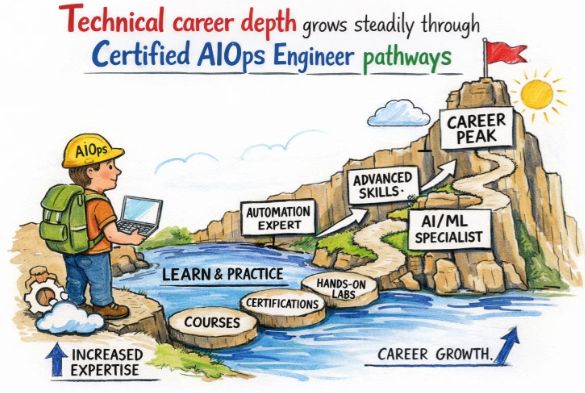
A shift is being seen in how engineers manage infrastructure. Instead of reacting to problems after they occur, predictive measures are now being taken. This guide is designed to provide a clear understanding of the Certified AIOps Engineer path. It is intended for those who wish to stay ahead in the competitive field of software engineering and operations. By the end of this guide, a clear roadmap for achieving mastery in this domain will be understood.
What is Certified AIOps Engineer?
A Certified AIOps Engineer is a professional who has been trained to apply AI and machine learning to IT operations. In this role, data is collected from various sources within an infrastructure and analyzed using advanced algorithms. The primary goal is to automate the identification and resolution of issues. It is not just about writing code; it is about building systems that can learn and adapt.
The certification validates that a person has the skills to manage automated systems effectively. Knowledge of data science, big data, and traditional DevOps is combined in this program. It is recognized as a high-level credential that sets a professional apart in the global market. The focus is placed on using intelligent tools to reduce downtime and improve system reliability.
Why it matters today?
The volume of logs, metrics, and traces produced by modern applications is overwhelming. It is widely acknowledged that human teams struggle to find the “needle in a haystack” when a critical system failure occurs. Alert fatigue is a common problem where too many notifications are sent to engineers, causing important issues to be missed.
AIOps matters because it provides the “brain” for the infrastructure. Automation is no longer a luxury; it is a necessity for survival in the digital age. Decisions are made faster when they are backed by data-driven insights. Businesses in India and across the world are looking for ways to reduce operational costs while increasing uptime. Professionals who understand how to implement these intelligent systems are in high demand.
Why Certified AIOps Engineer certifications are important?
Validation of expertise is crucial in a rapidly evolving tech industry. A certification serves as proof that a certain standard of knowledge has been met. It is often used by hiring managers to filter candidates for senior-level positions. Without a formal certification, it can be difficult to demonstrate one’s ability to handle complex AI-driven environments.
Furthermore, the structured learning provided by a certification program ensures that no gaps are left in an engineer’s knowledge. Practical skills are tested, and real-world scenarios are explored. It is also observed that certified professionals often command higher salaries and better job titles. In a market where competition is fierce, having a specialized credential like the Certified AIOps Engineer is a significant advantage.
Why choose AIOps School?
When a platform for learning is chosen, the quality of the curriculum must be considered. AIOps School is selected by many because it focuses specifically on the intersection of AI and IT operations. Unlike general platforms, the content here is tailored for the needs of modern SREs and DevOps engineers.
The labs provided are designed to simulate real production environments. It is ensured that every student gets hands-on experience with the tools used in the industry. The instructors are experienced professionals who have dealt with large-scale system challenges. By choosing AIOps School, a commitment is made to a high-quality, specialized education that directly translates to workplace success.
Certification Deep-Dive
What is this certification?
This certification is an advanced program that teaches the application of machine learning algorithms to IT operational data. It focuses on automating incident management, root cause analysis, and performance monitoring through intelligent systems.
Who should take this certification?
This program is designed for Software Engineers, DevOps Engineers, SREs, and IT Managers. It is also highly beneficial for anyone involved in cloud architecture or system administration who wants to move into AI-driven automation.
Certification Overview Table
| Track | Level | Who it’s for | Prerequisites | Skills Covered | Recommended Order |
| DevOps | Intermediate | DevOps Engineers | Basic Linux & Scripting | CI/CD, Infrastructure as Code | 1 |
| DevSecOps | Advanced | Security Engineers | DevOps Knowledge | Security Automation, Compliance | 2 |
| SRE | Advanced | Site Reliability Engineers | System Admin Experience | Error Budgets, SLOs, Monitoring | 3 |
| AIOps/MLOps | Expert | SREs & Data Engineers | SRE or DevOps background | ML Algorithms, Data Pipelines | 4 |
| DataOps | Advanced | Data Engineers | SQL & Cloud Basics | Data Governance, Orchestration | 5 |
| FinOps | Intermediate | Cloud Architects | Cloud Cost Management | Cost Optimization, Forecasting | 6 |
Skills you will gain
- Pattern Recognition: The ability to identify recurring issues in large datasets is developed.
- Anomaly Detection: Automated systems are built to find unusual behavior in system metrics.
- Root Cause Analysis: Tools are used to automatically find the source of a system failure.
- Predictive Maintenance: Knowledge of how to predict failures before they happen is gained.
- Data Orchestration: Complex data pipelines for operational monitoring are managed.
- ML Model Management: Small-scale machine learning models for IT tasks are deployed and maintained.
Real-world projects you should be able to do
After getting certified, the following projects can be handled:
- Automated Incident Response: A system is created where low-level incidents are resolved without human help.
- Intelligent Alerting System: Noise is reduced by grouping related alerts into a single incident.
- Capacity Planning with AI: Future infrastructure needs are predicted based on historical usage patterns.
- Log Clustering: Millions of log lines are grouped into manageable categories for faster analysis.
- Performance Bottleneck Identification: AI tools are used to pinpoint exactly where an application is slowing down.
Preparation plan
7–14 Days Plan (Express Path)
This path is intended for those who already have a strong background in SRE and basic machine learning. Most of the time is spent on reviewing exam objectives and taking practice tests. The focus is placed on understanding the specific tools mentioned in the curriculum.
30 Days Plan (Standard Path)
In this plan, two hours are dedicated every day to study. The first two weeks are used to understand the theoretical concepts of AIOps. The remaining two weeks are spent on hands-on labs and building small automation scripts.
60 Days Plan (Comprehensive Path)
This is recommended for those who are new to the world of AI. The first month is spent learning the basics of data analysis and machine learning. The second month is used to apply these concepts to IT operations and infrastructure management.
Common mistakes to avoid
- Ignoring Data Quality: It is often forgotten that AI is only as good as the data provided to it.
- Overcomplicating Models: Simple scripts are sometimes more effective than complex ML models.
- Lack of Practical Practice: Too much time is spent on theory without enough hands-on lab work.
- Skipping Prerequisites: Attempting AIOps without a solid understanding of DevOps or SRE concepts is not advised.
- Ignoring Business Context: Automation is implemented without understanding how it affects the actual business goals.
Best next certification after this
Same Track
The MLOps Professional certification is considered the best next step. It allows for a deeper dive into the lifecycle of machine learning models.
Cross-Track
Certified FinOps Practitioner is recommended. It helps in understanding the cost implications of the automated systems that have been built.
Leadership / Management
Engineering Management for SRE is a great choice. It prepares a professional to lead teams that are implementing these advanced technologies.
Choose Your Learning Path
1. DevOps Path
This path is best for engineers who focus on the software delivery lifecycle. It starts with automation of builds and deployments and ends with intelligent monitoring.
2. DevSecOps Path
This is intended for security-focused professionals. The goal is to use AI to detect threats and vulnerabilities in the code and the cloud environment automatically.
3. Site Reliability Engineering (SRE) Path
This path is best for those responsible for system uptime. AI is used to manage error budgets and ensure that service level objectives are met consistently.
4. AIOps / MLOps Path
This is the most technical path. It is designed for engineers who want to specialize in building and maintaining the AI models that run the infrastructure.
5. DataOps Path
This is best for data engineers. The focus is on the reliability and quality of data pipelines that feed into the AI systems.
6. FinOps Path
This is intended for those who want to manage the financial side of the cloud. AI is used to forecast spending and find areas where money can be saved.
Role → Recommended Certifications Mapping
| Current Role | Recommended Certification | Key Benefit |
| DevOps Engineer | Certified AIOps Engineer | Better automation and less manual work. |
| Site Reliability Engineer | Certified SRE Professional | Mastery of reliability metrics and tools. |
| Platform Engineer | Certified Cloud Architect | Understanding of underlying cloud structures. |
| Cloud Engineer | Certified AIOps Engineer | Intelligent management of cloud resources. |
| Security Engineer | Certified DevSecOps Professional | Automation of security compliance checks. |
| Data Engineer | Certified DataOps Professional | Improved data pipeline reliability. |
| FinOps Practitioner | Certified FinOps Guide | Better cost forecasting and visibility. |
| Engineering Manager | Leadership in DevOps | Improved team efficiency and strategy. |
Next Certifications to Take
One same-track certification
Deepening the knowledge within the AIOps domain is suggested. A specialized course in MLOps is often pursued. This ensures that the technical skills required for model deployment are fully mastered.
One cross-track certification
Broadening the skill set by taking a FinOps course is highly recommended. It is important to understand how much the AI infrastructure costs the business. This cross-training makes an engineer more valuable to the organization.
One leadership-focused certification
Moving into management is facilitated by taking a leadership course for engineering managers. It helps in understanding how to lead a team through a digital transformation. Communication and strategic planning skills are developed here.
Training & Certification Support Institutions
DevOpsSchool
A wide range of training programs for all levels of engineers is provided here. It is known for its extensive library of technical content and expert-led sessions. Many professionals start their journey with their foundation courses.
Cotocus
Specialized training for enterprise teams is offered by this institution. The focus is placed on real-world applications and practical projects. It is a preferred choice for companies looking to upskill their entire engineering department.
ScmGalaxy
A community-driven platform that provides a wealth of resources for DevOps and SRE. It is recognized for its blogs, forums, and hands-on workshops. It is a great place to stay updated with the latest industry trends.
BestDevOps
Detailed training paths for various specialized roles are provided. It is known for its clear and simple teaching methods. The courses are designed to be beginner-friendly while still being valuable for seniors.
devsecopsschool.com
This institution focuses entirely on the security aspect of the DevOps lifecycle. Courses are offered on how to integrate security tools into the CI/CD pipeline. It is a top choice for those moving into the DevSecOps space.
sreschool.com
Everything related to Site Reliability Engineering is taught here. The curriculum is focused on reliability, scalability, and performance. It is ideal for engineers who are responsible for large-scale production environments.
aiopsschool.com
As the primary provider for the AIOps certification, this site offers the most relevant and up-to-date content. It is dedicated to the field of AI-driven operations. All aspects of the AIOps lifecycle are covered in detail.
dataopsschool.com
The focus is placed on the management and orchestration of data pipelines. It is a great resource for data engineers who want to apply DevOps principles to their work. Training is provided on data quality and governance.
finopsschool.com
This school is dedicated to the practice of cloud financial management. It teaches how to bring financial accountability to the variable spend model of the cloud. It is essential for anyone managing large cloud budgets.
FAQs Section
- How difficult is the Certified AIOps Engineer exam?
The difficulty level is considered advanced. A strong foundation in IT operations and a basic understanding of data science is required to pass. - How much time is required to prepare?
It depends on the experience level, but usually, 30 to 60 days are sufficient for a thorough preparation. - What are the prerequisites for this certification?
There are no strict prerequisites, but knowledge of Linux, scripting, and basic DevOps tools is highly recommended. - What is the recommended certification sequence?
It is suggested to start with DevOps, move to SRE, and then take the Certified AIOps Engineer certification. - Is there career value in becoming an AIOps Engineer?
Yes, the career value is very high as companies are looking for ways to automate complex tasks using AI. - What job roles can I apply for after this?
Roles such as AIOps Engineer, Senior SRE, Automation Architect, and MLOps Engineer can be pursued. - Does this certification help in salary growth?
It is observed that professionals with specialized certifications in AI and operations often see a significant increase in their compensation. - Is the exam conducted online?
Yes, the exam is usually conducted through an online proctored platform. - How long is the certification valid?
The certification is typically valid for two years, after which a renewal or advanced course might be needed. - Are there any hands-on labs in the training?
Yes, extensive hands-on labs are included to ensure that practical skills are mastered. - Can an Engineering Manager take this course?
Yes, it is very beneficial for managers to understand the technical capabilities of the teams they lead. - Is this certification recognized globally?
Yes, it is recognized by many global organizations and is valued in the Indian market as well.
Certified AIOps Engineer Specific FAQs
- What specific AI concepts are covered?
Concepts like regression, clustering, and neural networks are covered in the context of IT data. - Is coding knowledge required?
Basic knowledge of Python or similar scripting languages is very helpful for the automation parts. - Which monitoring tools are discussed?
The training covers how to integrate AI with popular tools like Prometheus, ELK stack, and Grafana. - How does AIOps differ from traditional DevOps?
AIOps adds a layer of intelligence and predictive analysis to the standard automation found in DevOps. - Can I take this exam without prior ML experience?
Yes, but extra time should be spent learning the basic concepts of machine learning during the preparation. - Are there practice exams available?
Yes, practice tests are provided by AIOps School to help students prepare for the actual exam. - What kind of data is analyzed in AIOps?
Metrics, logs, traces, and incident tickets are the primary data sources analyzed. - How does AIOps improve SRE practices?
It helps SREs by automating root cause analysis and reducing the time taken to resolve incidents (MTTR).
Testimonials
Aditi
A much better understanding of how AI fits into my daily work was gained. The career clarity I now have is amazing, and I feel much more confident in my role.
Arjun
The real-world application of the labs was very impressive. Complex automation tasks are now handled with ease, and my technical skills have improved significantly.
Sana
This program provided the confidence needed to lead our new automation project. The concepts are explained simply, and the focus on practical skills is very helpful.
Vihaan
A lot of value was found in the structured learning path. The transition from a traditional role to an AI-driven one was made much smoother by this certification.
Kiara
The training helped me see the big picture of infrastructure management. My ability to predict system issues has improved, and I am now seen as a domain expert in my team.
Conclusion
The Certified AIOps Engineer certification is a powerful tool for any technical professional. As the industry moves toward more intelligent systems, the need for skilled engineers who can manage them will only grow. A significant investment in one’s career is made when this path is chosen.
the career include better job security, higher pay, and the ability to work on cutting-edge technology. It is encouraged that a strategic learning plan be made today. By following the roadmap provided in this guide, a successful transition into the world of AI-driven operations can be achieved.

