
Introduction
In the modern enterprise, the “plumbing” of the digital ecosystem is no longer a background task—it is the strategic engine driving every successful product launch and reliable customer experience. DevOps engineers, SREs, and platform architects have become the essential architects of this infrastructure, and because their work sits directly at the intersection of business continuity and rapid innovation, their market value has surged to become one of the most competitive compensation tiers in the technology sector. However, the true path to a high-earning career isn’t found in a single, static salary figure, but rather in the intricate equation of technical mastery, specialized cloud expertise, and the ability to solve complex, high-stakes operational problems. By understanding how these variables—ranging from container orchestration and security automation to regional market demand—interact to define your total compensation, you can shift your professional trajectory from chasing standard paychecks to commanding your true market worth in an evolving global landscape.
What Does “DevOps Salary” Mean?
When you see a job posting or a salary survey, the number quoted is rarely the full picture. A “DevOps salary” is essentially your Total Compensation (TC), which is the sum of various financial rewards offered by an employer. Relying solely on the base salary figure can be misleading, as high-performing roles often include significant bonuses and equity packages that can increase your annual take-home pay by 20% to 50%.
Key Components of DevOps Compensation:
- Base Salary: The fixed, guaranteed amount paid regularly, regardless of company performance.
- Performance Bonuses: Annual or quarterly payouts contingent on meeting personal, team, or company-wide KPIs.
- Equity/Stock Options (RSUs): Common in tech companies, these represent ownership in the firm and can become highly valuable over time.
- Sign-on Bonuses: One-time payments offered to attract experienced talent or to compensate for unvested equity left behind at a previous job.
- Benefits & Perks: Remote work stipends, certification exam reimbursements, health insurance, and learning budgets that indirectly increase your net worth.
DevOps Salary Overview
Globally, the DevOps pay scale remains one of the most competitive in the IT industry. This high compensation reflects the complexity of the work: DevOps engineers manage the infrastructure that powers critical services, meaning their impact on company uptime and revenue is direct and measurable.
Key Highlights:
- Premium for Skill: Professionals with specialized knowledge in Kubernetes and security automation consistently command the highest pay brackets.
- Cloud Dominance: Organizations moving to multi-cloud environments are willing to pay a premium for engineers who can manage complexity without compromising security.
- Continuous Growth: Even during economic fluctuations, the demand for SRE and Platform Engineering roles remains robust, keeping salary floors high.
Table 1 – DevOps Salary by Experience Level
| Experience Level | Average Base Salary | Typical Range | Typical Responsibilities |
| Entry-Level / Junior | $75,000 – $95,000 | $65k – $110k | Scripting, basic CI/CD, monitoring, Git |
| Mid-Level Engineer | $105,000 – $135,000 | $95k – $150k | Infrastructure as Code (IaC), Docker, Cloud |
| Senior DevOps | $145,000 – $180,000 | $130k – $210k | Architecture, Kubernetes, security, mentoring |
| Lead / Principal | $190,000 – $250,000+ | $180k – $300k+ | Strategy, multi-cloud design, team leadership |
| SRE / Platform Lead | $170,000 – $240,000 | $160k – $280k+ | Scalability, reliability, observability, automation |
Factors That Influence DevOps Salary
Compensation in this field is rarely arbitrary. It is a calculated reflection of the value you bring to the organization. Employers assess your salary based on several core pillars that define your professional leverage.
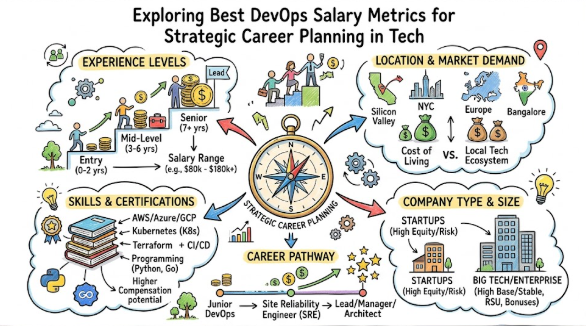
- Geographic Region: Your location often dictates the local “market rate” based on cost of living, local competition, and the concentration of tech hubs.
- Company Size & Maturity: Startups might offer higher equity, while large enterprises or FAANG-equivalent companies often provide higher base salaries and more stable bonus structures.
- Cloud Expertise: Mastering a specific cloud (AWS, Azure, or GCP) is essential, but proficiency in architecting cost-effective solutions for those clouds is what triggers the highest salary tiers.
- Container Orchestration: Expertise in Kubernetes (K8s) is currently one of the most reliable drivers of higher pay, as it is complex to manage and critical for modern scaling.
- Security Integration (DevSecOps): A candidate who can automate security patches and compliance checks is significantly more valuable than one who only manages deployment.
- Operational Excellence: Experience with observability (Prometheus, Grafana, ELK) and incident response (SRE principles) drastically increases your value, as these skills directly minimize downtime risk.
Regional Salary Comparisons
While the internet allows for global collaboration, your salary is frequently anchored to the regional market in which your employer operates. Markets like the US and Australia generally offer higher base salaries but come with higher costs of living, whereas other regions may offer different balances of compensation and lifestyle.
Regional Dynamics:
- United States: Continues to lead with the highest overall compensation, particularly in hubs like San Francisco, Seattle, and New York.
- Europe (UK, Germany, Netherlands): Salaries are often slightly lower than in the US but are frequently supplemented by stronger social benefits, vacation time, and job security.
- India: Seeing explosive growth, with top-tier product companies paying salaries comparable to global standards for senior and specialized roles.
- Middle East: A rapidly maturing market where experienced DevOps architects are in high demand, often with tax-efficient packages.
Table 2 – DevOps Salary Comparison by Region
| Region | Avg. Salary (USD) | Cost of Living Adj. | Key Demand Skills |
| USA | $140,000+ | Very High | Multi-cloud, K8s, AI/MLOps |
| Canada | $105,000 | Moderate | AWS, Azure, CI/CD |
| UK/Europe | $90,000 – $115,000 | Moderate/High | Security, Compliance, Cloud |
| India | $30,000 – $60,000 | Low | Jenkins, Docker, Terraform |
| Australia | $110,000 – $135,000 | High | Cloud Migrations, SRE |
Step-by-Step Guide to Increase Your DevOps Salary
- Master Core Foundations: Become an expert in Linux internals and Git workflows. If you cannot troubleshoot a server at the command line, your career will hit a ceiling.
- Specialize in Cloud: Pick one major provider (AWS/Azure/GCP) and get to the “Professional” or “Architect” certification level.
- Adopt Infrastructure as Code (IaC): Make Terraform or Ansible your primary language. Writing reusable code for infrastructure is a high-value skill.
- Prioritize Observability: Learn to monitor systems effectively. A DevOps engineer who can identify and fix a bottleneck before it impacts the user is a top-earner.
- Build a Portfolio: Don’t just list tools on your resume; build a real-world project that deploys an application on Kubernetes with automated security scans.
- Develop Soft Skills: DevOps is a culture of collaboration. If you can bridge the communication gap between developers and stakeholders, your value increases tenfold.
- Negotiate with Data: When it’s time for a review or a new offer, use salary aggregators and market research to present your value backed by achievements.
Skills That Maximize DevOps Salary
- Kubernetes (K8s) Expertise: Managing clusters at scale is the “gold standard” for high-paying roles.
- IaC Mastery: Writing modular, secure, and version-controlled infrastructure code.
- Security Automation (DevSecOps): Implementing “shift-left” security, where testing occurs early in the pipeline.
- SRE Mindset: Writing code to solve manual operational problems.
- Scripting Proficiency: Advanced Python or Go scripting to automate custom integrations.
- Multi-Cloud Strategy: Ability to migrate or manage workloads across different environments.
Real-World Salary Growth Scenarios
- The Transitioner: A SysAdmin making $70k learned Terraform and Docker in their spare time, landed a Junior DevOps role at $95k, and reached $125k within two years by mastering AWS.
- The Specialist: A mid-level engineer who focused solely on Kubernetes managed to jump from $110k to $165k by moving to a company specifically seeking a K8s subject matter expert.
- The Architect: A Senior DevOps Lead leveraged years of multi-cloud experience to become a Platform Architect, moving their salary from $160k to $240k by taking ownership of the company’s entire infrastructure strategy.
Common Mistakes to Avoid
- Relying solely on “paper” certifications: Employers value the ability to solve problems more than the ability to pass a test.
- Ignoring the “Ops” in DevOps: If you focus only on deployment (Dev) and ignore monitoring or reliability (Ops), your role remains narrow.
- Stagnating on one stack: If you haven’t touched new tooling in two years, you are losing market value.
- Failing to quantify results: On your resume, say “reduced deployment time by 40%” instead of “worked with CI/CD tools.”
FAQs
1. What is the average DevOps salary worldwide?
The average salary is highly subjective, but most experienced DevOps engineers earn between $100,000 and $160,000 USD annually in mature tech markets.
2. How much do entry-level DevOps engineers earn?
Entry-level professionals typically start between $75,000 and $95,000, depending on their internship experience and technical project portfolio.
3. Does DevOps salary vary by country?
Yes, significantly. Salary levels correlate with regional cost of living, local demand for specialized cloud talent, and the maturity of the local software industry.
4. Which skills increase DevOps pay the most?
Mastery of Kubernetes, advanced Cloud Architecture, and DevSecOps automation are currently the highest-paying skill sets.
5. Do certifications improve salary?
Certifications prove commitment and provide a baseline of knowledge, but they are most effective when coupled with a portfolio of real-world projects.
6. What is the difference in salary between DevOps and SRE?
SRE roles often carry a slight premium over traditional DevOps roles because they focus heavily on high-stakes reliability and system-level performance.
7. Is cloud expertise necessary to earn more?
Yes. In the current market, cloud-native skills are effectively the price of admission for mid-to-senior level compensation tiers.
8. Can I earn more as a DevOps engineer without a degree?
Absolutely. The industry is skill-first. If you have the practical expertise, certifications, and a strong portfolio, companies will prioritize your ability over a degree.
9. What is the salary trend for DevOps in 2026?
The trend is moving toward “specialized DevOps,” where engineers who understand AI integration and advanced cloud security are commanding higher pay than generalists.
10. Do DevSecOps skills increase pay?
Yes. As companies become more vulnerable to cyberattacks, engineers who can bridge the gap between DevOps and security are highly sought after and well-compensated.
Conclusion
DevOps is a discipline that rewards continuous learners. Your salary growth is tied directly to your ability to solve increasingly complex problems using modern cloud, container, and automation technologies. By focusing on practical application, building a portfolio, and staying aligned with the latest industry shifts, you can build a career that is as financially rewarding as it is intellectually stimulating.

