
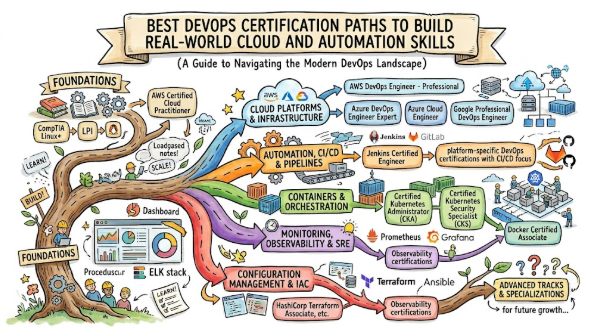
Introduction
In an era where software velocity defines market leadership, the boundary between building an application and keeping it resilient has completely dissolved. Organizations no longer look for developers who simply write code or administrators who merely maintain servers; they demand T-shaped professionals who understand the entire lifecycle of a product. However, navigating the alphabet soup of modern technologies—from Kubernetes and Terraform to MLOps and GitOps—can feel like a Sisyphean task. A strategic certification path acts as your professional blueprint, transforming overwhelming technical noise into a structured, actionable expertise that separates industry practitioners from mere tool-users.
What is a DevOps Certification?
A Best DevOps certification serves as the industry-recognized benchmark for validating your proficiency in modern engineering methodologies. It is not just about passing an exam; it is a rigorous process that demands mastery over continuous integration, automated deployment, infrastructure scalability, and reliability engineering. When you invest in a professional certification, you are acquiring a proven framework to handle complex, distributed systems. These programs bridge the gap between theoretical understanding and the “in-the-trenches” reality of production environments, ensuring you have the hands-on capability to optimize performance, enhance security, and maintain uptime under pressure.
Why DevOps Certifications Matter
Certifications eliminate guesswork by providing a verified roadmap of the skills that top employers actually value. In a world of rapidly shifting tech stacks, following a certified path ensures you are building a future-proof career.
The Certification Process:
- Audit Your Professional Goals: Define whether you want to focus on platform architecture, security, or data-driven operations.
- Evaluate Certification Credibility: Look for programs that emphasize practical labs over multiple-choice theory.
- Establish a Learning Cadence: Devote consistent, dedicated hours to technical deep-dives rather than sporadic cramming.
- Execute Labs & Simulations: Actively build, break, and fix infrastructure in sandboxed environments.
- Apply to Tangible Outcomes: Translate your certification knowledge into a GitHub portfolio or workplace optimization project.
Who Should Take DevOps Certifications?
These certifications are designed for any forward-thinking professional operating within the software ecosystem:
- Software Engineers: Shifting toward full-stack ownership and infrastructure-aware coding.
- System Administrators: Evolving into cloud-native operators and SREs.
- QA Engineers: Moving from manual testing to automated, continuous quality assurance.
- Data & ML Engineers: Bridging the gap between model development and production deployment.
- Cloud Architects: Designing highly available, secure, and cost-effective environments.
- Technical Leaders: Bridging the communication gap between business objectives and engineering execution.
Core Skills Covered
Modern certification paths are comprehensive, covering the critical pillars of contemporary infrastructure:
- Automation Mastery: Scripting and orchestrating complex workflows to eliminate manual toil.
- Cloud Architecture: Leveraging native services to build scalable, resilient platforms.
- Container Lifecycle Management: Handling microservices with precision using container engines.
- Declarative Infrastructure: Managing state and resources as code for consistent environments.
- Security-by-Design: Embedding compliance and threat mitigation directly into CI/CD pipelines.
- Observability & Telemetry: Implementing data-driven insights to monitor system health in real-time.
Table 1: Best DevOps Certifications
| Certification Name | Best For | Skill Level | Career Direction |
| DevOps Certified Professional | Entry | Essential | DevOps Engineer |
| DevSecOps Certified Professional | Security | Advanced | DevSecOps Engineer |
| Site Reliability Engineering Certified Professional | Infrastructure | Intermediate | SRE Specialist |
| Master in DevOps Engineering | Admins | Intermediate | DevOps Lead |
| Master in Azure DevOps | Cloud Users | Advanced | Cloud Architect |
| AWS Certified DevOps Professional | Cloud Users | Advanced | Cloud Engineer |
| Master in Python Programming | Everyone | Beginner | Automation Engineer |
| Hashicorp Certified Terraform Associate | IaC | Intermediate | Platform Engineer |
| Certified Kubernetes Administrator | Containers | Advanced | Kubernetes Engineer |
| Docker Certified Associate | Dev/Ops | Intermediate | Container Specialist |
| Envoy ISTIO Certification Training | Networking | Advanced | Service Mesh Expert |
| MLOps Certification Training Course | AI/ML | Advanced | MLOps Engineer |
| Google Cloud Professional Cloud DevOps Engineer | Cloud Users | Advanced | Cloud DevOps Engineer |
| Master in Machine Learning | Data Science | Advanced | ML Engineer |
| Master in Artificial Intelligence | Software | Advanced | AI Developer |
| Master in AppDynamics | Observability | Intermediate | Monitoring Expert |
| Master in Data Science | Data | Intermediate | Data Engineer |
| Master in Deep Learning | Researchers | Advanced | AI Scientist |
| Prometheus with Grafana | SRE | Intermediate | Observability Engineer |
| GitOps Certified Professional | Platform | Advanced | GitOps Engineer |
Certification Deep Dive
Real-World Use Case
Imagine a high-traffic e-commerce platform struggling with manual deployments that frequently cause downtime. A professional certified in these domains introduces an automated CI/CD pipeline, utilizes Kubernetes for self-healing infrastructure, and implements Prometheus for instant alerts, transforming a chaotic release process into a seamless, high-velocity engine.
Skills You Will Learn
- Designing high-concurrency microservices architectures.
- Implementing robust version control and branching strategies for GitOps.
- Automating compliance reporting and security audits.
- Optimizing cloud resource consumption and cost-efficiency.
Career Scope
The market for these credentials is global and expanding. Organizations across every sector are prioritizing individuals who can demonstrate the ability to maintain the “always-on” nature of modern digital business.
Difficulty Level
Scalable; from introductory fundamentals for newcomers to complex, high-stakes architecture exams for senior professionals.
Best Career Fit / Who Should Take It
Ideal for those who enjoy solving complex logic puzzles, optimizing system performance, and building the “invisible” foundations that allow applications to thrive.
Hands-On Projects
- Designing an auto-scaling cluster on a public cloud provider.
- Automating a deployment pipeline that includes security vulnerability scanning.
- Creating a centralized dashboard that tracks system health and business metrics.
DevOps Certification Roadmap
A roadmap is essential to avoid burnout and ensure mastery. Focus on building your foundation before escalating to niche technologies.
Table 2: Career Goal Path
| Career Goal | Recommended Certification Path | Why It Fits |
| Foundational DevOps | DCP + Python | Establishes the core automation mindset. |
| Cloud Architect | AWS/Azure Master | Validates mastery over major cloud infrastructures. |
| Reliability Focused | SRE Pro + Prometheus | Optimizes system availability and incident response. |
| Security Pro | DevSecOps Pro | Protects the pipeline from end to end. |
| AI Infrastructure | MLOps + Data Science | Enables the productionalization of complex AI models. |
Types of DevOps Certifications
1. Cloud-Vendor Specific Certifications
These are the most highly demanded credentials by employers, as they validate your ability to manage infrastructure within a specific cloud provider’s ecosystem. They cover everything from automated deployment to cloud-native security and governance.
- Best For: Professionals working in environments tied to AWS, Azure, or GCP.
- Key Examples: AWS Certified DevOps Engineer – Professional, Microsoft Certified: DevOps Engineer Expert, Google Cloud Professional Cloud DevOps Engineer.
2. Technology & Tool-Focused Certifications
These certifications provide deep expertise in the specific “building blocks” of DevOps. By focusing on a single technology, you prove your ability to implement, troubleshoot, and optimize that tool within any pipeline.
- Best For: Engineers who want to become subject matter experts in containerization, orchestration, or infrastructure as code.
- Key Examples: Certified Kubernetes Administrator (CKA), Docker Certified Associate (DCA), HashiCorp Certified Terraform Associate.
3. Methodology & Operational Certifications
These focus on the “how” rather than the “what.” They validate your ability to implement specific operational philosophies like Site Reliability Engineering (SRE) or specialized deployment strategies like GitOps.
- Best For: Professionals looking to move into high-level strategy, reliability, and maintenance roles.
- Key Examples: Site Reliability Engineering (SRE) Certified Professional, GitOps Certified Professional, TOGAF (for enterprise architecture integration).
4. Security-Centric (DevSecOps) Certifications
As security “shifts left,” these certifications are becoming critical. They validate your ability to integrate automated security scanning, compliance, and threat mitigation into the software delivery lifecycle.
- Best For: Engineers aiming to bridge the gap between security teams and development pipelines.
- Key Examples: DevSecOps Certified Professional, Certified Kubernetes Security Specialist (CKS), HashiCorp Vault Associate.
5. Foundation & Skill-Specific Certifications
These act as essential prerequisites or foundational boosters, focusing on the underlying languages and technical skills that power all DevOps activities, such as programming and observability.
Key Examples: Master in Python Programming, Prometheus with Grafana, Linux Foundation Certified System Administrator (LFCS).
Best For: Freshers or professionals transitioning into IT who need to build a strong baseline before tackling complex DevOps workflows.
Common Mistakes to Avoid
- Focusing on Theory Alone: Knowledge without hands-on lab execution is quickly forgotten.
- Ignoring the “Culture” Aspect: DevOps is a human methodology; don’t focus only on tools.
- Neglecting Fundamentals: Master networking, Linux, and OS concepts before jumping into service meshes.
- Over-certifying: Gain one certification, apply the skills, and build a project before moving to the next.
Real-Life Examples
- A developer earned the DevOps Certified Professional designation, which allowed them to lead a migration from monolithic servers to a scalable microservices architecture.
- A system administrator leveraged their Certified Kubernetes Administrator status to drastically reduce deployment times during peak holiday traffic.
- A security analyst took the DevSecOps path, helping their company secure a major compliance certification by automating their threat detection logs.
- A data engineer used MLOps training to build a pipeline that automated the retraining and deployment of their firm’s predictive models.
- An SRE used Prometheus and Grafana certification to cut incident response times in half by implementing proactive, metric-based alerting systems.
FAQs
Q: Are these certifications worth the time investment?
Yes, they provide a structured framework that accelerates learning far beyond what self-taught, scattered reading can achieve.
Q: Do I need to be a developer to get certified?
No, while coding helps, many certifications focus on architecture, system management, and operational logic.
Q: Which cloud platform should I start with?
Choose the one most prevalent in your target job market or the one you currently have the most access to for practice.
Q: How do I choose between different certification providers?
Look for providers that offer integrated lab environments and real-world project portfolios rather than just theoretical exams.
Q: Is it possible to hold multiple certifications?
Absolutely; high-performing engineers often stack certifications, such as combining Cloud Architect with SRE or Security.
Q: Do these certifications guarantee a job?
They provide the necessary validation to pass screening, but your project portfolio and interview communication remain crucial for success.
Q: Can I take these courses while working full-time?
Yes, most high-quality programs are designed with flexible, self-paced, or weekend-based scheduling for working professionals.
Q: What is the most common prerequisite?
A functional understanding of Linux and basic shell scripting is recommended before tackling advanced DevOps topics.
Q: Are remote labs included?
Top-tier certification providers provide browser-based, instant-access labs so you can practice without needing local hardware.
Q: How do I prove my skills to a recruiter?
Beyond the certificate, a link to your public repository showcasing labs and projects completed during your training is the strongest proof.
Conclusion
Embarking on a certification journey is the most effective way to signal your dedication to professional excellence in the DevOps space. By methodically following a role-based roadmap—from mastering foundational automation to navigating complex service meshes and AI operations—you build a tangible skill set that transforms abstract concepts into production-ready infrastructure. Remember, the true value lies not in the credential itself, but in the hands-on mastery you cultivate through consistent lab practice and project building. Take charge of your career trajectory today; visit the BestDevOps certification page to discover the curriculum that aligns with your professional ambitions.

