
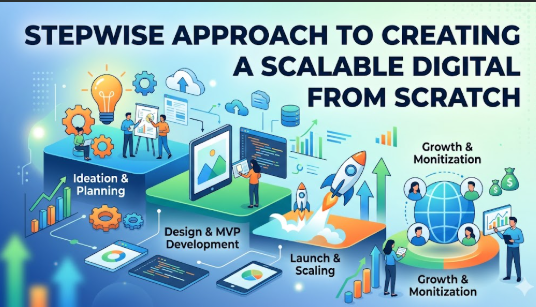
Introduction
Many beginners start a digital product with excitement, but confusion begins when they face decisions about features, budget, technology, design, users, security, and growth. A product idea may sound simple in the beginning, but building something that works for real users and can handle future demand requires planning. Poor decisions can lead to wasted money, weak user experience, slow performance, security problems, and expensive rework. That is why understanding How to Build a Scalable Digital Product from Scratch matters for founders, small business owners, students, salaried professionals, and teams entering product development for the first time. This blog explains the complete journey in simple words, from idea validation and MVP planning to technology choices, testing, launch, risk control, and long-term improvement. Instead of rushing into development, readers will learn how to think clearly, plan practically, and build with discipline.
Understanding How to Build a Scalable Digital Product from Scratch in Simple Words
A digital product is any software-based solution that users access through a website, mobile app, dashboard, platform, SaaS tool, marketplace, learning portal, booking system, or online service. Building a scalable digital product means creating it in a way that can support more users, more data, more features, and more business activity without breaking easily.
In simple words, scalability means your product should not work only for ten users and fail when one thousand users arrive. It should be planned so that performance, security, user experience, and operations can grow step by step.
People search for How to Build a Scalable Digital Product from Scratch because they may have an idea but do not know where to begin. Some may be planning a startup. Some may want to digitize their existing business. Some may want to create a SaaS product, e-commerce platform, booking app, learning platform, or internal business tool.
A scalable digital product connects directly with money and business planning because every product decision affects cost, risk, revenue, customer trust, and long-term operations. Choosing too many features early can waste money. Choosing poor technology can increase maintenance cost. Ignoring security can damage trust. Not validating user demand can create a product nobody uses.
For example, imagine a small coaching institute wants to create an online learning platform. If it builds only a basic website without considering student login, video access, payment tracking, mobile use, and course progress, it may struggle later. A scalable approach would start with a clear MVP, test student needs, build essential features first, and then improve step by step.
A common misunderstanding is that scalability means building a large and expensive product from day one. That is not true. Scalability means building the right foundation so the product can grow when needed.
The practical takeaway is simple: start small, validate early, build cleanly, and improve based on real user behavior.
Why How to Build a Scalable Digital Product from Scratch Is Important
Knowing How to Build a Scalable Digital Product from Scratch is important because a digital product is not only a technical project. It is also a business, financial, customer, operational, and risk-management decision. A product can look attractive on the surface but still fail if it is not useful, secure, affordable to maintain, or easy to improve.
For small business owners, a scalable product can help improve customer service, automate work, reduce manual effort, and create new revenue channels. For salaried professionals or students, product-building knowledge can help them start a side project carefully instead of spending money without direction. For investors or business decision-makers, understanding scalability helps evaluate whether a product idea has a practical foundation.
The topic also affects savings and budgeting. A poorly planned product can drain money through repeated redesigns, changing developers, unclear requirements, technical mistakes, and unnecessary features. A planned approach helps protect resources by focusing first on real user problems.
It affects borrowing and funding decisions too. If someone takes a loan or uses savings to build a product, they must understand development cost, maintenance cost, marketing cost, hosting cost, legal requirements, and support responsibilities. Borrowing money without a clear product plan can create financial pressure.
It also affects investing decisions. Investors usually look for clarity, user problem, market need, business model, product roadmap, technology stability, and growth potential. A scalable product plan gives better confidence than a rough idea without structure.
Risk awareness is another important part. Digital products may involve data privacy, payment security, cyber threats, compliance, platform dependency, user complaints, and operational failures. Beginners often focus only on launch, but responsible product building includes risk reduction.
A short practical scenario: a founder spends a large amount building a full app with many features before speaking to users. After launch, users only use two features and ignore the rest. The better approach would be to validate the core problem, build a smaller MVP, test usage, and then invest in the next features.
The Real Problem Readers Face With Digital Product Building
The biggest problem beginners face is not lack of ideas. It is lack of structured execution. Many people have product ideas, but they do not know how to convert those ideas into a clear, testable, scalable, and financially responsible product plan.
One common issue is lack of awareness. Beginners may not understand the difference between an idea, a prototype, an MVP, a full product, and a scalable platform. They may ask a developer to “build an app” without writing clear requirements or understanding user journeys.
Another problem is too much confusing advice online. Some content says build fast. Some says build perfectly. Some says raise funding first. Some says launch immediately. Beginners become confused because they do not know which advice applies to their situation.
Emotional decision-making also creates mistakes. A founder may become attached to an idea and ignore user feedback. A business owner may want every feature in the first version. A team may copy competitors without understanding their own customers.
Poor planning is another major issue. Without a product roadmap, budget estimate, feature priority, technical architecture, and launch plan, development becomes messy. Changes keep increasing. Costs rise. Timelines slip. The final product may still not solve the real problem.
Weak comparison also hurts decisions. Beginners may select a technology, agency, freelancer, hosting provider, or design approach based only on price. Low cost may look attractive initially, but poor quality can become expensive later.
Unrealistic expectations create disappointment. A digital product does not become successful only because it is launched. It needs user research, marketing, support, feedback, improvement, security, analytics, and business discipline.
Ignoring risk is another serious mistake. Many products collect user data, accept payments, send notifications, or manage accounts. Without privacy, security, and compliance awareness, the product may expose users and owners to avoidable risks.
Some beginners depend only on social media advice. They may follow random product-building trends without checking whether those ideas fit their business, audience, budget, or market.
The right next step is to slow down, define the problem clearly, validate demand, create a practical MVP, choose reliable technology, and build a scalable foundation with risk awareness.
How Digital Product Building Works Step by Step
Step 1: Define the Real Problem
The first step is to define the exact problem your digital product will solve. A product should not begin with “I want to build an app.” It should begin with “Who has a problem, what problem do they face, and why does it matter?”
This matters because users do not pay for features. They use products that solve problems, save time, reduce effort, improve convenience, or help them make better decisions.
To apply this step, write the problem in one clear sentence. For example, “Small clinics need a simple way to manage patient appointments without manual phone calls.”
A practical example is a local service provider building a booking platform. The problem is not “build a website.” The problem is “customers cannot easily check availability, compare services, and book appointments online.”
The common mistake is starting development before understanding the user problem. The better approach is to interview potential users, study their current process, and confirm whether the problem is real.
Step 2: Identify the Target Users
After defining the problem, identify who will use the product. Target users may include customers, admins, vendors, students, doctors, employees, freelancers, or business owners.
This matters because every user type has different needs. A student wants easy access. An admin wants control. A customer wants trust. A business owner wants reports.
To apply this step, create simple user profiles. Mention their goals, pain points, comfort level with technology, and expected behavior.
For example, if you are building a learning platform, your target users may be students, instructors, and administrators. Each group needs different features.
The common mistake is saying “everyone can use this product.” Products made for everyone often feel unclear to everyone. The better approach is to start with a specific user group and expand later.
Step 3: Validate the Idea Before Building
Idea validation means checking whether people actually need your product before you spend heavily on development.
This matters because an idea may sound useful to you but may not be important enough for users to adopt or pay for. Validation protects time, savings, and development budget.
To apply this step, speak to users, create a simple landing page, collect interest, test a prototype, run surveys, or manually provide the service before building software.
For example, before building a complete food delivery app for a small town, you can test demand through a simple form, WhatsApp ordering, and limited delivery tracking.
The common mistake is assuming demand without proof. The better approach is to collect real feedback before full development.
Step 4: Plan the MVP
An MVP, or minimum viable product, is the simplest useful version of your product. It includes only the core features needed to solve the main problem.
This matters because beginners often waste money building too many features too early. An MVP helps test the idea with less complexity.
To apply this step, divide features into must-have, should-have, and later features. Build only the must-have features first.
For example, a doctor appointment product may start with doctor listing, availability, booking request, patient contact details, and admin approval. Advanced analytics, loyalty points, and AI suggestions can come later.
The common mistake is treating the first version like the final version. The better approach is to launch a focused MVP, collect feedback, and improve based on real usage.
Step 5: Choose the Right Technology Foundation
Technology selection includes frontend, backend, database, hosting, APIs, payment systems, security tools, and development frameworks.
This matters because technology affects performance, cost, hiring, maintenance, security, and scalability.
To apply this step, choose technology based on product needs, team skills, budget, expected traffic, security requirements, and long-term maintenance. Do not choose technology only because it is trending.
For example, a simple content platform may not need complex microservices in the beginning. A payment-heavy marketplace may need stronger backend planning, secure payment integration, and reliable database design.
The common mistake is using overcomplicated technology too early or weak technology for serious use cases. The better approach is to choose a practical stack that supports current needs and future growth.
Step 6: Design User Experience Clearly
User experience means how easily users can understand, navigate, and complete tasks inside your product.
This matters because even a powerful product can fail if users feel confused. Clear design improves trust, engagement, and adoption.
To apply this step, create simple user flows, wireframes, screen layouts, and content instructions before full development. Test the design with a few real users.
For example, if users need to book a service, the steps should be simple: choose service, select date, enter details, confirm request, and receive confirmation.
The common mistake is designing for appearance only. The better approach is to design for clarity, speed, accessibility, and user confidence.
Step 7: Build, Test, and Launch in Controlled Phases
Development should happen in phases. Build the core version, test it, fix issues, launch with a small user group, and then expand.
This matters because launching without testing can create bugs, downtime, poor reviews, and user frustration.
To apply this step, test functionality, performance, mobile experience, forms, payments, emails, login, permissions, security basics, and admin controls.
For example, before launching an online course product publicly, test student login, video access, payment confirmation, certificate generation, and support requests.
The common mistake is launching too quickly without quality checks. The better approach is to use staged testing, beta users, feedback loops, and issue tracking.
Step 8: Measure, Improve, and Scale
After launch, the product journey continues. You must track user behavior, collect feedback, improve features, fix bugs, monitor performance, and prepare for growth.
This matters because scalability is not a one-time setup. It is a continuous process of improving systems, user experience, operations, and business model.
To apply this step, use analytics, user feedback, support tickets, performance monitoring, security reviews, and product roadmap updates.
For example, if users drop off during checkout, you may need to simplify payment steps or improve trust signals.
The common mistake is thinking launch means completion. The better approach is to treat launch as the beginning of learning.
Key Factors That Influence Digital Product Scalability
Problem Clarity
Problem clarity means knowing exactly what your product solves. It matters because unclear products become difficult to market, design, and improve. Beginners should write the problem statement before writing feature lists. The common mistake is building around assumptions. The better approach is to validate the pain point with real users.
User Demand
A scalable product needs real demand. Demand does not mean people say “nice idea.” It means users are willing to use, recommend, pay for, or depend on the product. Beginners can test demand through interviews, forms, demo pages, waitlists, or manual service delivery. The mistake is confusing compliments with demand. The better approach is to check user action.
MVP Focus
MVP focus helps avoid unnecessary cost. It allows you to build the smallest useful version and learn faster. The mistake is adding every feature before launch. The better approach is to prioritize features that solve the main user problem first.
Technology Architecture
Architecture is the structure behind your product. It includes database design, APIs, server setup, integrations, authentication, and deployment practices. Poor architecture can create slow performance and expensive rework. The better approach is to design a clean foundation that supports current needs and future scaling.
Budget Planning
Digital product cost includes design, development, testing, hosting, maintenance, marketing, support, security, and future upgrades. Beginners often calculate only development cost. The better approach is to prepare a full product budget with monthly and long-term expenses.
Security and Privacy
Many products collect user names, emails, phone numbers, payments, documents, or business data. Security and privacy are essential for trust. The mistake is treating security as a later task. The better approach is to include secure login, data protection, access control, backups, and privacy awareness from the beginning.
Performance
Performance means how fast and reliably the product works. Slow products can frustrate users. Beginners should test page speed, database queries, mobile performance, API response time, and server capacity. The mistake is checking performance only after complaints. The better approach is to monitor performance continuously.
Team Capability
A scalable product needs the right people: product planner, designer, developer, tester, DevOps support, content person, marketer, and support process. A small team can start lean, but roles must be clear. The mistake is expecting one person to handle everything perfectly. The better approach is to define responsibilities and use expert help where needed.
User Feedback
User feedback shows what works and what needs improvement. It helps avoid building features nobody needs. The mistake is ignoring complaints or relying only on internal opinions. The better approach is to collect feedback regularly and use it to improve the roadmap.
Business Model
A product must have a practical business model. It may earn through subscriptions, commissions, service fees, ads, licenses, paid features, or enterprise plans. The mistake is building first and thinking about revenue later. The better approach is to understand how value, pricing, and user willingness connect.
Detailed Breakdown of Digital Product Development
Start With Product Discovery
Product discovery is the research phase where you understand users, problems, market gaps, competitors, and possible solutions. This stage helps you avoid building blindly.
A beginner should ask:
- What problem exists?
- Who faces it?
- How are users solving it now?
- What is missing in current solutions?
- How painful is the problem?
- Will users change their behavior for a new product?
The common mistake is skipping research because the idea feels obvious. The better approach is to gather evidence before investing heavily.
Convert the Idea Into Requirements
Requirements explain what the product should do. They include user roles, features, workflows, admin functions, notifications, reports, integrations, and security needs.
For example, a marketplace product may need buyer login, seller profiles, listing creation, search filters, booking requests, payment tracking, reviews, admin approval, and support management.
The mistake is giving vague instructions like “make it like another app.” The better approach is to prepare clear feature documents and user journeys.
Create User Journeys
A user journey shows the steps a user takes to complete a task. It helps designers and developers understand product flow.
For example, in a service booking product, the journey may be:
- User searches for a service
- User checks provider details
- User selects date and time
- User submits request
- Provider confirms booking
- User receives notification
- Admin tracks the booking
The mistake is designing screens without understanding flow. The better approach is to map journeys first, then design screens.
Design the MVP Experience
The MVP should be simple but useful. It should not feel incomplete in the core area. If users cannot solve the main problem, it is not a good MVP.
For example, a finance tracking app MVP may include income entry, expense entry, category view, monthly summary, and basic reports. It does not need advanced AI forecasting in the first version.
The mistake is confusing “minimum” with “poor quality.” The better approach is to build fewer features but make them reliable.
Plan the Product Roadmap
A roadmap explains how the product will improve over time. It helps teams avoid random feature decisions.
A simple roadmap may include:
- MVP launch
- User feedback improvements
- Performance upgrades
- Payment integration
- Mobile app
- Automation features
- Analytics dashboard
- Advanced personalization
The mistake is changing direction every week. The better approach is to review the roadmap regularly but keep decisions connected to user value.
Build With Maintainability in Mind
Maintainability means the product can be fixed, improved, and updated without breaking everything. Clean code, documentation, version control, testing, and modular design help maintenance.
The mistake is building fast with no structure. It may look cheaper first, but future changes become difficult. The better approach is to balance speed with quality.
Use Testing Before Launch
Testing checks whether the product works correctly. It includes functional testing, usability testing, mobile testing, browser testing, security checks, performance checks, and user acceptance testing.
For example, a payment product should test successful payments, failed payments, refunds, invoices, email confirmations, and admin records.
The mistake is testing only by the developer. The better approach is to test through multiple users and real scenarios.
Prepare for Launch Operations
Launch is not only publishing the product. You need support, monitoring, backup, issue handling, user communication, analytics, and update planning.
The mistake is launching without support readiness. The better approach is to prepare a launch checklist, support process, and bug reporting system.
Improve Through Product Analytics
Analytics helps you understand how users behave. You can see where users sign up, where they drop off, which features they use, and where they face problems.
The mistake is depending only on opinions. The better approach is to combine analytics, feedback, and business goals.
Common Mistakes Beginners Make With Digital Products
Following Random Advice
Beginners often follow social media advice without checking context. What works for one product may not work for another. This is risky because product decisions depend on audience, budget, technology, business model, and market stage. Instead, use advice as input, not as final direction.
Ignoring Risk
Some founders focus only on features and forget security, privacy, cost, performance, and legal responsibilities. This can create serious problems later. Instead, review risk from the beginning and take expert help where needed.
Not Comparing Options
Choosing the first developer, tool, platform, or technology without comparison may lead to poor results. Instead, compare quality, experience, process, communication, support, security, and long-term maintenance.
Trusting Fake Growth Claims
Some people may promise instant users, guaranteed revenue, or viral success. Digital products do not grow only because someone promises results. Instead, focus on user value, marketing discipline, feedback, and steady improvement.
Ignoring Hidden Costs
Development is only one part of cost. Hosting, maintenance, bug fixes, content, support, marketing, legal work, and upgrades also matter. Instead, create a realistic budget before starting.
Making Emotional Decisions
A founder may love a feature, but users may not need it. Emotional decisions can waste time and money. Instead, use user feedback and business priorities.
Using Emergency Money for Risky Product Experiments
Building a product involves uncertainty. Using emergency savings or borrowed money without planning can create pressure. Instead, start lean and protect essential funds.
Not Reading Terms and Conditions
Tools, hosting platforms, payment gateways, and third-party APIs have policies and limitations. Ignoring terms can create compliance or operational issues. Instead, review terms before depending on any platform.
Sharing Sensitive Information Carelessly
Beginners may share passwords, server access, API keys, customer data, or payment details without controls. This can create security risks. Instead, use proper access management and protect sensitive data.
Ignoring Legal, Tax, or Compliance Responsibilities
Products that collect data, accept payments, sell subscriptions, or serve regulated sectors may require legal and tax awareness. Instead, consult qualified professionals when needed.
Depending Only on Social Media Advice
Trends can be useful, but they should not replace research. Instead, combine expert guidance, user interviews, testing, and practical planning.
Acting in Panic, Greed, or Pressure
Product decisions made in fear or greed often create mistakes. Instead, use a written plan, review options calmly, and move step by step.
Don’t Do This Checklist
- Do not start development without validating the problem.
- Do not build every feature in the first version.
- Do not choose technology only because it is trending.
- Do not ignore security and privacy.
- Do not use emergency funds without a budget plan.
- Do not believe guaranteed success claims.
- Do not skip testing before launch.
- Do not share passwords or sensitive access casually.
- Do not copy competitors blindly.
- Do not launch without a support process.
- Do not ignore user feedback.
- Do not treat product launch as the final step.
Practical Real-Life Examples of Digital Product Building
Example 1: Salaried Professional Building a Side Product
A salaried person wants to build an expense tracking app after noticing personal budgeting problems. The mistake is planning a large app with complex reports, bank integrations, and premium features immediately. The better action is to start with a simple MVP for manual expense tracking and monthly summaries. The learning is that small, focused products are easier to test and improve.
Example 2: Small Business Owner Creating a Booking Platform
A salon owner wants customers to book appointments online. The challenge is unclear feature planning. Instead of building a full marketplace, the better action is to begin with service listing, time slots, customer details, and admin confirmation. The learning is that business digitization should start with the most painful daily workflow.
Example 3: Startup Founder Planning a SaaS Tool
A founder wants to build a SaaS dashboard for small teams. The mistake is building advanced analytics before users even try the product. The better action is to validate the main workflow, launch an MVP, and track usage. The learning is that SaaS success depends on solving a repeated problem, not only adding features.
Example 4: Student Creating a Learning Platform
A student team wants to create a platform for study notes and quizzes. The challenge is limited budget and technical knowledge. The better action is to first create a simple web version with notes, categories, login, and quiz attempts. The learning is that clear user value matters more than a complex first version.
Example 5: Local Marketplace for Service Providers
A business group wants to connect local service providers with customers. The mistake is trying to build payments, reviews, chat, maps, and subscriptions at once. The better action is to test listings, inquiry forms, provider verification, and admin tracking first. The learning is that marketplace products need trust and supply quality before advanced automation.
Two Useful Tables for Better Understanding
Table 1: Product Stage, Main Focus, Risk, and Better Approach
| Product Stage | Main Focus | Common Risk | Better Approach |
|---|---|---|---|
| Idea Stage | Understand the problem | Assuming users need it | Interview users and validate demand |
| Planning Stage | Define MVP and roadmap | Adding too many features | Prioritize core user value |
| Design Stage | Create clear user flows | Designing only for looks | Design for usability and trust |
| Development Stage | Build stable features | Poor code structure | Use clean architecture and testing |
| Launch Stage | Release to real users | Launching without support | Use beta testing and monitoring |
| Growth Stage | Improve and scale | Scaling without data | Use analytics and feedback |
Table 2: Beginner Mistake vs Better Product-Building Approach
| Beginner Mistake | What Can Go Wrong | Better Product-Building Approach |
|---|---|---|
| Building without validation | Product may not attract users | Test demand before development |
| Adding too many features | Cost and timeline increase | Build a focused MVP first |
| Choosing the cheapest option only | Quality and support may suffer | Compare value, skill, and reliability |
| Ignoring security | User data may be exposed | Add security basics from day one |
| Skipping testing | Bugs may hurt user trust | Test before and after launch |
| No budget planning | Expenses may become stressful | Plan development and maintenance cost |
| No analytics | Decisions become guesswork | Track user behavior and feedback |
| No roadmap | Product direction becomes unclear | Plan improvements in phases |
Tools, Methods, and Frameworks Readers Can Use
Problem Statement Framework
A problem statement explains who has the problem, what the problem is, and why it matters. It helps beginners avoid vague product ideas. Use a simple format: “User type faces problem because reason.” This avoids the mistake of building features without a clear purpose.
User Persona Sheet
A user persona sheet describes your target user’s goals, pain points, behavior, and comfort with technology. It helps teams design for real users, not assumptions. Beginners can create two or three personas before designing the product.
MVP Feature Prioritization
This method divides features into must-have, useful later, and unnecessary for now. It helps reduce cost and confusion. Beginners can use it to decide what belongs in the first version.
Product Roadmap
A roadmap shows how the product will grow over time. It helps avoid random development. Beginners can create a simple roadmap for the next few phases instead of planning everything at once.
Wireframes
Wireframes are simple screen layouts. They help visualize the product before coding starts. Beginners can use wireframes to test user flow and reduce design confusion.
User Journey Mapping
This method shows each step a user takes to complete a task. It helps identify friction points. For example, a booking journey may include search, selection, confirmation, payment, and notification.
Development Checklist
A development checklist helps track features, bugs, testing, integrations, security, and launch tasks. It avoids missed steps and improves team coordination.
Budget Planner
A budget planner tracks development cost, hosting, maintenance, support, design, marketing, legal review, and future upgrades. It helps avoid the mistake of calculating only coding cost.
Risk Checklist
A risk checklist helps review security, privacy, legal, financial, performance, and operational risks. Beginners should complete it before launch.
Analytics Dashboard
Analytics tools help track user signups, active users, feature usage, drop-offs, and conversion points. This avoids guessing and supports better decisions.
Feedback Collection System
Feedback can come from surveys, support forms, interviews, reviews, and user calls. It helps improve the product based on real needs instead of internal assumptions.
Product Review Meetings
A regular product review helps teams check progress, user feedback, bugs, budget, and roadmap priorities. It avoids emotional and random decision-making.
Expert Tips to Make Better Product Decisions
1. Learn Before Building
Understanding the problem, audience, and market before development reduces wasted effort. Apply this by speaking with users, studying existing solutions, and writing a clear product brief before hiring developers.
2. Start With a Focused MVP
A focused MVP helps you test the core idea quickly and responsibly. Apply this by selecting only the features required to solve the main problem in the first version.
3. Validate With Real Users
User validation protects you from assumption-based decisions. Apply this by asking users to test prototypes, landing pages, demos, or manual workflows before full development.
4. Keep the Budget Practical
A product needs money beyond development. Apply this by planning for hosting, maintenance, support, marketing, testing, security, and future improvements.
5. Avoid Feature Overload
Too many features can confuse users and increase cost. Apply this by asking whether each feature supports the main user problem or can wait for a later phase.
6. Choose Technology Carefully
Technology affects performance, hiring, security, and maintenance. Apply this by choosing tools based on product needs, not trends or personal preference only.
7. Protect User Data
Trust is essential for digital products. Apply this by using secure login, access control, backups, privacy-friendly data collection, and careful handling of sensitive information.
8. Test Before Launch
Testing helps prevent avoidable user frustration. Apply this by testing forms, login, payment, emails, mobile views, admin controls, and error scenarios.
9. Track Product Metrics
Metrics show what users actually do. Apply this by reviewing signups, usage, drop-offs, support issues, and feature engagement regularly.
10. Keep Emergency Money Separate
Product building has uncertainty. Apply this by avoiding risky spending from essential savings or funds needed for daily life and obligations.
11. Document Important Decisions
Documentation helps teams work clearly. Apply this by recording requirements, design choices, technical decisions, access details, testing results, and roadmap changes.
12. Take Expert Advice Where Needed
Legal, tax, security, architecture, and finance decisions may need expert support. Apply this by consulting qualified professionals instead of guessing on high-risk matters.
Case Studies: How Better Understanding Changes Decisions
Case Study 1: Small Business Booking Product
Profile: A small business owner running a local wellness service.
Situation: The owner wanted a mobile app for bookings, customer reminders, payments, loyalty points, and staff management.
Problem: The budget was limited, and the business had not tested whether customers preferred app-based booking.
Wrong Approach: The owner planned a full app with many features before validating demand. This could have increased cost and delayed launch.
Better Approach: The owner first launched a simple web-based booking MVP with service list, time slots, customer details, and admin approval. Customer feedback was collected for one month.
Result or Learning: Customers mainly needed simple appointment booking and reminders. Advanced loyalty features were not urgent.
Key Takeaway: A scalable product starts by solving the main problem first, then grows based on real usage.
Case Study 2: SaaS Tool for Team Productivity
Profile: A first-time founder building a SaaS tool for small remote teams.
Situation: The founder wanted dashboards, chat, file sharing, analytics, task management, and AI summaries in the first version.
Problem: The product was becoming too broad and expensive. The target users were also unclear.
Wrong Approach: Building all features at once would have created complexity without proving demand.
Better Approach: The founder narrowed the MVP to task tracking and weekly progress reporting for small teams. A small group of users tested it and shared feedback.
Result or Learning: Users valued simple reporting more than extra communication features. The roadmap became clearer.
Key Takeaway: Product focus improves learning, reduces cost, and supports better scalability.
Case Study 3: Marketplace for Local Services
Profile: A team planning a marketplace for home repair and local service providers.
Situation: The team wanted provider profiles, customer booking, payments, live chat, ratings, location tracking, and subscription plans.
Problem: Trust and provider verification were more important than advanced features in the beginning.
Wrong Approach: Launching a feature-heavy marketplace without verified providers could have damaged user trust.
Better Approach: The team first built provider listing, verification status, inquiry forms, admin review, and customer support tracking. Payment and ratings were planned for later.
Result or Learning: Users cared most about reliable provider information and response quality.
Key Takeaway: For marketplace products, trust and quality control must come before aggressive scaling.
Risk Awareness: What Readers Must Check First
Financial Risk
Financial risk means spending more than you can afford or investing in a product without clear planning. It matters because product development can involve ongoing costs. Reduce this risk by preparing a budget, starting with an MVP, and keeping emergency funds separate.
Market Risk
Market risk means users may not need, understand, or adopt your product. It matters because a product without demand cannot grow sustainably. Reduce this risk through user interviews, validation, and small launches.
Technology Risk
Technology risk means the product may be built on weak architecture, poor code, or unsuitable tools. It matters because technical problems can increase maintenance costs. Reduce this risk by choosing practical technology and experienced technical guidance.
Cybersecurity Risk
Cybersecurity risk includes hacking, data leaks, weak passwords, insecure APIs, and unauthorized access. It matters because user trust depends on safety. Reduce this risk with secure authentication, access controls, backups, testing, and expert review.
Data Privacy Risk
Data privacy risk means collecting or using user data without proper care. It matters because users expect their information to be protected. Reduce this risk by collecting only necessary data and using clear privacy practices.
Platform Risk
Platform risk occurs when your product depends heavily on one third-party service, tool, app store, payment gateway, or API. It matters because policy changes or outages can affect operations. Reduce this risk by understanding dependencies and preparing alternatives where possible.
Legal and Compliance Risk
Legal and compliance risk may arise from contracts, data rules, payments, taxes, industry-specific requirements, or user terms. It matters because mistakes can create penalties or disputes. Reduce this risk by consulting qualified professionals when needed.
Performance Risk
Performance risk means the product becomes slow or unstable when users grow. It matters because poor performance can reduce trust. Reduce this risk through monitoring, optimized code, scalable hosting, and proper testing.
Operational Risk
Operational risk means the team is not ready to manage users, bugs, support, updates, and complaints. It matters because products need ongoing operations. Reduce this risk by setting support workflows and issue tracking systems.
Misinformation Risk
Misinformation risk happens when product decisions are based on random advice, fake success stories, or incomplete knowledge. It matters because wrong decisions can waste money. Reduce this risk by verifying information and using expert guidance.
Readers should verify important details and consult qualified legal, tax, financial, technical, or business professionals where required.
Checklist Before Taking Action
Before starting a digital product, review this checklist carefully:
- The main user problem is clearly defined.
- The target audience is specific.
- Basic market and user validation is completed.
- The MVP features are separated from future features.
- A practical budget is prepared.
- Development, hosting, maintenance, and marketing costs are considered.
- Technology options are compared properly.
- Security and privacy needs are reviewed.
- User data protection practices are planned.
- Legal, tax, or compliance impact is checked where relevant.
- Payment gateway or third-party terms are reviewed if applicable.
- A simple product roadmap is prepared.
- Design wireframes or user flows are created.
- Testing plan is ready before launch.
- Support and bug reporting process is planned.
- Analytics and feedback collection are included.
- Emergency funds are kept separate from product risk spending.
- Fake growth or guaranteed success claims are avoided.
- Written requirements are prepared before development begins.
- Professional advice is considered for high-risk decisions.
Use this checklist before investing money, hiring a developer, choosing technology, or launching the product. It helps slow down emotional decisions and encourages practical, risk-aware action.
Strategic Insights for Better Decision-Making
Product Positioning
Product positioning means explaining who the product is for and why it is useful. Clear positioning helps users understand the product quickly. For example, “appointment booking for small clinics” is clearer than “complete healthcare platform.”
Value Proposition
A value proposition explains the benefit users receive. It should be simple and practical. Beginners should avoid broad promises and focus on specific user outcomes, such as saving time, reducing manual work, or improving visibility.
Feature Prioritization
Feature prioritization helps decide what to build first. A good product does not need every feature immediately. For example, a marketplace may need verified listings before advanced recommendation systems.
Technical Scalability
Technical scalability means the system can support growth in users, data, and transactions. Beginners should not over-engineer early, but they should avoid choices that block future growth.
Operational Scalability
Operational scalability means the business can handle support, onboarding, content updates, vendors, payments, and user issues as it grows. A product may be technically strong but operationally weak if support is not planned.
Cost Control
Cost control helps prevent financial stress. Product owners should monitor development cost, monthly infrastructure cost, tool subscriptions, support expenses, and future upgrade needs.
User Feedback Loops
Feedback loops help teams learn what users need. A simple feedback form, support chat, user interview, or product survey can reveal important improvements.
Data-Driven Decisions
Data-driven decisions use analytics and behavior patterns instead of guesswork. For example, if many users stop at signup, the signup process may need improvement.
Security by Design
Security by design means thinking about safety from the beginning. It includes authentication, access roles, backups, secure APIs, and responsible data handling.
Long-Term Maintainability
A scalable product must be easy to maintain. Documentation, clean code, testing, and version control help future developers improve the product without confusion.
Avoiding Herd Mentality
Beginners may copy trending features like AI, chatbots, or gamification without understanding need. A better approach is to ask whether the feature improves the main user problem.
Growth Readiness
Growth readiness means preparing for more users, more support requests, more data, and more product complexity. It should happen gradually based on actual demand.
Key Terms Explained for Beginners
- Digital Product: A software-based product that users access online, such as an app, website, SaaS platform, marketplace, portal, or dashboard.
- Scalability: Scalability means the product can handle growth in users, data, features, and activity without failing easily.
- MVP: MVP means minimum viable product. It is the simplest useful version of a product that solves the main user problem.
- Prototype: A prototype is an early model or visual sample used to test an idea before full development.
- Wireframe: A wireframe is a simple screen layout that shows structure before final design.
- User Persona: A user persona is a simple profile of your target user, including needs, problems, behavior, and goals.
- User Journey: A user journey shows the steps a user takes to complete a task inside the product.
- Product Roadmap: A roadmap is a plan that shows how the product will improve over time.
- Frontend: Frontend is the part of the product users see and interact with, such as screens, buttons, forms, and pages.
- Backend: Backend is the system behind the product that manages data, logic, users, security, and integrations.
- Database: A database stores product information such as users, orders, bookings, payments, content, or records.
- API: An API helps different software systems communicate with each other.
- Cloud Hosting: Cloud hosting allows the product to run on online servers instead of local computers.
- Technical Debt: Technical debt means shortcuts in development that may create problems or extra cost later.
- Product Analytics: Product analytics tracks how users interact with the product, helping teams make better decisions.
Who Should Read This Blog
Beginners
Beginners can use this blog to understand product building without technical confusion. It explains the process step by step in simple language.
Students
Students interested in startups, software, entrepreneurship, or product management can learn how ideas become real products.
Salaried Employees
Salaried professionals planning a side project can understand how to start carefully without risking savings blindly.
Small Business Owners
Small business owners can learn how to digitize services, bookings, operations, customer management, or sales processes responsibly.
New Investors
New investors can use this knowledge to evaluate whether a digital product idea has structure, demand, and scalability potential.
Traders and Finance Learners
Traders and finance learners planning tools, dashboards, or education platforms can understand product planning and risk control.
Loan Seekers
Loan seekers considering borrowing for a product idea can understand why budgeting, validation, and repayment awareness matter before taking financial risk.
Crypto Learners
Crypto learners planning blockchain or Web3 products can understand the importance of security, wallet safety, platform risk, and user trust.
Casino Content Creators
Casino content creators planning digital platforms can learn why responsible content, compliance awareness, transparency, and user safety matter.
Finance Bloggers
Finance bloggers building calculators, comparison tools, or educational platforms can understand MVP planning and trustworthy product design.
People Improving Money Awareness
Anyone who wants to avoid financial mistakes can learn why product development requires budgeting, planning, risk review, and disciplined decisions.
Frequently Asked Questions
1. What is How to Build a Scalable Digital Product from Scratch?
How to Build a Scalable Digital Product from Scratch means planning, validating, designing, developing, testing, launching, and improving a digital product from the beginning. The goal is to create a product that solves a real problem and can grow responsibly.
2. Why is building a scalable digital product important for beginners?
It is important because beginners often spend money without clear planning. A scalable approach helps reduce waste, avoid confusion, improve user experience, and prepare the product for future growth.
3. What should I do before developing a digital product?
Before development, define the problem, identify users, validate demand, plan the MVP, estimate budget, compare technology options, and review risks. Starting with clarity can prevent expensive mistakes.
4. Is an MVP necessary for every digital product?
An MVP is useful for most digital products because it helps test the main idea with fewer features. It does not mean poor quality. It means building the simplest reliable version that solves the core problem.
5. How much technology knowledge is needed to start?
You do not need to be an expert coder, but you should understand product basics, user needs, feature planning, budget, security, and scalability. Technical experts can help with architecture and development.
6. What is the biggest mistake in digital product development?
The biggest mistake is building before validating the problem. Many products fail to gain users because the idea was never tested with real people before development.
7. How to Build a Scalable Digital Product from Scratch with low risk?
Start with research, validate demand, create a focused MVP, control budget, test carefully, protect user data, and improve based on feedback. Avoid spending heavily before proving the core value.
8. Can small business owners build scalable digital products?
Yes, small business owners can build scalable products by starting with one important workflow, such as booking, customer management, orders, payments, or service tracking. The key is to start practical and grow gradually.
9. Should I hire a freelancer, agency, or in-house team?
The right choice depends on budget, complexity, timeline, and long-term needs. Compare experience, communication, support, security awareness, documentation, and maintenance before deciding.
10. What risks should I know before launching?
Important risks include financial risk, market risk, technology risk, cybersecurity risk, data privacy risk, legal risk, platform dependency, and operational risk. Review these before launch.
11. How often should I review my digital product after launch?
You should review the product regularly through analytics, feedback, bug reports, user behavior, performance, and business goals. Product improvement should be continuous, not occasional.
12. What is the best next step after learning How to Build a Scalable Digital Product from Scratch?
The best next step is to write your problem statement, define target users, list MVP features, estimate budget, and speak to real users. This gives you a practical foundation before development.
Conclusion and Next Steps
Understanding How to Build a Scalable Digital Product from Scratch is valuable because a digital product is not just an app, website, or software tool; it is a complete system that connects user needs, business goals, technology, money, trust, risk, and long-term improvement. Beginners should remember that a strong product does not start with coding. It starts with problem clarity, user understanding, validation, focused MVP planning, responsible budgeting, secure technology, careful testing, and continuous learning after launch. The most practical next step is to write down the problem your product solves, identify the exact users, speak to real people, separate must-have features from later features, and prepare a realistic budget before hiring anyone or starting development. Avoid emotional decisions, fake success promises, unnecessary features, and spending money without validation. Also remember that product building involves risk. There may be financial risk, market risk, technical risk, security risk, privacy risk, legal risk, and operational risk. A careful founder or business owner does not ignore these risks; they reviews them early and gets professional help where needed. Scalable product development is a disciplined journey. Start small, build properly, measure honestly, improve consistently, and grow only when the product shows real value. With the right planning and patience, beginners can move from idea to product with more confidence, less confusion, and better decision-making.

