
Introduction
Many technology projects begin with excitement, but they can quickly become stressful when goals are unclear, teams work in isolation, budgets stretch, deadlines shift, and quality problems appear late in the process. Beginners often think technology project risk comes only from coding mistakes, but in reality, risk usually starts much earlier: weak discovery, unclear requirements, poor communication, unrealistic timelines, missing user feedback, incomplete testing, and no post-launch improvement plan. This is why understanding How Full-Cycle Product Delivery Reduces Technology Project Risk is important for startups, product owners, business leaders, students, project managers, and small business owners who depend on digital platforms. Full-cycle product delivery means managing the complete journey of a product from idea, research, planning, design, development, testing, launch, support, and continuous improvement. Instead of treating each phase as a separate task, it connects every stage so that decisions are clearer, ownership is stronger, and problems are caught early. This blog explains the topic in simple words, shows how it works step by step, highlights common mistakes, and gives practical ways to reduce delivery risk without using confusing technical language. The purpose is not to promise perfect results, because every technology project carries uncertainty. The real value is learning how to make better decisions, reduce avoidable mistakes, protect budgets, improve team productivity, and build products that are more useful, stable, and aligned with business goals.
Understanding Full-Cycle Product Delivery
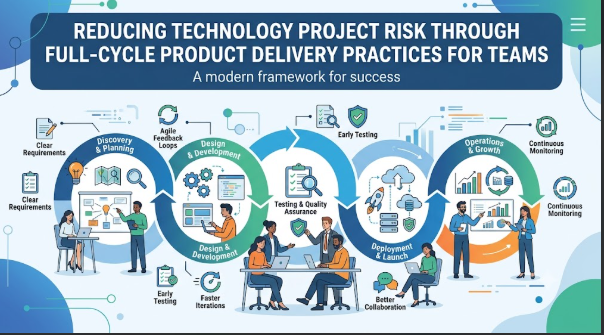
Full-cycle product delivery means handling a technology product from the first idea to long-term improvement after launch. It includes research, planning, design, development, testing, deployment, monitoring, feedback, support, and future updates.
In simple terms, it is like building a house with one clear plan from foundation to maintenance. If the architect, engineer, builder, electrician, and owner do not communicate, the final result may be costly and weak. Technology products are similar. If business teams, designers, developers, testers, and support teams work separately, risk increases.
People search for full-cycle product delivery because they want fewer delays, fewer budget surprises, better software quality, and stronger control over project outcomes. It is used in mobile apps, SaaS platforms, e-commerce websites, enterprise systems, fintech products, health platforms, education portals, and internal business tools.
It connects with money because technology mistakes can create direct financial loss. A poorly planned project may waste salary cost, vendor cost, hosting cost, marketing cost, and customer trust. For example, a small business may build an online booking platform without checking user needs. After launch, customers may not understand how to book, payment errors may occur, and the business may need expensive rework.
A common misunderstanding is that full-cycle delivery means doing everything slowly. The better understanding is that it helps teams move with more control. The practical takeaway is simple: when every stage is connected, teams can identify risk earlier and correct problems before they become expensive.
Why Full-Cycle Product Delivery Is Important
Full-cycle product delivery is important because it turns technology work into a controlled business process. It helps teams understand what they are building, why they are building it, how it will be delivered, what risks exist, and how success will be measured.
From a financial perspective, it protects budgets by reducing rework, unclear scope, and late-stage corrections. From a planning perspective, it helps leaders understand delivery timelines, team responsibilities, and project dependencies. From a risk perspective, it creates checkpoints where issues can be reviewed before they damage the full project.
For salaried employees and project team members, full-cycle delivery reduces confusion because roles become clearer. For small business owners, it helps avoid spending money on features that customers may not use. For investors or founders, it improves confidence because progress can be reviewed through structured milestones. For technology learners, it shows how real projects move beyond coding into research, user experience, quality, security, and operations.
A practical scenario can make this clearer. A company wants to build a customer support portal. Without full-cycle delivery, the team may directly start development. Later, they may discover that customers need multilingual support, ticket tracking, mobile access, and integration with email. This causes delays and extra cost. With full-cycle delivery, the team studies users first, creates priorities, validates design, tests early, and launches in stages. The better approach reduces uncertainty and gives the business more control.
The Real Problem Readers Face With Full-Cycle Product Delivery
The real problem is that many teams start technology projects with a broad idea but without a complete delivery system. They may know what they want at a high level, but they do not define user needs, acceptance criteria, budget limits, risk areas, ownership, testing expectations, or post-launch responsibilities.
Beginners often face too much confusing advice online. Some people say build fast, some say plan deeply, some say hire more developers, and some say use the latest tools. But tools alone do not reduce risk. A strong delivery process does.
Another major issue is emotional decision-making. Founders may add features because competitors have them. Managers may push unrealistic deadlines because of pressure. Teams may ignore quality checks because launch dates are near. These decisions create hidden risk.
Poor comparison also creates problems. Businesses may compare vendors only by price instead of delivery capability. They may ignore communication quality, testing process, security awareness, documentation, and support readiness.
Unrealistic expectations are another common issue. Some stakeholders expect technology products to work perfectly after the first launch. In reality, good products improve through feedback, data, maintenance, and updates.
Ignoring risk is especially dangerous. Teams may not read contracts, service terms, data privacy requirements, hosting limits, or compliance needs. Depending only on social media advice or random recommendations can lead to wrong decisions.
The better approach is to treat product delivery as a complete lifecycle. Before taking the next step, teams should define the problem clearly, compare options, review risks, create a realistic plan, test continuously, and prepare for improvement after launch.
How Full-Cycle Product Delivery Works Step by Step
Step 1: Discover the Real Business Problem
This step means understanding the real problem before building any solution. It matters because many projects fail when teams solve the wrong problem. To apply it, speak with users, business teams, support teams, and decision-makers before finalizing the product idea. For example, a company may think customers need a mobile app, but research may show they only need a faster checkout process on the website. The common mistake is jumping directly into development. The better approach is to document the problem, expected users, business goal, and success indicators first.
Step 2: Define Scope and Priorities Clearly
Scope means what will be included and what will not be included in the first delivery. It matters because unclear scope causes delays, budget pressure, and team confusion. To apply it, divide features into must-have, should-have, and future improvements. For example, an online learning platform may need login, course listing, payment, and video access first, while advanced analytics can come later. The common mistake is adding every idea into the first version. The better approach is to build the most useful version first and improve it gradually.
Step 3: Plan Design, User Experience, and Workflow
This step means designing how users will move through the product. It matters because even technically strong products can fail if users find them confusing. To apply it, create user flows, wireframes, simple prototypes, and feedback sessions before development. For example, a loan application platform should make eligibility checks, document upload, and application status easy to understand. The common mistake is treating design as decoration. The better approach is to use design as a risk-reduction tool that prevents usability problems early.
Step 4: Build With Technical and Business Alignment
Development should follow both technical standards and business priorities. It matters because a product must be stable, secure, scalable, and useful. To apply it, developers should work with product owners, testers, and business teams through regular reviews. For example, if a dashboard is being built for finance reporting, developers must understand the business meaning of each metric. The common mistake is coding based only on incomplete requirements. The better approach is to keep requirements, architecture, and business outcomes connected throughout development.
Step 5: Test Early and Continuously
Testing means checking whether the product works as expected. It matters because late testing can expose serious issues when fixing them is more costly. To apply it, test features during development, not only before launch. Include functional testing, usability testing, security checks, performance review, and acceptance testing. For example, an e-commerce checkout should be tested for payment failure, discount codes, mobile layout, and order confirmation. The common mistake is testing only the happy path. The better approach is to test real user situations, edge cases, and failure scenarios.
Step 6: Launch in a Controlled Way
Launch means making the product available to users. It matters because an unplanned launch can cause downtime, user confusion, and support pressure. To apply it, prepare release notes, backup plans, monitoring, support teams, and rollback options. For example, a business may release a new customer portal first to a small user group before opening it to everyone. The common mistake is treating launch as the finish line. The better approach is to treat launch as a controlled transition from building to learning.
Step 7: Monitor Performance and User Feedback
Monitoring means checking how the product behaves after launch. It matters because real users may face issues that were not visible during testing. To apply it, track errors, speed, user behavior, support tickets, and feedback. For example, if many users abandon a registration form, the team should review whether the form is too long or unclear. The common mistake is ignoring feedback after launch. The better approach is to create a feedback loop that helps the product improve continuously.
Step 8: Improve, Maintain, and Reduce Future Risk
Product delivery does not end after launch. Maintenance includes bug fixes, security updates, performance improvements, and feature enhancements. It matters because technology, user needs, and business goals keep changing. To apply it, schedule regular reviews, prioritize improvements, and keep documentation updated. For example, a SaaS product may need monthly security reviews and quarterly feature planning. The common mistake is leaving the product unsupported after launch. The better approach is to plan ongoing improvement as part of the delivery cycle from the beginning.
Key Factors That Influence Full-Cycle Product Delivery
Several factors influence whether full-cycle product delivery reduces risk effectively. The first factor is clarity of business goals. Teams should know the purpose of the product, the problem it solves, and the expected value. Without this clarity, even skilled teams may build unnecessary features.
The second factor is user understanding. Products are built for people, so user needs must guide important decisions. A product that looks good internally may still fail if real users find it confusing.
The third factor is scope discipline. Every extra feature adds time, cost, testing, and maintenance responsibility. Beginners often underestimate how small changes can affect the whole project.
The fourth factor is team communication. Designers, developers, testers, product managers, operations teams, and business stakeholders must share updates regularly. Weak communication creates duplicate work and hidden issues.
The fifth factor is technical quality. Code quality, architecture, security, performance, and integration planning directly affect project risk. Poor technical decisions can create long-term maintenance problems.
The sixth factor is testing maturity. Testing should not be rushed or delayed. It should cover real user behavior, business rules, security, and system performance.
The seventh factor is budget control. Full-cycle delivery helps teams connect cost with scope and priority. This prevents uncontrolled spending and helps leaders make informed trade-offs.
The eighth factor is post-launch ownership. A product needs support after release. If no team owns monitoring, support, and improvements, small issues can become serious business problems.
Detailed Breakdown of Full-Cycle Product Delivery
Product Discovery
Product discovery is the starting point where teams understand the market need, user problem, business goal, and project risk. It helps answer what should be built and why it matters. A common mistake is assuming that the founder’s idea automatically matches user needs. The better approach is to validate the idea through interviews, surveys, support insights, competitor review, and simple prototypes.
Product Strategy
Product strategy connects the product idea with business value. It defines the target audience, core features, success measures, budget direction, and delivery roadmap. Without strategy, teams may work hard but move in different directions. The better approach is to create a simple strategy document that explains the product goal, users, value proposition, risks, and priorities.
Requirement Planning
Requirements explain what the product must do. Good requirements include user stories, acceptance criteria, business rules, integrations, data needs, and limitations. A common mistake is writing vague requirements like “make dashboard better.” The better approach is to define what data should appear, who will use it, how often it updates, and what decisions it supports.
User Experience and Design
Design is not only about colors or layout. It is about making the product easy to use. Good design reduces support requests, user frustration, and rework. A common mistake is approving design without testing it with real users. The better approach is to review user flows, navigation, forms, error messages, and accessibility before development.
Development and Engineering
Development turns ideas into working software. Good engineering considers architecture, code quality, scalability, security, integration, and maintainability. A common mistake is focusing only on fast delivery while ignoring long-term stability. The better approach is to balance speed with quality through code reviews, standards, documentation, and technical planning.
Quality Assurance
Quality assurance checks whether the product works correctly and safely. It includes manual testing, automated testing, user acceptance testing, performance testing, and security review. A common mistake is testing only after all development is complete. The better approach is to test continuously and fix issues early.
Deployment and Release Management
Deployment is the process of moving the product into the live environment. Good release management reduces downtime, confusion, and user impact. A common mistake is launching without backup, rollback, or support preparation. The better approach is to use release checklists, controlled rollouts, monitoring, and clear communication.
Operations and Support
Operations ensure the product continues to work after launch. Support teams handle user issues, bug reports, and service requests. A common mistake is not training support teams before launch. The better approach is to prepare help documents, known issue lists, escalation paths, and monitoring dashboards.
Continuous Improvement
A product should improve based on feedback, usage patterns, business needs, and technical health. A common mistake is adding features without reviewing existing problems. The better approach is to prioritize improvements using user impact, business value, technical risk, and delivery effort.
Common Mistakes Beginners Make With Full-Cycle Product Delivery
One common mistake is following random advice. It happens because beginners want fast answers. It is risky because every project has different users, budgets, risks, and goals. The better approach is to use structured discovery and expert review before making decisions.
Another mistake is ignoring risk. Teams may focus only on features and forget security, testing, privacy, performance, and support. This can lead to failure after launch. The better approach is to review risk at every stage.
A third mistake is not comparing options properly. Businesses may choose vendors, tools, or technologies based only on price or popularity. What can go wrong is poor quality, poor support, or high maintenance cost. The better approach is to compare delivery capability, communication, technical fit, and long-term support.
A fourth mistake is trusting unrealistic promises. Some vendors or tools may claim fast results without explaining limitations. This is risky because technology delivery always has dependencies. The better approach is to ask for scope, assumptions, risks, timelines, and responsibilities in writing.
A fifth mistake is making emotional decisions. Teams may add features because of pressure, panic, or competitor fear. This can increase cost and delay launch. The better approach is to prioritize features based on user value and project goals.
A sixth mistake is not reading terms and conditions. Contracts, software licenses, hosting rules, data policies, and service-level terms can affect cost and compliance. The better approach is to review important documents before commitment.
A seventh mistake is sharing sensitive information carelessly. Project data, customer data, credentials, and financial details must be protected. The better approach is to use secure access controls, role-based permissions, and approved communication channels.
Don’t Do This Checklist
- Don’t start development before defining the business problem.
- Don’t approve vague requirements.
- Don’t add every feature into the first version.
- Don’t choose tools only because they are popular.
- Don’t ignore testing until the end.
- Don’t launch without monitoring and support planning.
- Don’t depend only on social media advice.
- Don’t share passwords, keys, or sensitive data casually.
- Don’t treat launch as the end of product responsibility.
- Don’t ignore legal, tax, privacy, or compliance review when relevant.
Practical Real-Life Examples of Full-Cycle Product Delivery
Example 1: Small Business Building an Online Booking System
A small service business wants an online booking platform. The challenge is that the owner starts with too many feature ideas. The better action is to first define essential features like service selection, time slot booking, customer confirmation, and admin management. The learning is that a focused first version reduces cost and launch risk.
Example 2: Startup Creating a Mobile App
A startup plans to build a mobile app for local services. The mistake is hiring developers before validating user demand. The better action is to create a simple prototype and test it with target users. The learning is that early feedback can prevent expensive development of unwanted features.
Example 3: Enterprise Upgrading an Internal Dashboard
A company wants to modernize its reporting dashboard. The challenge is that each department wants different metrics. The better action is to define user roles, decision needs, data sources, and reporting frequency before design. The learning is that requirement clarity reduces confusion and rework.
Example 4: SaaS Team Launching a New Feature
A SaaS company adds a billing feature. The mistake is testing only normal payment success cases. The better action is to test failed payments, refunds, tax rules, invoice generation, and user notifications. The learning is that full-cycle testing protects both customer experience and financial accuracy.
Example 5: Finance Blogger Managing a Digital Content Platform
A finance blogger wants to improve a content platform with calculators, guides, and comparison pages. The challenge is managing content accuracy, user trust, and technical performance together. The better action is to plan content workflow, review process, user experience, and compliance-sensitive language before launch. The learning is that digital product delivery also applies to content platforms, not only software apps.
Two Useful Tables for Better Understanding
Table 1: Traditional Delivery vs Full-Cycle Product Delivery
| Area | Traditional Delivery Risk | Full-Cycle Product Delivery Approach |
|---|---|---|
| Planning | Requirements may be unclear or incomplete | Discovery, scope, and priorities are defined early |
| Design | User experience may be reviewed too late | User flows and prototypes are tested before development |
| Development | Teams may build without full context | Engineering stays aligned with business goals |
| Testing | Testing may happen only near launch | Quality checks happen continuously |
| Launch | Release may be rushed or unsupported | Launch is planned with monitoring and rollback options |
| Support | Ownership may be unclear after release | Post-launch support and improvement are planned |
| Budget | Rework can increase cost | Scope control and early validation reduce avoidable spend |
| Risk | Problems appear late | Risks are reviewed across the full lifecycle |
Table 2: Beginner Mistake vs Better Product Delivery Approach
| Beginner Mistake | Why It Creates Risk | Better Approach |
|---|---|---|
| Starting with development immediately | The team may build the wrong solution | Start with discovery and problem validation |
| Adding too many features | Increases cost, testing, and delay | Prioritize must-have features first |
| Ignoring user feedback | Product may not match real needs | Test ideas with users early |
| Weak documentation | Teams may misunderstand decisions | Maintain clear requirements and decisions |
| Late testing | Serious issues may appear near launch | Test continuously throughout delivery |
| Poor vendor comparison | Low price may hide delivery weakness | Compare process, quality, support, and fit |
| No post-launch plan | Product may fail after release | Prepare monitoring, support, and improvement cycles |
| Ignoring security | Data and system risk may increase | Include security review from the beginning |
Tools, Methods, and Frameworks Readers Can Use
A product roadmap helps teams plan what will be built now, next, and later. It helps beginners avoid random feature additions. Teams can use it to connect product goals with delivery priorities.
A risk checklist helps identify possible problems before they become expensive. It can include scope risk, budget risk, technical risk, security risk, vendor risk, and user adoption risk. Beginners can use it before approving each stage.
A user story framework explains product needs from the user’s point of view. For example, “As a customer, I want to track my order so that I know its delivery status.” This helps avoid vague requirements.
A prototype is a simple visual model of the product before full development. It helps teams test ideas early. The mistake it avoids is spending money on a feature that users do not understand.
A quality assurance checklist helps teams test features, forms, workflows, errors, permissions, and performance. It avoids the mistake of testing only the most obvious cases.
A delivery dashboard helps track progress, blockers, risks, and upcoming milestones. Beginners can use it in weekly reviews to stay updated without depending on scattered messages.
A post-launch feedback system collects user comments, support issues, bug reports, and improvement requests. It avoids the mistake of assuming that the product is complete after launch.
A decision log records important project decisions, reasons, owners, and dates. It helps teams avoid confusion when people forget why a decision was made.
Expert Tips to Make Better Decisions
- Start with the problem, not the tool. This matters because tools cannot fix unclear thinking. Apply it by writing the business problem in one simple sentence before discussing technology.
- Validate user needs early. This matters because internal assumptions may be wrong. Apply it by speaking with real users or reviewing support queries before finalizing scope.
- Keep the first version focused. This matters because too many features increase delivery risk. Apply it by separating must-have features from future improvements.
- Define acceptance criteria clearly. This matters because teams need to know when a feature is complete. Apply it by writing what the feature must do, how it should behave, and what result is expected.
- Review risks in every phase. This matters because risk changes during delivery. Apply it through regular risk reviews during discovery, design, development, testing, launch, and support.
- Avoid emotional feature decisions. This matters because panic and competitor pressure can damage priorities. Apply it by checking every feature against user value and business impact.
- Test real user journeys. This matters because users do not always behave like teams expect. Apply it by testing common paths, errors, mobile use, and edge cases.
- Protect sensitive data from the start. This matters because privacy and security issues can damage trust. Apply it through access control, secure storage, and careful data handling.
- Create a launch readiness checklist. This matters because launch is a high-risk moment. Apply it by checking monitoring, support, rollback, communication, and documentation before release.
- Review vendor capability beyond price. This matters because low cost can lead to poor delivery. Apply it by checking process, past work, communication style, testing approach, and support readiness.
- Keep documentation simple but active. This matters because outdated documents create confusion. Apply it by updating requirements, decisions, workflows, and known issues as the project changes.
- Plan for maintenance before launch. This matters because every product needs updates and support. Apply it by assigning ownership for bug fixes, monitoring, security, and improvements.
- Use feedback as a delivery input. This matters because real usage reveals hidden issues. Apply it by reviewing user feedback regularly and prioritizing improvements.
- Do not ignore compliance-sensitive areas. This matters especially for finance, health, tax, education, and data-heavy platforms. Apply it by consulting qualified professionals where legal, tax, or privacy impact exists.
- Think long term. This matters because fast shortcuts can create future cost. Apply it by balancing immediate launch needs with scalability, quality, and maintainability.
Case Studies: How Better Understanding Changes Decisions
Case Study 1: Startup Avoiding Feature Overload
Profile: A new startup building a marketplace platform.
Situation: The founders wanted chat, payment, ratings, location tracking, subscriptions, and analytics in the first release.
Problem: The first version became too large, expensive, and difficult to test.
Wrong approach: The team tried to build everything at once because competitors had many features.
Better approach: They used full-cycle product delivery to identify the core user journey: search, booking, payment, and confirmation. Advanced features were moved to later phases.
Result or learning: The team reduced complexity, improved focus, and created a clearer first release.
Key takeaway: A focused scope is often safer than a feature-heavy launch.
Case Study 2: Business Reducing Rework Through Early Design Review
Profile: A medium-sized service company building a customer portal.
Situation: The company wanted customers to submit requests, upload documents, and track progress.
Problem: Initial screens were designed internally without customer feedback.
Wrong approach: The team planned to start development immediately after internal approval.
Better approach: They tested the prototype with a few users and discovered that document upload instructions were confusing. The design was improved before development.
Result or learning: Early review prevented rework and improved user experience.
Key takeaway: Design validation is a practical risk-reduction step, not an optional activity.
Case Study 3: Enterprise Improving Launch Readiness
Profile: A large organization replacing an internal reporting system.
Situation: The new system had multiple integrations and many department users.
Problem: The team focused heavily on development but had weak launch planning.
Wrong approach: They planned a full launch without enough training, monitoring, or support preparation.
Better approach: They used controlled rollout, user training, support documentation, monitoring, and fallback planning.
Result or learning: Users adapted more smoothly, and issues were handled with less disruption.
Key takeaway: Launch planning is a critical part of full-cycle product delivery.
Risk Awareness: What Readers Must Check First
Scope risk means the project may grow beyond the original plan. It matters because uncontrolled scope increases cost and delay. Reduce it by defining priorities and approval rules for changes.
Budget risk means the project may cost more than expected. It matters because rework, unclear requirements, and delays can increase spending. Reduce it by connecting budget with scope, timeline, and delivery milestones.
Technical risk means the technology may not perform, scale, integrate, or remain maintainable. It matters because poor technical decisions can create long-term problems. Reduce it through architecture review, code quality checks, and experienced technical guidance.
Security risk means systems or data may be exposed to unauthorized access. It matters because customer trust and business operations can be affected. Reduce it through secure design, access control, testing, and privacy-aware practices.
Vendor risk means an external team or tool may not meet expectations. It matters because poor vendor selection can cause delays and quality issues. Reduce it by reviewing process, communication, contract terms, support, and references.
Compliance risk means the product may fail to meet legal, tax, data, or industry requirements. It matters especially for finance, healthcare, education, and data-driven platforms. Reduce it by involving qualified professionals when needed.
User adoption risk means users may not use the product as expected. It matters because a technically complete product can still fail if users find it difficult or unnecessary. Reduce it through user research, training, onboarding, and feedback.
Operational risk means the product may face downtime, support gaps, or maintenance problems after launch. Reduce it by planning monitoring, support ownership, backups, and update processes.
Misinformation risk means teams may make decisions based on incomplete advice, online opinions, or assumptions. Reduce it by verifying information and consulting experienced professionals where required.
Checklist Before Taking Action
- Have you clearly defined the business problem?
- Have you identified the target users?
- Have you separated must-have features from future features?
- Have you reviewed project risks before development?
- Have you compared vendors, tools, or delivery options properly?
- Have you checked cost, scope, and timeline assumptions?
- Have you documented requirements and acceptance criteria?
- Have you reviewed design and user experience before development?
- Have you planned testing from the beginning?
- Have you included security and data privacy checks?
- Have you reviewed legal, tax, or compliance impact where relevant?
- Have you prepared a launch checklist?
- Have you planned monitoring and support after launch?
- Have you protected sensitive business and user data?
- Have you avoided emotional or pressure-based decisions?
- Have you considered expert advice where required?
Use this checklist before approving a technology project, selecting a vendor, starting development, launching a product, or adding major new features. It helps teams slow down at the right moments, ask better questions, and reduce avoidable risk.
Strategic Insights for Better Decision-Making
Product vision helps teams understand the long-term purpose of the product. Without vision, teams may make short-term decisions that do not support business growth.
Scope control protects the project from unnecessary complexity. Beginners should remember that every feature requires design, development, testing, security review, support, and maintenance.
Risk allocation means deciding which risks are acceptable and which must be reduced before moving forward. For example, a minor design issue may be acceptable for a small release, but a payment security issue should not be ignored.
Delivery milestones help teams review progress in smaller parts. Instead of waiting until the end, teams can check discovery, design, development, testing, and launch readiness separately.
Feedback loops help products improve after real usage. A beginner-friendly example is reviewing support tickets every week to identify repeated user problems.
Documentation discipline keeps teams aligned. Simple documents such as user stories, decision logs, test cases, and release notes can prevent confusion.
Quality gates are checkpoints before moving to the next stage. For example, a feature should not move to launch unless it passes functional testing, user acceptance, and security checks where required.
Post-launch ownership ensures that someone is responsible after release. Without ownership, bugs, performance problems, and customer complaints may remain unresolved.
Long-term maintainability helps reduce future cost. A quick shortcut may look cheaper today but can create technical debt that becomes expensive later.
Key Terms Explained for Beginners
- Full-Cycle Product Delivery: This means managing a product from idea to launch and continuous improvement. It connects planning, design, development, testing, release, and support.
- Technology Project Risk: This means the chance that a technology project may face delays, cost increases, quality issues, security problems, or user adoption failure.
- Product Discovery: This is the process of understanding the user problem, business goal, and project need before building the solution.
- Scope: Scope defines what is included and excluded from a project. Clear scope helps control cost, time, and expectations.
- User Story: A user story explains a feature from the user’s point of view. It helps teams understand why a feature is needed.
- Acceptance Criteria: These are conditions that define when a feature is complete and working correctly.
- Prototype: A prototype is a simple model of the product used to test ideas before full development.
- Quality Assurance: Quality assurance means checking whether the product works correctly, safely, and reliably.
- Technical Debt: Technical debt happens when teams take shortcuts that may create future maintenance problems.
- Release Management: This means planning how a product or feature will be launched safely.
- Rollback Plan: A rollback plan explains how to return to a previous stable version if a launch causes problems.
- Post-Launch Support: This means helping users, fixing issues, monitoring performance, and improving the product after release.
- Risk Review: A risk review is a structured check of possible problems before making important project decisions.
- Vendor Risk: Vendor risk means problems that may come from choosing an external provider who cannot deliver quality, support, or reliability.
- Continuous Improvement: This means improving the product over time based on feedback, data, and changing business needs.
Who Should Read This Blog
Beginners should read this blog because it explains product delivery without complex technical language.
Students can use it to understand how real-world software and digital products are planned, built, tested, launched, and improved.
Salaried employees working in technology, sales, operations, or support can use it to understand how their role connects with product success.
Small business owners can use it before investing money in websites, apps, portals, automation tools, or SaaS products.
New investors and founders can use it to evaluate whether a technology project has clear planning and risk controls.
Traders and finance professionals managing digital tools can use it to understand why platform reliability, data security, and testing matter.
Loan seekers and financial service businesses can use it when building or reviewing digital application platforms, calculators, or customer portals.
Crypto learners and blockchain teams can use it to understand the importance of security, testing, and platform risk in technology products.
Casino content creators can use it if they manage review platforms, affiliate systems, or compliance-sensitive content workflows.
Finance bloggers can use it when building calculators, comparison pages, subscription tools, or educational content platforms.
People improving money awareness can learn how technology decisions affect budget, business risk, and long-term planning.
People trying to avoid financial mistakes can use the blog to make more careful decisions before spending money on technology projects.
Frequently Asked Questions
1. What is full-cycle product delivery?
Full-cycle product delivery is the complete process of taking a product from idea to launch and ongoing improvement. It includes research, planning, design, development, testing, release, monitoring, and support. It helps teams manage the full journey instead of only focusing on coding.
2. How Full-Cycle Product Delivery Reduces Technology Project Risk for beginners?
How Full-Cycle Product Delivery Reduces Technology Project Risk is by creating structure across every stage. Beginners can identify unclear requirements, weak design, testing gaps, cost issues, and launch risks earlier. This reduces avoidable mistakes and improves decision-making.
3. Why is full-cycle product delivery important for businesses?
It is important because technology projects affect money, time, customer trust, and team productivity. A full-cycle approach helps businesses plan better, test earlier, launch more safely, and improve after release. It creates better control over project outcomes.
4. What is the biggest mistake in technology product delivery?
The biggest mistake is starting development without understanding the real problem. This can lead to wrong features, rework, budget pressure, and poor user adoption. The better approach is to begin with discovery, user needs, and clear goals.
5. Is full-cycle product delivery useful for small businesses?
Yes, small businesses can benefit because they often have limited budgets and cannot afford repeated rework. Full-cycle delivery helps them define priorities, compare vendors, test early, and launch carefully. It supports smarter technology spending.
6. How does full-cycle delivery help reduce cost risk?
It reduces cost risk by catching mistakes early, controlling scope, improving communication, and avoiding unnecessary features. It also helps teams plan testing, launch, and support properly. This does not guarantee lower cost, but it reduces avoidable waste.
7. What risks should teams check before starting a project?
Teams should check scope risk, budget risk, technical risk, security risk, vendor risk, compliance risk, and user adoption risk. Each risk should have a clear owner and reduction plan. This helps prevent surprises during delivery.
8. How often should a product delivery plan be reviewed?
A product delivery plan should be reviewed regularly during discovery, design, development, testing, and launch preparation. Teams should also review it after launch using feedback and performance data. Regular review helps keep the project aligned with real needs.
9. Does full-cycle product delivery replace project management?
No, it does not replace project management. It strengthens project management by connecting strategy, users, design, engineering, testing, release, and improvement. Project management focuses on coordination, while full-cycle delivery focuses on the complete product journey.
10. How Full-Cycle Product Delivery Reduces Technology Project Risk during launch?
How Full-Cycle Product Delivery Reduces Technology Project Risk during launch is by preparing monitoring, support, rollback plans, communication, and user readiness in advance. This helps teams respond faster if issues appear after release.
11. Should beginners take expert advice before technology delivery?
Yes, expert advice can help when projects involve security, complex integrations, payments, tax, legal rules, or sensitive user data. Beginners should not rely only on informal opinions. Qualified review can reduce serious mistakes.
12. What is the best next step after reading this blog?
The best next step is to review your current or planned technology project using a simple checklist. Define the problem, users, scope, risks, budget, testing plan, and post-launch support. This helps you apply the concept practically.
Conclusion
Full-Cycle Product Delivery Reduces Technology Project Risk is valuable because technology projects are not only technical tasks; they are business decisions with cost, time, quality, security, user experience, and long-term maintenance impact. A project can have talented developers and still face problems if discovery is weak, requirements are unclear, testing is delayed, users are ignored, or launch planning is incomplete. Full-cycle product delivery gives beginners and decision-makers a better way to think about the complete journey. It starts with understanding the real problem, then moves through scope planning, design, development, testing, launch, monitoring, support, and continuous improvement. This approach does not remove all risk, and it should not be treated as a guaranteed formula for success. Instead, it helps reduce avoidable risk by creating structure, visibility, communication, and accountability. Beginners should remember that practical understanding is more useful than rushing into decisions. Before investing money in an app, website, platform, automation tool, or software product, it is important to ask basic questions: Who is the user? What problem are we solving? What is included in the first version? What can go wrong? How will we test it? Who will support it after launch? What legal, financial, privacy, or compliance issues need review? These questions may look simple, but they protect teams from costly mistakes.

