
Introduction
Imagine a company where the people who write software (developers) and the people who keep servers running (operations staff) live in two different worlds.
The developers want to launch new features as fast as possible to please customers. The operations staff want to keep the system stable and safe from crashes. When something breaks, the two groups blame each other instead of fixing the problem together.
This friction slows down business, frustrates employees, and angers customers.
To solve this, many companies buy expensive automation software and cloud management tools. They assume technology is the magic cure. Yet, six months later, deployments are still failing, and teams are just as stressed.
This article explores why culture is the hidden engine behind successful software delivery, why tools alone cannot save a broken organization, and how to build a workplace where technology actually helps people succeed.
What Is DevOps Culture?
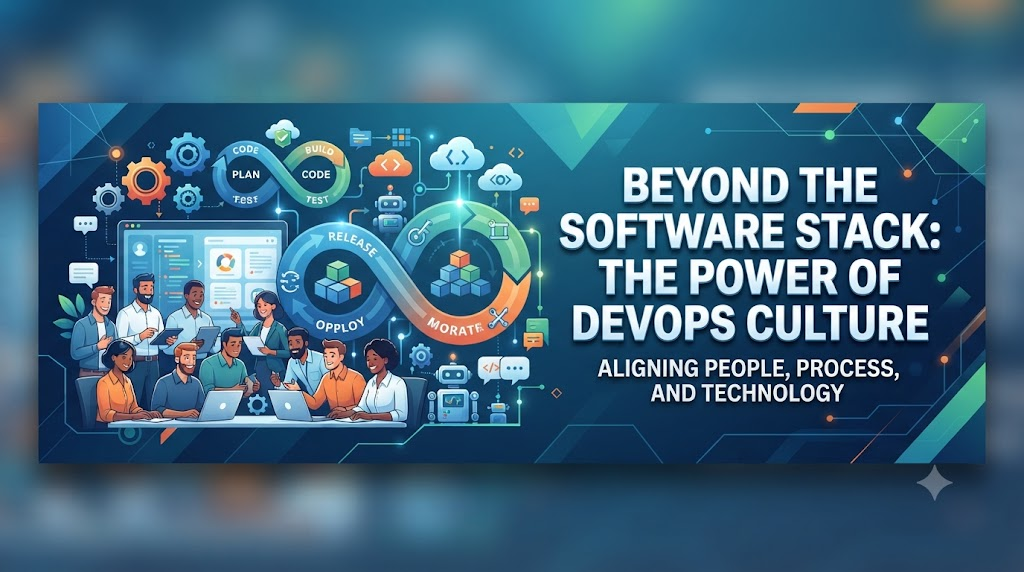
At its core, DevOps culture is a shared way of working where software development and IT operations teams stop acting like separate camps and start acting as a single team.
In a traditional setup, developers throw their code over an imaginary wall to the operations team, saying, “My job is done, now make it run.” If the code crashes in the real world, operations takes the blame.
DevOps tears down that wall. It unites the entire lifecycle of software—from the first line of code written on a laptop to the moment a customer uses it on a website.
Why Culture Matters More Than Tools
Tools are like sports equipment. If you hand a professional tennis racket to someone who has never played tennis, they will not win a match.
Similarly, giving an uncoordinated, siloed organization a modern cloud platform just gives them a bigger, more expensive way to break things. Culture determines how people use those tools. When a team shares goals and trusts one another, they use tools to solve problems. When a team is divided, tools become weapons for pointing fingers.
How Traditional Teams vs. DevOps Teams Work
To understand the power of culture, it helps to look at how daily habits differ between traditional companies and culture-first DevOps organizations.
The Traditional Siloed Approach
- Isolated Goals: Developers are rewarded for writing code quickly; operations is rewarded for keeping systems unchanged.
- Slow Feedback: Weeks or months pass between writing code and launching it to users.
- Fear of Failure: Mistakes lead to lengthy investigations to find out who to blame.
- Manual Hand-offs: Every step requires filling out tickets and waiting for approvals from other departments.
The DevOps Cultural Approach
- Shared Ownership: Everyone owns the product from development to production.
- Continuous Feedback: Small batches of code are tested and launched frequently, catching errors early.
- Blameless Post-Mortems: When failures happen, teams ask what went wrong in the system, not who made the mistake.
- Automation of Routine Work: Repetitive tasks are automated so humans can focus on creative problem-solving.
The Core Pillars of DevOps Culture
Building a strong DevOps culture requires intentional changes in daily habits. Four key pillars form this foundation.
1. Shared Responsibility
In a healthy DevOps environment, nobody says, “That is not my job.” If a customer experiences an outage, developers and operators work together to fix it. Developers care about how their code behaves on real servers, and operators understand the design choices behind the code.
2. Psychological Safety
People cannot innovate if they are afraid of making mistakes. Psychological safety means team members feel safe speaking up, reporting bugs, and suggesting bold changes without fear of punishment. When fear drops, problem-solving speed increases.
3. Continuous Learning
Technology changes rapidly, and no one knows everything. A strong culture encourages experimentation, shared code reviews, and honest discussions about failures. Every mistake becomes a lesson for the whole organization instead of a secret swept under the rug.
4. Transparency
Information should flow freely between departments. Hiding technical debt, secret project timelines, or server issues creates panic. Transparent teams share metrics, status reports, and roadblocks openly.
Real-World Practical Example: The Bank Website Upgrade
Consider a traditional bank trying to update its mobile banking app.
- The Tool-First Mistake: The bank spends millions on the latest cloud infrastructure and automated deployment software. However, the development team and the security compliance team still refuse to talk to each other until the very last day. When the app launches, security blocks it because compliance checks were ignored during development. The project stalls for months.
- The Culture-First Approach: The bank reorganizes its teams into cross-functional squads that include developers, security experts, and operations staff working side-by-side from day one. Security rules are built directly into the development workflow. The app launches smoothly in small, safe pieces because everyone collaborated throughout the process.
Common Mistakes Organizations Make
Many companies try to adopt DevOps and fail because they fall into predictable traps.
- Buying Tools First: Organizations purchase expensive software licenses before changing how their teams communicate, expecting the software to magically fix human problems.
- Creating a “DevOps Team”: Creating a separate department called “The DevOps Team” just builds a new silo. DevOps is a culture for everyone, not a job title for a select few.
- Punishing Failure: Companies claim they want innovation, but they punish employees when an experiment fails, driving fear back into the workplace.
- Ignoring Feedback Loops: Teams push code faster using automation but ignore user complaints and system error logs, speeding up the delivery of poor-quality software.
Risks and Limitations of Focusing Only on Culture
While culture is critical, ignoring technical reality creates its own dangers.
- Culture Without Engineering Standards: A happy, collaborative team that lacks technical skills will still produce insecure, messy software. Culture must be paired with solid engineering practices.
- Burnout from Endless Collaboration: If every single decision requires endless meetings and consensus, teams slow to a crawl. Good culture also requires clear ownership and decision-making boundaries.
- Resistance to Change: In large, traditional companies, entrenched habits can take years to shift. Expecting cultural transformation overnight leads to frustration and cynicism.
Checklist for Evaluating Your Team Culture
Before investing your next budget cycle into more software tools, review this checklist to assess your organization’s human readiness:
- Do developers and operations staff sit together or communicate regularly to solve joint problems?
- When a system crashes, do leaders look for systemic fixes or look for someone to blame?
- Are security and testing considered early in development or tacked on at the very end?
- Do team members feel comfortable pointing out flaws in code or project plans?
- Is automation used to reduce human toil rather than just speed up a broken process?
Key Terms
- Continuous Delivery: The practice of building, testing, and preparing software updates so they can be released to users at any time with minimal human effort.
- Silo: An isolated department or team that refuses to share information or work collaboratively with other groups in the same company.
- Blameless Post-Mortem: A structured meeting held after an outage or failure to analyze what happened mechanically without pointing fingers at individuals.
- Technical Debt: The future cost of choosing quick, sloppy software shortcuts today instead of clean, sustainable design.
- Cross-Functional Team: A group made up of people with different skills (such as coding, testing, and infrastructure) working together on the same goal.
FAQs
Can a company achieve DevOps success without buying expensive tools?
Yes. While tools help automate repetitive tasks, a company with strong communication, shared responsibility, and a blameless culture will always outperform a dysfunctional company that owns the most expensive software on the market.
Is DevOps only for large technology companies?
No. Any organization that builds and maintains software—from small retail startups to traditional hospitals and banks—benefits from removing silos and improving collaboration between teams.
Who is responsible for DevOps in an organization?
Everyone. DevOps is not a single job title or department. It is a cultural mindset shared by developers, operations staff, testers, managers, and business leaders.
Why do companies keep buying tools instead of fixing culture?
Buying software is easy and fast to measure on a corporate budget. Changing human behavior, breaking down departmental walls, and building trust takes time, patience, and strong leadership.
How long does it take to shift toward a DevOps culture?
Cultural transformation is a journey that often takes anywhere from several months to a few years, depending on the size of the organization and the depth of existing habits.
Conclusion
Tools are necessary, but they are only amplifiers. If your organization is collaborative, transparent, and focused on shared success, tools will amplify your speed and stability. If your organization is divided, fearful, and plagued by finger-pointing, tools will only amplify your chaos.
Before upgrading your software stack, invest in your people. Clear communication, shared goals, and psychological safety lay the foundation upon which all lasting technological success is built.

