
Introduction
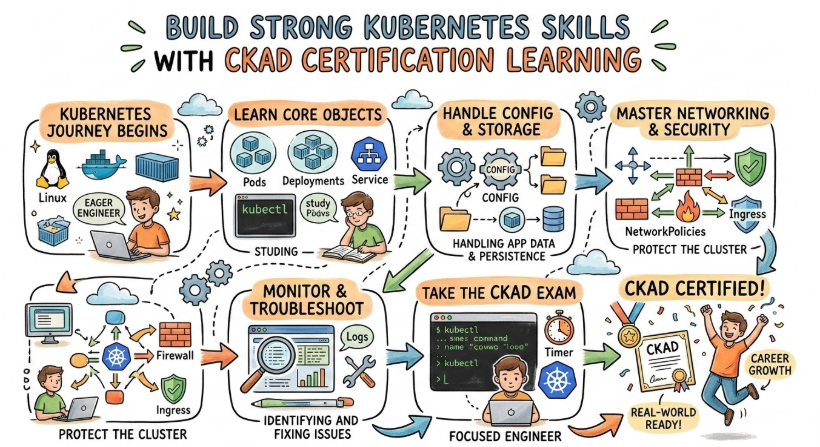
The Certified Kubernetes Application Developer (CKAD) is an industry-recognized, performance-based certification. It is designed to evaluate an individual’s ability to design, build, and configure cloud-native applications within a live Kubernetes cluster. Unlike theoretical assessments, this exam is conducted entirely within a command-line interface, requiring the hands-on resolution of real-world scenarios under timed conditions.
Why it matters in today’s software, cloud, and automation ecosystem
Infrastructure is now being treated as an extension of the application itself. Because organizations are demanding faster release cycles and higher resilience, the “silo” between development and operations is being dismantled. The CKAD empowers engineers to manage their own application lifecycle, from pod creation to complex network policies, ensuring that high-performance software is delivered consistently.
Why certifications are important for engineers and managers
A structured validation of skill is provided by professional certifications. For the engineer, it acts as a roadmap for mastering the intricacies of container orchestration. For the manager, it serves as a reliable metric for team capability, ensuring that architectural decisions are made based on deep technical knowledge rather than guesswork.
Certification Overview Table
| Track | Level | Who it’s for | Prerequisites | Skills Covered | Recommended Order |
| Cloud Native | Specialist | Developers & SREs | Basic Linux & Docker | Pods, Deployments, ConfigMaps | After CKA or Standalone |
Why Choose DevOpsSchool?
Deep industry expertise is shared by mentors at DevOpsSchool who have managed production clusters for over two decades. A curriculum is followed that goes beyond the exam objectives, focusing instead on the challenges faced in real-world enterprise environments. Students are provided with high-end lab access and one-on-one support, ensuring that complex concepts like multi-container pods and persistent volumes are fully grasped. This institution is recognized for transforming students into high-value assets for any technical organization.
Certification Deep-Dive
Certified Kubernetes Application Developer (CKAD)
What is this certification?
This is a practical exam focused on the application developer’s role in a Kubernetes ecosystem. It tests the ability to deploy, monitor, and troubleshoot applications using core Kubernetes primitives.
Who should take this certification?
Engineers involved in building microservices, DevOps practitioners, and SREs are the primary candidates. It is also highly recommended for platform engineers who focus on the developer experience.
Skills you will gain
- Multi-container pod patterns (Sidecar, Ambassador, Adapter) are implemented.
- Application configurations are managed using ConfigMaps and Secrets.
- Seamless rolling updates and rollbacks are executed.
- Probes are configured to ensure application health and self-healing.
- Resource limits and quotas are established to optimize cluster performance.
Real-world projects you should be able to do after this certification
- A legacy monolithic application is successfully migrated to a Kubernetes-native microservice.
- Zero-downtime deployment pipelines are built for high-traffic environments.
- Troubleshooting is performed on complex networking issues within a cluster.
- Statefull applications are managed using Persistent Volume Claims.
Preparation plan
- 7–14 days plan: The focus is placed on the imperative commands of
kubectl. Mock exams are taken daily to build speed and muscle memory. - 30 days plan: Two hours are dedicated each evening to a different domain. Networking and Security are given extra focus in the third week.
- 60 days plan: A comprehensive approach is taken, starting with containerization fundamentals. Every lab is repeated three times to ensure total mastery of the CLI.
Common mistakes to avoid
- Too much time is spent on non-essential YAML formatting.
- The official documentation is not used as an effective search tool.
- Context switches are ignored, leading to work being performed in the wrong namespace.
Best next certification after this
- Same track: Certified Kubernetes Administrator (CKA).
- Cross-track: Certified Kubernetes Security Specialist (CKS).
- Leadership / management: Certified Business Agility Professional.
Choose Your Learning Path
DevOps Learning Path
This path is chosen by those who want to bridge the gap between development and operations. It is focused on end-to-end automation and CI/CD mastery.
DevSecOps Learning Path
Security is integrated into every stage of the lifecycle in this path. It is ideal for engineers who prioritize cluster hardening and vulnerability management.
Site Reliability Engineering (SRE) Path
Scalability and uptime are the primary objectives here. This path is designed for professionals responsible for the reliability of high-scale systems.
AIOps / MLOps Path
Machine learning models are orchestrated and scaled using Kubernetes in this path. It is targeted at data scientists and AI engineers.
DataOps Path
Data delivery and integrity are managed through automated pipelines. This is the preferred path for data engineers working in cloud-native environments.
FinOps Path
Cloud expenditure is optimized through technical insights. This path is intended for those who balance performance requirements with financial constraints.
Role → Recommended Certifications Mapping
- DevOps Engineer: CKAD, CKA, Terraform Associate.
- Site Reliability Engineer (SRE): CKAD, Prometheus Certified, Chaos Engineering.
- Platform Engineer: CKAD, CKA, Certified GitOps Associate.
- Cloud Engineer: CKAD, AWS Solutions Architect, Azure Administrator.
- Security Engineer: CKAD, CKS, Certified DevSecOps Professional.
- Data Engineer: CKAD, Apache Spark, DataOps certifications.
- FinOps Practitioner: CKAD, FinOps Certified Practitioner.
- Engineering Manager: CKAD, PMP, Leading SAFe.
Next Certifications to Take
For the technical enthusiast:
- Same-track: Certified Kubernetes Administrator (CKA) is taken to understand the control plane.
- Cross-track: HashiCorp Certified: Terraform Associate is recommended for infrastructure as code.
- Leadership-focused: Professional Scrum Master (PSM) is suggested for leading agile teams.
Training & Certification Support Institutions
DevOpsSchool
Mentorship is provided by industry experts with deep hands-on experience. This institution is known for its focus on career outcomes and practical skills.
Cotocus
Customized training programs are delivered to corporate teams worldwide. The training is centered on solving real-world production challenges.
ScmGalaxy
A vast library of technical content and community support is offered. It is a premier destination for mastering configuration management.
BestDevOps
Simplified and practical learning paths are created for busy professionals. A high success rate is maintained through intensive lab sessions.
devsecopsschool.com
A dedicated focus is placed on the security aspect of the DevOps lifecycle. Advanced courses on container security are provided.
sreschool.com
Reliability, monitoring, and incident response are the core pillars of training here. It is designed for those managing “always-on” systems.
aiopsschool.com
Automation and artificial intelligence are combined in their specialized training modules. It is a hub for future-ready operations.
dataopsschool.com
Training is provided for the seamless orchestration of data pipelines. It is highly valued by data engineers globally.
finopsschool.com
The intersection of cloud technology and finance is explored. Strategies for cost-efficient cloud operations are taught here.
FAQs Section
General Career Value
- Is CKAD required for high-paying roles?
It is considered a major advantage in the cloud-native job market. - How much time is needed for the exam?
Two hours are allotted for the completion of the tasks. - What is the difficulty level?
It is rated as intermediate but challenging due to the practical format. - Are there prerequisites?
No, but Linux proficiency is expected. - Is the certificate recognized globally?
Yes, it is the standard for Kubernetes application development. - Does it help in remote job roles?
Many global firms prioritize certified candidates for remote engineering positions. - What is the passing score?
A score of at least 66% must be achieved. - How long is the validity?
The certification is valid for a period of 36 months. - Are retakes allowed?
One free retake is typically provided with the exam voucher. - Is an IDE available during the exam?
No, only the terminal and a simple text editor are provided. - Can documentation be used?
Access to the official Kubernetes documentation is permitted. - Is it worth it for developers?
Yes, it is the best way to prove mastery of the deployment environment.
CKAD Specifics
- Is Docker tested?
While container knowledge is needed, the exam uses the Kubernetes runtime. - Are Helm charts included?
Yes, basic Helm operations are part of the latest curriculum. - What is the focus on Networking?
NetworkPolicies and Services are major areas of testing. - Are storage concepts included?
Yes, PersistentVolumes and Claims are evaluated. - Is YAML manually written?
Using imperative commands to generate YAML is highly recommended. - Is the exam multiple-choice?
No, it is a 100% performance-based exam. - How often is the exam updated?
It is updated regularly to reflect the current Kubernetes version. - Can I use my own notes?
No external notes are allowed; only official documentation is permitted.
Testimonials
Aman Verma, DevOps Engineer
“The training at DevOpsSchool was instrumental in my success. Complex concepts were made simple and easy to apply in my daily tasks.”
Sowmya Reddy, SRE
“Becoming CKAD certified has given me immense confidence. I can now troubleshoot production issues with much greater speed.”
Deepak Gupta, Cloud Engineer
“The practical approach followed during the preparation was the key. My professional value has increased significantly in the industry.”
Neha Sharma, Security Specialist
“A deep understanding of application security within Kubernetes was gained. This certification is a must for any modern engineer.”
Vikram Singh, Engineering Manager
“The technical depth of my team has improved remarkably since we prioritized the CKAD. It has made our architectural reviews much more efficient.”
Conclusion
The Certified Kubernetes Application Developer (CKAD) certification is recognized as a cornerstone for anyone serious about a career in cloud-native engineering. As the complexity of software systems continues to increase, the ability to manage applications within a Kubernetes cluster is seen as a critical skill. By committing to a structured learning plan and choosing the right training partner, a long-term career benefit is secured. The path to mastery is challenging, but the outcomes for professional growth and confidence are unparalleled.

