
Introduction
Infrastructure as Code (IaC) has become the backbone of modern software delivery. In an era where cloud resources are provisioned at a rapid pace, manual configuration is no longer considered a viable option. The ability to manage servers, databases, and networks through code is a skill that is highly sought after by organizations worldwide. Among the various tools available for this purpose, Terraform stands out as a leader due to its cloud-agnostic nature and robust ecosystem.
A structured path is often required by engineers to master this powerful tool. The Hashicorp Certified Terraform Associate program is designed to provide this structure. It is recognized as a benchmark for professionals who wish to demonstrate their proficiency in infrastructure automation. Whether an engineer is working in a startup or a large enterprise, this certification is viewed as a significant milestone in a career dedicated to cloud and automation.
What is Hashicorp Certified Terraform Associate?
The Hashicorp Certified Terraform Associate is a professional credential that validates a candidate’s fundamental knowledge of Terraform. It is an industry-recognized exam that tests the understanding of infrastructure as code principles. The core concepts of the Terraform workflow, such as initializing, planning, and applying changes, are thoroughly evaluated during the process.
Knowledge of Terraform Cloud and Terraform Enterprise is also assessed. It is intended for individuals who have practical experience in using Terraform in a professional environment. The certification ensures that a standard level of competency is maintained across the industry, making it easier for hiring managers to identify qualified talent.
Why it Matters in Today’s Software, Cloud, and Automation Ecosystem
The software ecosystem is currently driven by speed and reliability. Continuous Integration and Continuous Deployment (CI/CD) pipelines are heavily reliant on stable infrastructure. When infrastructure is treated as code, version control can be applied, and errors can be minimized. Terraform allows for this consistency across multiple cloud providers like AWS, Azure, and Google Cloud.
In today’s automation-first world, the following points highlight why this certification is essential:
- Multi-Cloud Strategy: Most modern organizations utilize more than one cloud provider. Terraform is favored because it provides a single syntax to manage resources across different platforms.
- Operational Efficiency: Time is saved when infrastructure is automated. Manual errors are reduced, and the deployment process is accelerated.
- Scalability: Thousands of resources can be managed simultaneously with ease when the right code structure is utilized.
- Cost Control: Orphaned resources are easily identified and destroyed when everything is tracked through state files.
Why Certifications are Important for Engineers and Managers
Certifications act as a formal validation of a person’s skill set. For an engineer, it provides a sense of accomplishment and a clear learning path. It helps in bridging the gap between theoretical knowledge and practical application. When a resume is reviewed, a certification often serves as a filter that highlights dedication and expertise.
For managers, certifications are a tool for risk mitigation. When a team is certified, a certain level of technical quality is guaranteed. It becomes easier to assign complex tasks to individuals whose skills have been verified by a third party. Furthermore, certifications are often required by clients during the bidding process for new projects, making the team more competitive in the global market.
Why Choose DevOpsSchool?
When preparation for a high-stakes exam is undertaken, the choice of a training institution is critical. DevOpsSchool is widely recognized as a premier destination for specialized cloud and automation training. The curriculum is meticulously crafted by experts who have spent years in the field solving complex architectural problems.
A hands-on approach is prioritized at DevOpsSchool. Real-world scenarios are simulated to ensure that the learning is not just limited to passing an exam but also focused on job readiness. Support is provided by a dedicated community of learners and mentors, ensuring that no doubt remains unresolved. By choosing this platform, a learner is given access to updated study materials, lab environments, and expert guidance that is essential for a successful career in the DevOps ecosystem.
Certification Deep-Dive: Hashicorp Certified Terraform Associate
What is this certification?
The Hashicorp Certified Terraform Associate is a foundational exam designed for Cloud Engineers and DevOps professionals. It confirms the ability to create, change, and improve infrastructure safely and efficiently using Terraform.
Who should take this certification?
This certification is highly recommended for Software Engineers, Systems Administrators, and Cloud Architects. It is also suitable for Engineering Managers who wish to understand the technical depth of the automation tools used by their teams.
Certification Overview Table
| Track | Level | Who it’s for | Prerequisites | Skills Covered | Recommended Order |
| DevOps | Associate | DevOps Engineers | Basic Cloud Knowledge | IaC, Terraform Workflow, State Management | 1st |
| DevSecOps | Associate | Security Engineers | Security Fundamentals | Policy as Code, Sentinel, Secure Secrets | 2nd |
| SRE | Associate | SREs | System Administration | Reliability, Scaling, Drift Detection | 1st |
| AIOps/MLOps | Associate | Data Scientists | Python/Basic Linux | Infrastructure for Models, Resource Scaling | 2nd |
| DataOps | Associate | Data Engineers | SQL/Database Knowledge | Provisioning Data Warehouses, Pipelines | 2nd |
| FinOps | Associate | FinOps Analysts | Cloud Billing Knowledge | Tagging, Resource Optimization, Cost IaC | 3rd |
Skills You Will Gain
- Infrastructure Management: The ability to provision resources on any cloud platform is mastered.
- State Management: An understanding of how Terraform tracks the current state of infrastructure is developed.
- Modular Coding: Knowledge on how to create reusable modules for complex environments is gained.
- Collaboration: Proficiency in using Terraform Cloud for team-based infrastructure management is acquired.
- Workflow Optimization: The standard workflow of Init, Plan, and Apply is deeply understood.
Real-World Projects You Should Be Able to Do
- Automated VPC Creation: A complete Virtual Private Cloud with subnets and security groups is deployed across multiple regions.
- Multi-Tier Web Application: Load balancers, web servers, and database instances are provisioned and linked automatically.
- Kubernetes Cluster Deployment: Managed Kubernetes services like EKS or GKE are set up using Terraform scripts.
- Drift Detection System: A mechanism to identify and fix manual changes in the cloud environment is implemented.
Preparation Plan
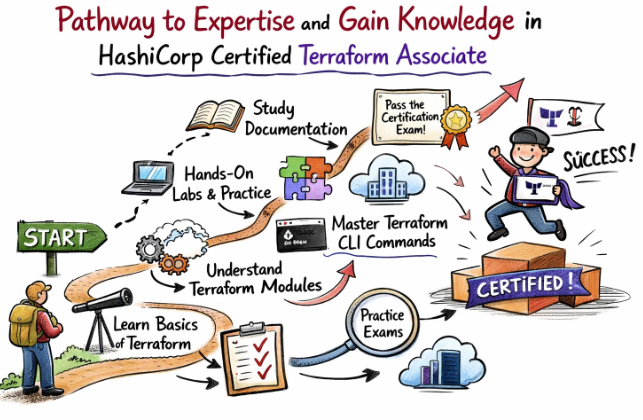
7–14 Days Plan (The Intensive Path)
- Days 1-3: Official documentation is read. The basic syntax and providers are explored.
- Days 4-7: Lab exercises are performed. Simple resources are provisioned on a free-tier cloud account.
- Days 8-10: Advanced concepts like State, Modules, and Functions are studied.
- Days 11-14: Practice exams are taken. Weak areas are reviewed and corrected.
30 Days Plan (The Balanced Path)
- Week 1: Theoretical foundations of IaC and Terraform architecture are established.
- Week 2: Hands-on practice with the Terraform CLI is prioritized.
- Week 3: Complex scenarios involving remote backends and state locking are practiced.
- Week 4: Mock tests are completed. Final review of Terraform Cloud features is conducted.
60 Days Plan (The Deep-Dive Path)
- Month 1: A deep understanding of cloud providers is gained alongside Terraform basics. Small projects are built every weekend.
- Month 2: Focus is shifted towards enterprise features, security best practices, and Sentinel policies. Extensive time is spent on troubleshooting common errors.
Common Mistakes to Avoid
- Ignoring the State File: The importance of the state file is often underestimated, leading to corrupted infrastructure.
- Hardcoding Values: Variables should be used instead of hardcoding sensitive information or environment-specific data.
- Skipping Documentation: The official Hashicorp documentation is frequently updated and should be the primary source of truth.
- Lack of Hands-on: Relying only on videos without actually running code is a common reason for failure.
Best Next Certification After This
- Same Track: Hashicorp Certified Vault Associate (to manage secrets within the infrastructure).
- Cross-Track: AWS Certified SysOps Administrator or Azure Administrator (AZ-104).
- Leadership / Management: Certified Kubernetes Administrator (CKA) or PMP for technical project management.
Choose Your Learning Path
DevOps Learning Path
This path is designed for those who want to master the art of continuous delivery. Terraform is used to build the underlying infrastructure that supports CI/CD tools. It is best for engineers focused on speed and reliability in software releases.
DevSecOps Learning Path
Security is integrated into the IaC templates. Policies are written to ensure that no insecure resource is ever provisioned. This is ideal for professionals who are passionate about cloud security and compliance.
Site Reliability Engineering (SRE) Learning Path
The focus here is on uptime and performance. Terraform is utilized to create highly available architectures and to detect infrastructure drift. It is best for those who enjoy troubleshooting and maintaining large-scale systems.
AIOps / MLOps Learning Path
Infrastructure for training and deploying machine learning models is automated. Large GPU clusters are provisioned only when needed to save costs. This path is perfect for data professionals moving into the operational side of AI.
DataOps Learning Path
Data pipelines and data warehouses are managed through code. Consistency in data environments is maintained across development and production. This is recommended for Data Engineers who want to automate their environment setup.
FinOps Learning Path
The financial impact of infrastructure is monitored. Tags are enforced through Terraform to ensure every dollar spent is accounted for. This is best for professionals who manage cloud budgets and resource optimization.
Role → Recommended Certifications Mapping
| Role | Primary Recommended Certification | Secondary Certification |
| DevOps Engineer | Terraform Associate | Kubernetes Administrator |
| Site Reliability Engineer | Terraform Associate | Promethues/Grafana Certified |
| Platform Engineer | Terraform Associate | Docker Certified Associate |
| Cloud Engineer | Terraform Associate | AWS/Azure Professional |
| Security Engineer | Terraform Associate | Vault Associate |
| Data Engineer | Terraform Associate | Databricks/Snowflake Certified |
| FinOps Practitioner | Terraform Associate | FinOps Certified Practitioner |
| Engineering Manager | Terraform Associate | Certified Cloud Practitioner |
Next Certifications to Take
- For the Automation Enthusiast:
- Same-track: Vault Associate
- Cross-track: Certified Kubernetes Administrator
- Leadership: ITIL Foundation
- For the Security Specialist:
- Same-track: Sentinel Policy Professional
- Cross-track: Certified Cloud Security Professional (CCSP)
- Leadership: CISM (Certified Information Security Manager)
- For the Data Focused:
- Same-track: Terraform Cloud Specialist
- Cross-track: Google Professional Data Engineer
- Leadership: Project Management Professional (PMP)
Training & Certification Support Institutions
DevOpsSchool
Comprehensive training for Terraform and various DevOps tools is provided by DevOpsSchool. A blend of live sessions and recorded content is offered to suit different learning speeds. The focus remains on practical implementation and career growth.
Cotocus
Specialized consulting and training services are delivered by Cotocus. Their programs are designed to meet the needs of modern enterprises looking to upskill their workforce in cloud-native technologies. Industry experts are involved in every step of the training process.
ScmGalaxy
A wealth of resources including blogs, tutorials, and community support is found at ScmGalaxy. It serves as a knowledge hub for Software Configuration Management and DevOps professionals across the globe.
BestDevOps
Premium quality training materials and certification guidance are provided by BestDevOps. Their curriculum is updated regularly to reflect the latest changes in the technology landscape, ensuring learners stay ahead of the curve.
devsecopsschool.com
A dedicated platform for security-focused DevOps training is provided here. The integration of security into every phase of the development lifecycle is taught with great detail.
sreschool.com
Reliability and performance of systems are the primary focus at sreschool.com. Training is centered around building resilient architectures and mastering monitoring tools.
aiopsschool.com
The intersection of Artificial Intelligence and Operations is explored at this institution. Training on how to apply AI to automate IT operations is provided to forward-thinking professionals.
dataopsschool.com
Data lifecycle management and automation are taught here. The institution focuses on making data delivery faster and more reliable through automated pipelines.
finopsschool.com
Cloud financial management is the core subject at finopsschool.com. Professionals are trained to bring financial accountability to the variable spend model of the cloud.
FAQs Section
What is the difficulty level of the Terraform Associate exam?
The difficulty level is considered moderate. A solid understanding of basic CLI commands and cloud concepts is required to pass.
How much time is required to prepare for this certification?
Approximately 4 to 6 weeks are needed if a few hours are dedicated each day. This varies based on prior experience with cloud tools.
Are there any prerequisites for taking this exam?
No formal prerequisites are mandated by Hashicorp. However, basic knowledge of cloud platforms is highly recommended.
What is the recommended sequence for Hashicorp certifications?
The Terraform Associate is usually taken first, followed by Vault and then Consul certifications.
What is the career value of being Terraform certified?
Significant career growth is often observed. It leads to higher salary packages and better job opportunities in top-tier tech companies.
Which job roles benefit most from this certification?
DevOps Engineers, Cloud Architects, and Site Reliability Engineers benefit the most from this credential.
Can the exam be taken online?
Yes, the exam is conducted online and is proctored remotely for the convenience of candidates.
Is Terraform only for AWS?
No, Terraform is cloud-agnostic. It is used to manage resources on Azure, Google Cloud, Oracle Cloud, and many others.
How long is the certification valid?
The certification is typically valid for two years, after which recertification is encouraged.
What kind of questions are asked in the exam?
Multiple-choice and multiple-response questions are included. Some questions may involve matching or fill-in-the-blanks.
Is coding knowledge required?
While deep programming skills are not needed, a basic understanding of configuration syntax and logic is essential.
Does this certification help in getting a job in India?
Yes, there is a massive demand for Terraform-certified professionals in the Indian IT sector, especially in service and product-based companies.
Hashicorp Certified Terraform Associate Specific FAQs
- What is the focus of the Hashicorp Certified Terraform Associate exam?
The focus is placed on the core features of Terraform and the standard workflow used in infrastructure automation.
- Is Terraform Cloud covered in the Associate exam?
Yes, basic concepts of Terraform Cloud and how it differs from the CLI-based workflow are included in the syllabus.
- How many questions are there in the Terraform Associate exam?
Usually, 57 to 60 questions are presented during the exam, which must be completed within 60 minutes.
- What is the passing score for the certification?
While the exact passing percentage is not always disclosed, a score of around 70% is generally required to pass.
- Are there any lab-based questions in the exam?
No, the current version of the exam does not include live lab tasks, but scenario-based questions are common.
- Can Terraform modules be tested in the exam?
Yes, the creation, usage, and benefits of modules are key areas that are frequently tested.
- What is the cost of the Hashicorp Certified Terraform Associate exam?
The exam fee is approximately 70 USD plus applicable taxes, depending on the region.
- Where can the official exam guide be found?
The official guide and syllabus are available at the provided DevOpsSchool certification URL.
Testimonials
Arjun
The concepts of infrastructure as code were finally cleared after I completed this certification. The real-world application of modules has improved the way our team manages cloud resources.
Ishani
Career clarity was gained after following the structured learning path provided. My confidence in handling complex multi-cloud deployments has grown significantly.
Kabir
Skill improvement was noticed by my peers immediately after I started applying the best practices learned during the preparation. It is a must-have for every cloud engineer.
Ananya
The ability to provision entire environments in minutes was a game-changer for our project. This certification validated my expertise and helped me secure a better role.
Vihaan
The structured approach to state management was the most valuable takeaway for me. Professional growth has been steady since I added this credential to my profile.
Conclusion
The Hashicorp Certified Terraform Associate certification is a vital asset for any modern engineer. It provides the necessary tools and knowledge to thrive in an industry that is moving rapidly toward total automation. By mastering Terraform, a professional is not just learning a tool but adopting a mindset of efficiency and scalability.
Long-term career benefits include higher visibility in the job market and the ability to lead complex automation projects. Strategic learning and planning are encouraged for everyone aiming to stay relevant in the cloud-native era. The journey toward becoming a Terraform expert is both challenging and rewarding, paving the way for a successful future in the technology domain.

