
Introduction
In the modern technology world, data is often viewed as a burden rather than a benefit. Massive amounts of information are collected daily, yet the ability to deliver that data reliably is frequently missing. Traditional methods are being replaced by automated workflows that focus on speed and quality. This movement is known as DataOps. The CDOM – Certified DataOps Manager program is established to address these modern challenges. A clear path is provided for those who wish to lead data teams with technical precision. This guide is curated to explain the importance of the certification and how it impacts long-term career growth.
What is CDOM – Certified DataOps Manager
The CDOM – Certified DataOps Manager is a professional credential that focuses on the intersection of data management and DevOps principles. It is centered on the automation of data delivery, the improvement of data quality, and the reduction of the cycle time for data analytics.
By this certification, a framework is provided for professionals to manage data as a product. The focus is placed on creating predictable, high-quality data flows that can support business intelligence and machine learning initiatives. It is not just about technical tools; it is about the cultural and process changes needed to make data operations seamless.
Why it matters today?
In today’s fast-paced digital economy, decisions are driven by data. However, many organizations struggle with “data debt” and broken pipelines. Traditional methods of managing data are found to be too slow and prone to errors.
DataOps is required because:
- Speed is essential: Businesses cannot wait weeks for data reports.
- Complexity is increasing: Data is being pulled from hundreds of different sources.
- Quality is non-negotiable: Poor data leads to poor business decisions.
- Collaboration is lacking: Data scientists and operations teams often work in isolation.
The CDOM program addresses these issues by teaching a methodology that brings agility to data workflows.
Why CDOM – Certified DataOps Manager certifications are important
The value of a certification is often measured by its relevance to industry pain points. The CDOM certification is considered important for several reasons.
Firstly, a standard language for DataOps is established. This allows teams to communicate more effectively. Secondly, a structured approach to automation is learned. Instead of manual data cleaning, automated tests and deployment pipelines are implemented.
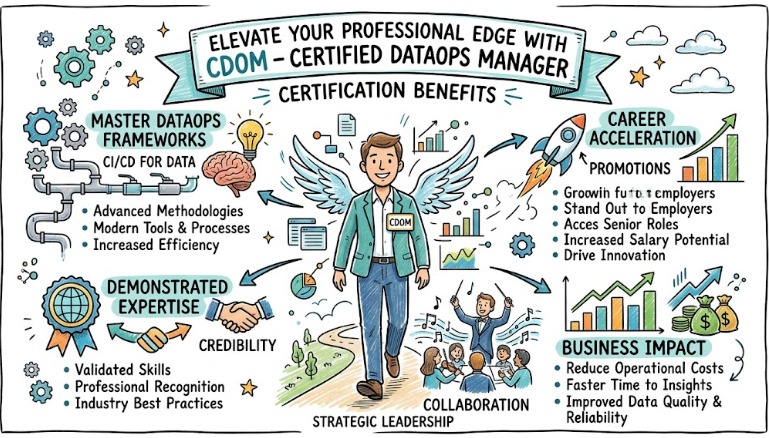
Thirdly, career growth is significantly enhanced. As companies invest more in AI and Big Data, the need for managers who understand the operational side of data is growing. Professionals who hold this certification are often viewed as leaders who can handle both the technical and strategic aspects of data infrastructure.
Why Choose DataOpsSchool?
When a certification is sought, the reputation of the training provider is of the utmost importance. DataOpsSchool is chosen by professionals globally for several specific reasons.
- Practical Curriculum: The focus is kept on real-world scenarios rather than just theoretical concepts.
- Industry Alignment: The course material is regularly updated to reflect the latest shifts in cloud data infrastructure.
- Expert Guidance: Knowledge is shared by mentors who have handled large-scale data environments.
- Comprehensive Support: From the start of the learning journey to the final exam, consistent support is provided to every candidate.
Certification Deep-Dive: CDOM – Certified DataOps Manager
What is this certification?
The CDOM is a management-level certification that validates the ability to implement and lead DataOps practices within an organization. It focuses on the end-to-end lifecycle of data, from ingestion to consumption.
Who should take this certification?
This program is intended for Data Engineers, DevOps Engineers, Engineering Managers, and IT professionals who are responsible for data infrastructure and delivery. It is also highly beneficial for those moving into leadership roles within data-centric organizations.
Certification Overview Table
| Track | Level | Who it’s for | Prerequisites | Skills Covered | Recommended Order |
| Foundation | Beginner | Aspiring Data Professionals | Basic IT Knowledge | DataOps Basics, Agile Data | 1st |
| Professional | Intermediate | Data Engineers / DevOps | Foundation Cert | Pipeline Automation, CI/CD | 2nd |
| Manager (CDOM) | Advanced | Team Leads / Managers | Professional Cert | Strategic Planning, Governance | 3rd |
| Architect | Expert | Senior Architects | CDOM / Professional | Scaling DataOps, Enterprise AI | 4th |
Skills you will gain
- The ability to design automated data pipelines.
- Expertise in implementing continuous integration and continuous delivery (CI/CD) for data.
- Knowledge of data quality monitoring and automated testing.
- Skills in managing cross-functional data and operations teams.
- The capability to reduce operational costs through better data resource management.
Real-world projects you should be able to do after this certification
- Automated Data Quality Gate: A system is built where data is automatically checked for errors before it reaches the dashboard.
- End-to-End Pipeline Orchestration: A workflow is designed to move data from a raw cloud storage bucket to a production database without manual intervention.
- Data Environment Provisioning: Tools are used to spin up temporary data environments for testing purposes.
- Monitoring and Alerting Dashboard: A central hub is created to track the health and latency of all data flows.
Preparation Plan
7–14 Days Plan (The Intensive Sprint)
- Days 1-3: Focus is placed on the core definitions of DataOps and the CDOM syllabus.
- Days 4-7: Official documentation and whitepapers from the provider are reviewed.
- Days 8-10: Practice exams are taken to identify weak areas.
- Days 11-14: Final revision of the strategic governance and management modules is completed.
30 Days Plan (The Balanced Approach)
- Week 1: Theoretical foundations and the history of DataOps are studied.
- Week 2: The technical pillars, such as automation and orchestration, are explored.
- Week 3: Case studies of successful DataOps implementations are analyzed.
- Week 4: Mock tests are performed, and time is spent on the FAQ sections of the official site.
60 Days Plan (The Deep Dive)
- Month 1: A deep understanding of how DataOps differs from traditional Data Management is built. Hands-on labs are practiced.
- Month 2: Advanced topics like Data Governance, Security in DataOps, and Team Leadership are mastered. Detailed notes are prepared for final review.
Common mistakes to avoid
- Focusing only on tools: The cultural aspect of DataOps is often ignored, which is a mistake.
- Skipping the prerequisites: A strong foundation in basic data concepts is needed before moving to the management level.
- Ignoring the strategic side: For the CDOM, the business value must be understood as much as the technical pipeline.
Best next certification after this
- Same track: Certified DataOps Architect (CDOA)
- Cross-track: Certified DevSecOps Professional (CDP)
- Leadership / management: Certified Site Reliability Manager (CSRM)
Choose Your Learning Path
1. DevOps Path
This path is best for those who already understand CI/CD for software and want to apply those same rigorous standards to data pipelines.
2. DevSecOps Path
This is ideal for security-focused professionals who need to ensure that data remains encrypted and compliant while moving through automated flows.
3. Site Reliability Engineering (SRE) Path
This is chosen by those who want to apply SRE principles—like SLIs and SLOs—to the reliability and uptime of data platforms.
4. AIOps / MLOps Path
This path is tailored for professionals working with AI models who realize that an AI is only as good as the data pipeline supporting it.
5. DataOps Path
The dedicated path for data engineers who want to specialize exclusively in the lifecycle and operational health of data assets.
6. FinOps Path
Best for those who are responsible for the cloud costs associated with large-scale data storage and processing.
Role → Recommended Certifications Mapping
| Role | Recommended Certification | Importance |
| DevOps Engineer | CDOM | Helps in managing data-heavy applications. |
| Site Reliability Engineer | CDOM | Ensures data pipeline stability. |
| Platform Engineer | CDOM | Assists in building internal data platforms. |
| Cloud Engineer | CDOM | Optimizes data storage in the cloud. |
| Security Engineer | CDOM | Focuses on data privacy within pipelines. |
| Data Engineer | CDOM | Elevates role from coder to manager. |
| FinOps Practitioner | CDOM | Manages data-related cloud expenses. |
| Engineering Manager | CDOM | Provides strategic oversight of data teams. |
Next Certifications to Take
Same-track Certification
The Certified DataOps Architect is recommended. This allows a deeper dive into the technical design of enterprise-level data systems. It is the logical progression after mastering the management aspect.
Cross-track Certification
The Certified DevSecOps Professional is a strong choice. As data pipelines become more automated, the security of those pipelines becomes a critical concern for every organization.
Leadership-focused Certification
The Certified Site Reliability Manager is suggested. This helps a professional transition into a high-level leadership role where the reliability of all digital services is managed under one umbrella.
Training & Certification Support Institutions
DevOpsSchool
A wide range of training programs is offered here for various cloud and automation tracks. It is known for its extensive library of resources and hands-on lab environments that help students prepare for global certifications.
Cotocus
This institution provides specialized support for professionals looking to upskill in niche technology areas. A focus is maintained on delivering high-quality training that is aligned with current industry standards and requirements.
ScmGalaxy
A large community and knowledge base are hosted by ScmGalaxy. It serves as a valuable resource for learning about software configuration management, DevOps, and the latest trends in automation and data operations.
BestDevOps
Comprehensive training modules are provided for those seeking to master DevOps and related fields. The programs are designed to be practical, ensuring that learners can apply their knowledge immediately in a professional setting.
Other Specialized Schools
Specialized support is also provided by portals like devsecopsschool.com, sreschool.com, aiopsschool.com, dataopsschool.com, and finopsschool.com. Each of these focus on their respective domains to provide targeted learning experiences.
FAQs
What is the difficulty level of the CDOM certification?
The level is considered moderate to high. It is expected that a candidate has a solid understanding of both data engineering and general operations before attempting the exam.
How much time is required to prepare?
Depending on the prior experience of the individual, between 30 and 60 days are usually suggested for a thorough preparation.
Are there any specific prerequisites?
While basic IT knowledge is required, it is beneficial if a candidate has some experience with data pipelines or DevOps tools.
What is the recommended certification sequence?
The Foundation level is typically taken first, followed by the Professional level, and finally the Manager level (CDOM).
What is the career value of this credential?
Significant value is added to a resume. It demonstrates that the professional can handle the modern challenges of data-driven enterprises.
Which job roles benefit the most from this?
Engineering Managers and Lead Data Engineers are found to gain the most immediate benefit in terms of role responsibilities and growth.
Is the certification recognized globally?
Yes, it is recognized by organizations worldwide that are looking to modernize their data operations.
How does this help in salary growth?
Certified professionals are often eligible for senior roles that command higher compensation due to the specialized nature of DataOps.
Is hands-on experience necessary for the exam?
Yes, many questions are based on real-world scenarios where practical knowledge is essential to choose the correct strategic path.
What is the format of the exam?
The exam is usually conducted online and consists of multiple-choice questions that test both technical and management skills.
How long is the certification valid?
The certification is typically valid for a period of two to three years, after which renewal or a higher-level certification is recommended.
Can this be taken by someone from a non-technical background?
It is designed for those with a technical foundation. However, a highly motivated manager with a basic understanding of data could succeed with dedicated study.
Additional FAQs for CDOM – Certified DataOps Manager
1. What is the main focus of the CDOM curriculum?
The focus is placed on the governance, management, and strategic implementation of DataOps within an enterprise setting.
2. How does CDOM differ from a standard Data Engineering certificate?
While data engineering focuses on building, CDOM focuses on the operational health, scaling, and management of those builds.
3. Is cloud knowledge required for CDOM?
Yes, a basic understanding of cloud infrastructure is needed, as most DataOps practices are implemented in cloud environments.
4. Does CDOM cover AI and Machine Learning?
It covers the data pipelines that support AI and ML, ensuring that the data provided to these models is reliable and timely.
5. Are there mock tests available for CDOM?
Practice exams are provided by the official training partners to help candidates assess their readiness.
6. What is the passing score for the CDOM exam?
The specific passing score is set by the provider, but a high level of proficiency in all modules is required to pass.
7. Can the training be done at one’s own pace?
Self-paced learning options are often available through the official portal and its affiliates.
8. Is there a community for CDOM certified professionals?
Access to a global network of DataOps professionals is often granted upon successful completion of the certification.
Testimonials
Aditi R.
The clarity provided by this program was exceptional. A new way of looking at data pipelines was developed, and it has significantly improved how tasks are managed within the team.
Vikram S.
A great deal of confidence was gained after completing this certification. The real-world scenarios mentioned in the course are exactly what is faced in the industry every day.
Sarah J.
The transition from a technical role to a management perspective was made much easier. The principles of DataOps are now applied to every project to ensure high quality and speed.
Rajesh M.
It was observed that the communication between the data team and the operations team improved after the strategies learned here were implemented. It is a highly recommended path.
Elena P.
A better understanding of the strategic value of automated data flows was achieved. This certification is a must for anyone looking to lead in the modern data era.
Conclusion
The CDOM – Certified DataOps Manager certification is a vital step for any professional who wishes to remain relevant in the evolving tech landscape. As organizations continue to struggle with the complexities of data, the demand for skilled managers who can streamline operations will only increase.
By choosing this learning path, a commitment is made to operational excellence and strategic growth. The long-term career benefits include not only improved job prospects but also the ability to lead impactful changes within any data-driven organization. Strategic planning and a focus on continuous learning are encouraged for all who seek to master the field of DataOps.

