
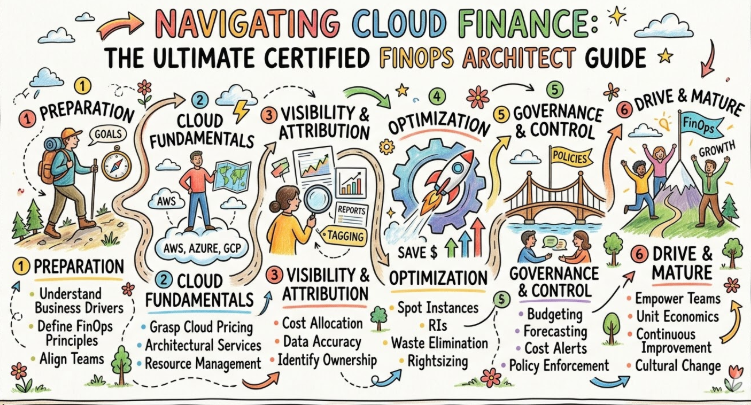
Introduction
Cloud infrastructure has become the backbone of modern business delivery. However, unmanaged cloud spending has emerged as a major challenge for organizations worldwide. Cloud platforms are often utilized without clear visibility into financial outcomes. This gap between engineering actions and business budgets is addressed by the discipline of FinOps.
A strategic approach to cloud financial management is required to balance performance and cost. Engineering choices are no longer made in isolation from financial realities. Instead, every architectural design is evaluated for its economic efficiency. This master-level guide is designed to clarify how cloud financial literacy can be attained through structured validation.
Core Breakdown: What is Certified FinOps Architect & Modern Importance
What is the Certified FinOps Architect Certification?
The Certified FinOps Architect designation is an advanced professional credential. It is designed to validate an individual’s ability to design, implement, and govern cloud architectures that are both technically sound and financially optimized. Complex cloud topologies are analyzed to ensure waste is eliminated while maintaining high availability and performance.
Why It Matters in Today’s
Cloud environments are easily scaled, but this scalability often leads to unexpected expenditures. Traditional procurement models are completely transformed by the on-demand nature of cloud consumption. Without proper architectural guardrails, cloud budgets are quickly exceeded.
The bridge between financial teams and engineering units is built by an architect who understands both code and cost. Strategic decisions are guided by financial data when optimized architectures are deployed. Waste is actively minimized, and maximum value is extracted from every cloud investment.
Why Certified FinOps Architect Certifications Are important
- Business-Engineering Alignment: Shared accountability for cloud spending is established across cross-functional teams.
- Architectural Cost-Efficiency: Cloud workloads are designed from the ground up with optimization principles in mind.
- Waste Reduction: Underutilized resources are systematically identified and remediated through automated governance.
- Career Progression: Technical professionals are elevated into strategic roles where business decisions are heavily influenced.
Why Choose FinOpsSchool?
Comprehensive educational frameworks are provided by FinOpsSchool to address the specific challenges of cloud financial management. Specialized curriculums are designed by industry professionals to ensure that theoretical knowledge is balanced with practical execution. Deep architectural insights are blended with real-world scenarios so that enterprise-level cloud budgeting can be mastered.
Comprehensive study materials, structured testing methodologies, and recognized career pathways are offered to global learners. Up-to-date methodologies are continuously integrated into the training materials to reflect shifting cloud market dynamics.
Deep-Dive into the Certified FinOps Architect Program
What is this certification?
The Certified FinOps Architect program is an advanced validation blueprint focused on the intersection of cloud engineering and cloud financial management. Advanced skills in designing cost-effective architectures, establishing financial governance, and automating cost anomaly detection across multi-cloud environments are certified through this rigorous evaluation.
Who should take this certification?
This professional credential is ideal for Software Engineers, DevOps Engineers, Cloud Architects, Platform Engineers, Site Reliability Engineers, and Engineering Managers. It is highly beneficial for any technical leader who is tasked with controlling cloud budgets while delivering scalable infrastructure solutions in global markets.
Certification Overview Table
| Track | Level | Who it’s for | Prerequisites | Skills Covered | Recommended Order |
| Cloud Financial Foundation | Associate | System Administrators, Engineers | Basic Cloud Knowledge | Cost allocation, tagging structures, cloud billing concepts | First |
| Cloud Cost Optimization | Professional | Cloud & Platform Engineers | Foundation Track | Right-sizing, reservation management, spot instances | Second |
| Enterprise FinOps Architecture | Expert | Senior Architects, Tech Leads | Optimization Track | Multi-cloud optimization, unit economics, architectural patterns | Third |
| FinOps Governance & Automation | Specialist | DevSecOps, SRE Leaders | Expert Track | Automated guardrails, anomaly detection, policy-as-code | Fourth |
Skills You Will Gain
- Advanced Unit Economics: Cloud costs are mapped directly to business metrics to measure profitability accurately.
- Architectural Cost Modeling: Cost-optimized cloud infrastructures are designed using cloud-native patterns.
- Automated Governance Implementation: Automated guardrails are built to terminate or resize underutilized resources.
- Multi-Cloud Billing Analysis: Complex, multi-cloud billing datasets are parsed and analyzed for strategic insights.
- Stakeholder Alignment: Financial updates are communicated effectively to engineering, finance, and leadership teams.
Real-World Projects You Will Be Able to Handle
- Enterprise Tagging Governance: A comprehensive, automated tagging enforcement policy is designed and deployed across enterprise cloud accounts.
- Automated Right-Sizing Pipeline: An automated system is built to identify oversized compute instances and safely downsize them during low-traffic periods.
- Multi-Cloud Cost Dashboard: A centralized financial dashboard is developed to consolidate billing data from multiple cloud providers into a single pane of glass.
- Anomaly Detection System: ML-driven alerts are configured to detect unexpected spikes in cloud resource consumption instantly.
Structured Preparation Plans
The 14-Day Accelerated Study Plan
- Days 1–5: Core FinOps framework principles and cloud billing structures are thoroughly studied.
- Days 6–10: Cost allocation strategies, tagging compliance models, and KPIs are analyzed.
- Days 11–14: Practice exams are completed, and architectural case studies are reviewed.
The 30-Day Comprehensive Study Plan
- Days 1–10: Cloud financial fundamentals and multi-cloud billing mechanics are deeply explored.
- Days 11–20: Practical optimization strategies, including reservation tools and savings plans, are mastered.
- Days 21–25: Governance structures, policy-as-code models, and automation tools are evaluated.
- Days 26–30: Intensive mock examinations are taken, and weak areas are systematically addressed.
The 60-Day Deep Mastery Study Plan
- Days 1–20: Foundational cloud finance principles and basic architectural design patterns are analyzed.
- Days 21–40: Advanced optimization strategies, real-world case studies, and unit economics are implemented in test environments.
- Days 41–50: Compliance automation, automated reporting pipelines, and alerting mechanisms are designed.
- Days 51–60: Extensive review sessions, community peer interactions, and final certification preparations are finalized.
Common Mistakes to Avoid
- Neglecting Engineering Realities: Cost optimization plans are designed without considering system performance or application availability constraints.
- Focusing Only on Compute Costs: Storage, data transfer, and network egress fees are overlooked during the architectural review process.
- Lack of Automated Enforcement: Governance strategies are reliant on manual updates rather than automated policy enforcement pipelines.
- Ignoring Organizational Culture: Cultural changes required to foster shared financial accountability among developers are ignored.
Best Next Certifications to Pursue
Same Track Focus
Advanced FinOps operational practices can be pursued to deepen knowledge of specialized cost-management tools.
Cross-Track Focus
Advanced Kubernetes management credentials or DevSecOps security automation tracks can be selected to merge cost efficiency with infrastructure security.
Leadership / Management Focus
Enterprise cloud strategy programs or technology management frameworks can be explored to transition into high-level executive decision-making roles.
Strategic Learning Paths
1. The DevOps Optimization Path
This path is tailored for infrastructure automation specialists. Continuous integration and continuous deployment (CI/CD) pipelines are enhanced with cost-validation steps. Automated scripts are created to ensure that every infrastructure deployment is verified against preset budget allocations before production deployment.
2. The DevSecOps Financial Protection Path
Security and cost efficiency are merged in this track. Unmanaged or rogue cloud deployments are treated as security threats and financial waste simultaneously. Security scanning tools are paired with cost governance frameworks to ensure compliant configurations.
3. The SRE Efficiency Path
This track is focused on maintaining high system reliability without inflating operational expenses. System performance metrics are analyzed alongside financial data. High-availability architectures are designed to be resilient while utilizing cost-efficient fault-tolerant cloud services.
4. The AIOps / MLOps Resource Management Path
Specialized cloud workloads like machine learning pipelines are managed here. Large-scale compute clusters are optimized for data training phases. Systems are designed to scale down rapidly the moment training jobs are concluded, avoiding massive idle resource costs.
5. The DataOps Budgetary Governance Path
Large data architectures and storage networks are optimized through this pathway. Storage tiers are automated so that older data sets are moved to cheaper archive storage automatically. Analytical query paths are streamlined to prevent expensive data processing overruns.
6. The Dedicated FinOps Practitioner Path
This path is structured for professionals focused entirely on enterprise cloud financial management. Financial modeling, cross-functional communication, and multi-cloud optimization methodologies are mastered to manage large-scale corporate technology budgets.
Role-to-Certification Mapping Matrix
| Professional Role | Recommended Certification Track | Core Focus Area |
| DevOps Engineer | Cloud Cost Optimization | Pipeline cost gating & resource right-sizing |
| Site Reliability Engineer | FinOps Governance & Automation | Resilient architectures with efficient utilization |
| Platform Engineer | Enterprise FinOps Architecture | Internal developer platforms with cost visibility |
| Cloud Engineer | Cloud Financial Foundation | Cost allocation, resource tagging, and basic patterns |
| Security Engineer | FinOps Governance & Automation | Rogue resource discovery and secure cost compliance |
| Data Engineer | Enterprise FinOps Architecture | Storage lifecycle management and query cost control |
| FinOps Practitioner | Full FinOps Architect Track | Multi-department budgeting and financial reporting |
| Engineering Manager | Enterprise FinOps Architecture | Strategic capacity planning and team alignment |
Next Certifications to Take
Same-Track Advanced Options
Advanced specialized training in multi-cloud financial accounting can be pursued. This path allows deep-dive analysis into complex enterprise agreements and programmatic billing data manipulation.
Cross-Track Strategic Options
Advanced container infrastructure management programs can be undertaken. The knowledge of container scheduling can be combined with financial visibility to optimize microservices architectures effectively.
Leadership-Focused Options
Executive technology management certifications can be selected. High-level corporate strategy can be combined with cloud economics to direct large IT organizations successfully.
Educational Support Frameworks
- DevOpsSchool: Intensive training programs are delivered to bridge the gap between software development and system operations. Deep technical curriculums are offered alongside real-world labs to ensure operational excellence is achieved by engineering teams.
- Cotocus: Advanced technical training solutions are provided with an emphasis on cloud-native architectures, infrastructure automation, and enterprise optimization frameworks. Hands-on learning environments are curated to support global upskilling needs.
- ScmGalaxy: A comprehensive platform dedicated to configuration management, continuous delivery, and DevOps tooling education is maintained. Detailed guides, tutorials, and community forums are offered to help engineers master modern delivery pipelines.
- BestDevOps: Highly practical resources and certification preparation materials focused on modern infrastructure management are curated. Simplified learning paths are emphasized to ensure technical complex topics are easily understood.
- devsecopsschool.com: Educational structures are provided to integrate security seamlessly into automated development pipelines. The shift-left security methodology is taught alongside practical tooling implementations.
- sreschool.com: Training paths focused on site reliability engineering, system observability, and high-availability design principles are managed. Resilient system behavior and modern monitoring practices are emphasized.
- aiopsschool.com: Specialized educational programs covering the intersection of artificial intelligence and IT operations are delivered. Automated system remediation and machine learning-driven log analysis are focused upon.
- dataopsschool.com: Structured courses centered on enterprise data pipeline efficiency, data quality management, and scalable data architectures are provided. Smooth delivery workflows for data engineering teams are targeted.
- finopsschool.com: A dedicated educational institution focused entirely on cloud financial management frameworks and architectural cost optimization strategies. Comprehensive career preparation paths are managed for global cloud professionals.
Strategic Perspectives FAQ
Q1: What level of difficulty is associated with this architectural assessment?
A1: A high degree of difficulty is encountered, as deep technical understanding of cloud systems must be balanced perfectly with corporate financial planning concepts.
Q2: How much preparation time is typically required to ensure success?
A2: A period of thirty to sixty days is generally needed, depending on prior familiarity with cloud systems and financial tracking methodologies.
Q3: Are any mandatory prerequisites required before enrollment can be finalized?
A3: No formal prerequisites are strictly demanded, but an advanced understanding of cloud platforms and basic financial principles is highly recommended.
Q4: What sequence should be followed when multiple cloud financial credentials are pursued?
A4: The foundational tracking paths should be mastered first, followed by optimization tracks, before the final architectural level is attempted.
Q5: What exact career value is unlocked by completing this program?
A5: Significant career growth is achieved as technical professionals are enabled to step into strategic roles that directly influence corporate financial outcomes.
Q6: Which job roles are most significantly transformed by this training?
A6: Cloud architects, platform leads, and engineering managers experience the highest growth, transitioning into positions focused on business-critical cloud governance.
Q7: How is cloud waste handled by an architectural professional?
A7: Underutilized cloud instances are systematically detected, and automated policies are deployed to eliminate idle resources without affecting production stability.
Q8: Is global market recognition provided by this credential?
A8: Yes, standardized cloud financial methodologies are validated, making the skills highly applicable across both Indian and global enterprise markets.
Q9: How are engineering velocity and cost control balanced?
A9: Automated guardrails are built into the deployment pipelines, ensuring that speed is maintained while budget compliance is verified automatically.
Q10: What financial metrics must be understood by technical teams?
A10: Unit economics, cloud run rates, and cost allocation percentages must be mastered to communicate effectively with finance departments.
Q11: How often are the framework concepts updated?
A11: The educational standards are continually reviewed to ensure alignment with the latest multi-cloud billing modifications and structural updates.
Q12: Can this training assist during large-scale enterprise cloud migrations?
A12: Yes, migration blueprints can be evaluated from day one to ensure post-migration operational costs remain within specified limits.
Certified FinOps Architect Focus
Q1: How does the Certified FinOps Architect program differ from basic cost-saving courses?
A1: Deep architectural redesign and automated governance models are prioritized over simple manual resource termination strategies.
Q2: What specific cloud providers are covered during the architectural analysis?
A2: Multi-cloud methodologies are emphasized, allowing optimization strategies to be applied universally across AWS, Azure, and Google Cloud Platform.
Q3: How is policy-as-code integrated into this specific certification?
A3: Automated tools are utilized to write infrastructure compliance rules that prevent non-optimized cloud resources from ever being deployed.
Q4: Why is unit economics considered a vital part of this curriculum?
A4: Technology expenses are allowed to be measured against actual business growth metrics, such as cost per active transaction or cost per customer profile.
Q5: What role does automation play in the architectural framework?
A5: Manual tracking is replaced with real-time alerting systems, auto-scaling configurations, and automated scheduling policies.
Q6: How are unexpected cloud cost anomalies addressed by an architect?
A6: Detection mechanisms are designed to flag irregular spending patterns immediately, allowing rapid investigation and containment before budgets are drained.
Q7: Is team collaboration emphasized within the study materials?
A7: Yes, the creation of cross-functional cloud centers of excellence (CCoE) is detailed to ensure engineering and finance units collaborate smoothly.
Q8: How can simulation environments be utilized during preparation?
A8: Real-world billing data datasets are analyzed within practical labs to practice allocation tracking and optimization modeling under realistic conditions.
Professional Feedback Stories
The architectural approach taught in this program allowed our deployment frameworks to be completely redesigned. Cloud waste was reduced significantly within the first few months.
— Rajesh K.
A clear understanding of cloud financial optimization was developed through these structured modules. The gap between engineering logic and corporate budgeting was finally bridged.
— Elena M.
Complex billing datasets are no longer a source of confusion. The automated governance strategies learned have been fully implemented across all our multi-cloud environments.
— Sandeep J.
Security parameters and cost validation models were successfully merged using the principles outlined here. Rogue cloud resource tracking has been completely automated.
— Clara T.
Strategic planning sessions are now approached with absolute confidence. Infrastructure investments can be easily defended before executive committees using clear unit economic data.
— Nitin V.
Summary
The management of cloud financial environments has become an essential corporate requirement. The Certified FinOps Architect program provides technical leaders with the exact skills needed to balance engineering innovation with strict cost efficiency. Long-term career sustainability is ensured as professionals learn to deliver high-performance cloud solutions that protect company margins.
Strategic career development can be achieved when learning tracks are planned with financial literacy in mind. Organizations will continue to reward experts who can scale infrastructure safely without inflating operational expenditures.

