
Introduction
Imagine you want to build a house, but instead of buying heavy bricks and renting a concrete mixer every time, you rent a fully equipped workshop where tools, walls, and rooms are already waiting for you to assemble. That workshop is cloud computing, and AWS is the biggest workshop in the world.
Today, millions of companies—from tiny startups to massive banks—run their websites, apps, and data on AWS. Because of this, companies desperately need people who know how to use it.
If you are trying to break into technology or level up your current IT career, you have probably heard that getting certified is a smart move. But you might wonder: Do certifications actually help you get hired, or are they just expensive pieces of paper?
This article explains how AWS certifications genuinely impact your career, what they teach you, and how to choose the right path without wasting your time or money.
What Is AWS Certification?
AWS Certification is a formal credential issued by Amazon Web Services that proves your ability to use their cloud platform.
To get certified, you must study a specific set of topics and pass a timed, multiple-choice exam at a testing center or online. Think of it like a driver’s license. Passing your driving test does not make you a Formula One champion, but it officially proves to the state that you know the rules of the road and can safely operate a vehicle.
Why It Matters
In the tech industry, anyone can write “knows AWS” on a resume. Because resumes are often scanned by automated software or busy human recruiters, hiring managers need a reliable way to separate people who have actually studied the platform from those who just watched a single YouTube video. An AWS certification acts as an instant trust signal.
How AWS Certifications Help Build a Cloud Career
Earning a certification changes your professional trajectory in several practical ways:
- Passing Resume Filters: Recruiters use certifications as a quick shortcut to find qualified candidates. If two applicants have similar backgrounds, the one with an official AWS credential often gets the interview call first.
- Structuring Your Learning: Cloud computing is massive. AWS offers over 200 different services. Studying for a certification gives you a clear, structured roadmap instead of wandering aimlessly through endless tutorials.
- Proving Hands-On Competency: Good certification exams test scenario-based problems, forcing you to learn how things actually break and how to fix them, rather than just memorizing definitions.
- Increasing Earning Potential: Certified professionals often command higher salaries because they bring validated, high-demand skills to organizations undergoing digital transformation.
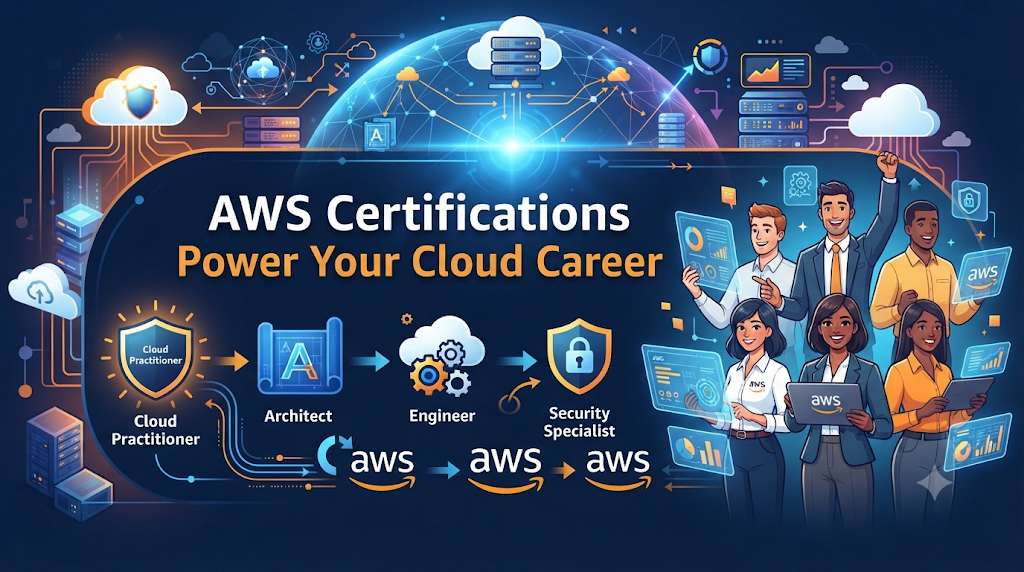
Understanding the AWS Certification Path
AWS organizes its credentials into different levels so you can grow alongside your experience.
1. Foundational Level (AWS Certified Cloud Practitioner)
- What it is: A high-level overview of cloud concepts, security, pricing, and core services.
- Who it is for: Beginners, project managers, sales professionals, or developers who want a general understanding of cloud technology without writing complex code.
- Example: A marketing manager at a retail company takes this exam to understand how their tech team deploys website updates, making them better at coordinating projects.
2. Associate Level (Solutions Architect, Developer, SysOps Administrator)
- What it is: Role-based certifications that dive deep into technical execution, configuration, and troubleshooting.
- Who it is for: People with 1 to 2 years of hands-on experience using AWS.
- Why it matters: This is the sweet spot for job hunters. The AWS Certified Solutions Architect – Associate is widely considered the gold standard for breaking into cloud engineering roles.
3. Professional and Specialty Levels
- What it is: Advanced credentials covering complex architectures, security tuning, machine learning, or data analytics.
- Who it is for: Experienced cloud engineers with 2 or more years of deep, daily hands-on AWS experience.
Real-World Considerations: Certifications vs. Experience
While certifications are powerful, they are not magic spells. A common trap for beginners is collecting multiple certificates without ever building anything practical.
Imagine hiring a mechanic who has read every textbook on engine repair but has never actually picked up a wrench. That is what a “paper certified” professional looks like to an experienced hiring manager.
The Right Balance
To build a sustainable cloud career, pair your certification study with hands-on practice:
- Build a free-tier AWS account and practice building real projects (like hosting a static website or setting up a secure database).
- Break things intentionally to see how error logs work and how to fix them.
- Use certification labs to reinforce theory with muscle memory.
Common Mistakes to Avoid
When pursuing AWS certifications, beginners often fall into predictable traps:
- Mistake: Memorizing exam dumps (stolen past exam questions) instead of learning the material.
- Why it causes problems: You might pass the exam, but you will fail the technical interview because you don’t actually understand how the technology works.
- What to do instead: Focus on understanding why a specific architecture works and what trade-offs it involves.
- Mistake: Starting with an advanced professional exam without foundational knowledge.
- Why it causes problems: You will get overwhelmed by complex networking and security concepts and likely fail, wasting money and motivation.
- What to do instead: Follow the natural progression from Foundational to Associate.
- Mistake: Ignoring cost management.
- Why it causes problems: In the real world, cloud engineers must build solutions that are both secure and affordable. Leaving a massive server running by mistake can result in a shocking credit card bill.
- What to do instead: Always learn AWS billing alerts, budgeting tools, and cost-optimization best practices.
Decision-Making Framework: Is an AWS Certification Right for You Right Now?
Use this simple checklist to decide your next career move:
- Step 1: Assess your current baseline. Do you understand basic computer networking (like IP addresses and routers) and operating systems? If yes, you can skip straight to the Associate level. If no, start with the Cloud Practitioner.
- Step 2: Check job descriptions. Look up cloud jobs in your local area or online remote boards. Notice which AWS certifications appear most frequently for the roles you want.
- Step 3: Evaluate your time commitment. Be honest about your schedule. Studying for an Associate exam typically requires 80 to 120 hours of focused learning and hands-on lab practice.
- Step 4: Commit and build. Set a fixed test date to keep yourself accountable, build side projects along the way, and update your resume once you pass.
Key Terms
- Cloud Computing: Delivering computing services—including servers, storage, databases, and networking—over the internet (“the cloud”).
- AWS Free Tier: A program offered by Amazon that lets new users try out dozens of cloud services for free up to certain usage limits.
- Solutions Architecture: The practice of designing and organizing cloud software systems to be secure, scalable, and cost-effective.
- Virtual Private Cloud (VPC): A private, isolated section of the AWS cloud where you can launch your resources in a secure network you control.
- Scalability: The ability of a system to handle growing amounts of work by adding resources (scaling out) or upgrading hardware (scaling up).
Frequently Asked Questions
Can I get a cloud job with just an AWS certification and no experience?
A certification helps you land interviews by proving foundational knowledge, but employers still value practical problem-solving. Building personal projects, contributing to open-source tools, or highlighting transferable IT skills will bridge the gap between certification and your first job.
Which AWS certification should I take first?
If you are completely new to technology, start with the AWS Certified Cloud Practitioner. If you already have a background in IT, software development, or networking, you can skip it and dive straight into the AWS Certified Solutions Architect – Associate.
How long does it take to prepare for an AWS exam?
For beginners studying part-time, it usually takes between 2 to 3 months to prepare for an Associate-level exam. Total study time generally ranges from 80 to 120 hours, depending on your prior technical background.
Do AWS certifications expire?
Yes. AWS certifications are valid for 3 years. To keep your credential active, you must retake the exam or pass a newer, higher-level exam to recertify your skills.
Are AWS certifications expensive?
Exam costs vary by level. Foundational exams generally cost around $100 USD, Associate exams cost $150 USD, and Professional/Specialty exams cost $300 USD. Many employers offer professional development budgets to cover these costs.
Do I need to know how to code to get an AWS certification?
You do not need to be a software developer to pass the Cloud Practitioner or Solutions Architect Associate exams. However, knowing basic scripting languages like Python or infrastructure-as-code tools like Terraform becomes very helpful as you advance in your cloud career.
Conclusion
Building a cloud career does not happen overnight, but earning an AWS certification gives you a reliable compass for your journey. It cuts through the noise of the job market, forces you to learn industry-standard tools, and proves to employers that you have put in the effort to master essential technical skills. Focus on practical understanding, build real things in your free tier account, and use your certification as a stepping stone toward long-term professional growth.

