
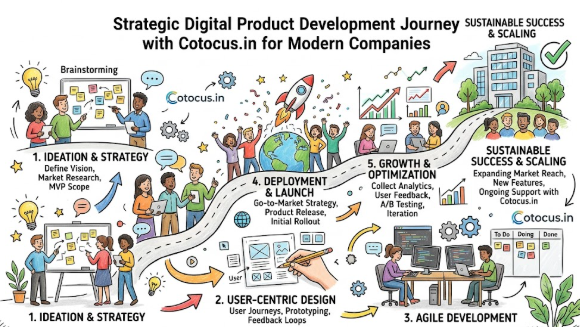
Introduction
Many companies begin their digital journey with one simple idea. It may be an online marketplace, a customer portal, a booking platform, a SaaS product, an AI-powered tool, a mobile-friendly web application, or an internal automation dashboard. In the beginning, the idea feels exciting because the business can imagine better customer experience, faster workflows, improved visibility, and long-term growth.
However, turning an idea into a real digital product is not as simple as hiring developers and asking them to start coding. A successful product needs clear business understanding, proper planning, user-focused design, suitable technology, cloud readiness, testing, security, launch support, and continuous improvement. Without this structure, even a strong idea can become delayed, expensive, confusing, or difficult for users to adopt.
Beginners usually feel confused because they do not know what should come first. Should they build a website first, create an app, design screens, choose a cloud provider, add AI features, or prepare a product roadmap? This confusion often leads to rushed decisions, unclear requirements, unnecessary features, budget pressure, and poor execution.
How Cotocus.in Helps Companies Turn Ideas into Digital Products matters because companies today need more than basic digital presence. A modern business may need software that can handle users, data, automation, payments, workflows, integrations, analytics, and future scaling. Cotocus.in describes its work around AI-powered software development, app engineering, digital product innovation, cloud-native development, DevOps automation, and intelligent software platforms.
The main pain point for many companies is not lack of ideas. The real problem is converting ideas into a clear, useful, and scalable product plan. A founder may know what problem they want to solve, but they may not know how to explain it to designers, developers, cloud engineers, AI experts, or business stakeholders. This gap can create confusion between business expectations and technical execution.
Poor understanding can cause serious business mistakes. A company may spend money on features users do not need, choose the wrong technology, ignore data security, skip testing, or launch without a maintenance plan. These mistakes do not only affect the product; they can also affect customer trust, team productivity, and long-term business growth.
This blog will explain the complete digital product journey in simple words. It will cover what digital products are, why they matter, how ideas are shaped, how development works step by step, what risks companies should check, and what mistakes beginners should avoid. The goal is to guide readers with practical understanding instead of selling unrealistic promises.
This blog is useful for startups, enterprises, students, small business owners, product managers, digital teams, and business leaders who want to build smarter digital products. The better approach is not to rush into development. The better approach is to understand the idea, validate the need, plan the product, build carefully, test properly, and improve continuously.
Understanding How Cotocus.in Helps Companies Turn Ideas into Digital Products
A digital product is a software-based solution that solves a real problem for users or businesses. It can be a web application, SaaS platform, mobile app, internal dashboard, customer portal, marketplace, automation system, AI tool, learning platform, healthcare portal, or cloud-based business system. Unlike a simple static website, a digital product usually allows users to perform actions, manage data, complete workflows, or interact with services.
In simple words, digital product development means taking a raw idea and converting it into a working software solution. This process includes understanding the problem, defining users, planning features, creating designs, choosing technology, developing the product, testing it, launching it, and improving it after real users start using it. Each stage matters because one weak stage can affect the complete product.
Cotocus.in’s public website describes the company as focused on AI-powered software development, app engineering, digital product innovation, AI and machine learning, DevOps, cloud, software engineering, SaaS product engineering, API design, microservices architecture, and full-stack digital platforms. This means the topic is not limited to coding. It connects with product strategy, cloud-native architecture, automation, security, scalability, and long-term operations.
Companies search for this topic because they often have ideas but lack technical direction. A founder may want to create a marketplace but may not know what features are needed in the first version. A small business may want automation but may not know whether to build a custom tool or use an existing platform. An enterprise may want AI integration but may not know where AI can create real value.
In real life, digital product development is used in many industries. Healthcare businesses may need appointment systems or patient portals. Education businesses may need learning platforms. Travel companies may need booking and local experience marketplaces. Finance teams may need dashboards, workflow tools, or reporting systems. Cotocus’s broader company information also mentions work around products in education, healthcare, professional services, travel, and digital domains.
A beginner-friendly example is a service company that wants to reduce manual customer support work. Instead of immediately building a large app, the company should first identify the actual problem. If customers repeatedly ask for order updates, then a simple customer portal with tracking, ticket status, and notifications may solve the first problem better than a complex app.
A common misunderstanding is that digital product development means only software coding. Coding is important, but it is only one part of the process. A product also needs user research, design, testing, cloud setup, data protection, monitoring, documentation, and support. A well-coded product can still fail if users do not understand how to use it.
The practical takeaway is simple: a strong digital product starts with a clear problem, not with random features. Companies should first understand what users need, why the product should exist, and what the first useful version should include. Once this foundation is clear, design and development become much more effective.
Why Digital Product Development Is Important
Digital product development is important because it directly affects how a company serves customers, manages operations, improves productivity, and grows online. A good digital product can reduce manual effort, organize data, improve service delivery, and make business workflows easier to manage. It can also help companies offer better digital experiences to customers who expect speed, clarity, and convenience.
For startups, digital product development is often the foundation of the entire business model. If the product is confusing, slow, unreliable, or poorly planned, users may not return. For small businesses, digital products can help replace scattered spreadsheets, manual follow-ups, and repeated phone calls with organized systems. For enterprises, digital products can modernize old workflows, connect departments, and support large-scale operations.
This topic is also important because product decisions affect money, planning, and long-term discipline. A company that builds without planning may spend more than expected because of rework and changing requirements. A company that plans properly can decide what to build first, what to delay, and how to use budget more responsibly. Better product planning helps reduce waste.
Digital product development also connects with risk awareness. Businesses must think about data privacy, cybersecurity, compliance, performance, cloud cost, user adoption, and maintenance. If these risks are ignored, the product may create problems after launch. A product should not only work today; it should also remain reliable and manageable tomorrow.
A practical scenario can make this clearer. Imagine a growing training company that handles course inquiries through phone calls, emails, and spreadsheets. As inquiries increase, the team starts missing leads and sending delayed responses. A digital product such as a lead management dashboard or learner portal can organize inquiries, assign follow-ups, track status, and improve response quality.
The common mistake is building technology without business clarity. Many companies ask for an app because competitors have one. But if the real issue is poor internal tracking, then an internal dashboard may be more useful than a public app. The better approach is to connect every product decision with a real business problem.
Digital product development is not only about launching something online. It is about creating a useful system that supports users, business goals, and future improvement. When companies understand this, they make better decisions about design, development, cloud, AI, automation, and support.
The Real Problem Companies Face With Digital Product Ideas
Most companies do not struggle because they lack ideas. They struggle because they do not know how to convert ideas into clear product requirements. An idea may sound strong in a meeting, but when the development team asks for user roles, workflows, features, data fields, integrations, and business rules, the team may not have clear answers.
One major problem is lack of awareness. Beginners often think development starts with screens or coding. In reality, development should start with understanding the problem, target users, product goals, technical feasibility, risks, and expected outcomes. When this awareness is missing, the product can move in the wrong direction from the beginning.
Another problem is too much confusing advice online. Some people say every business needs a mobile app. Others say every product should use AI, blockchain, automation, cloud, or microservices. These technologies can be useful, but only when they match the actual business need. Following trends without context can increase complexity.
Emotional decision-making is also common. Founders and business owners may feel excited about a product idea and want to build everything quickly. This excitement can lead to feature overload, unrealistic deadlines, and unclear priorities. A better approach is to control excitement with a written roadmap and practical milestones.
Poor planning creates another challenge. If the product scope keeps changing every week, designers and developers may need to redo work repeatedly. This increases cost and creates frustration for everyone involved. Clear planning does not mean the product cannot evolve. It means changes should be managed carefully.
Weak comparison is also a real issue. Companies may not compare custom development, SaaS tools, low-code platforms, cloud options, maintenance models, or security responsibilities. As a result, they may choose an approach that looks easy initially but becomes difficult later.
Unrealistic expectations can damage the product journey. Some companies expect users, revenue, or growth immediately after launch. But real digital products need user education, feedback, marketing, performance improvement, and trust-building. Launch is not the final stage; it is the beginning of learning.
The better approach is to treat the idea as a starting point, not a finished plan. A company should move from idea to discovery, from discovery to roadmap, from roadmap to MVP, and from MVP to improvement. This structured thinking helps reduce confusion and improves the chance of building something useful.
How Digital Product Development Works Step by Step
Step 1: Define the Business Problem
Defining the business problem means clearly writing what pain point the product will solve. Many companies start with a broad statement like “we need a platform,” but that does not explain the real issue. A better problem statement could be, “Our sales team loses follow-ups because customer data is scattered across emails and spreadsheets.”
This step matters because the problem becomes the foundation for every future decision. If the problem is unclear, the team may build features that look attractive but do not solve the user’s actual need. Clear problem definition keeps the product focused.
To apply this step, write the problem in one or two simple sentences. Then ask who faces this problem, how often it happens, what it costs the business, and what better result the product should create. This helps convert a vague idea into a practical product direction.
A common mistake is starting with the solution before understanding the problem. For example, saying “we need AI chatbot” without knowing whether customers need faster answers, better tracking, or self-service support. The better approach is to define the problem first, then choose the right solution.
Step 2: Identify the Target Users
Target users are the people who will use the product. They may be customers, admins, employees, vendors, partners, managers, students, patients, agents, or support teams. Each user type has different goals, access levels, and expectations.
This step matters because a product designed for everyone often becomes useful for no one. A customer may need a simple interface, while an admin may need controls, reports, and permissions. Understanding user roles helps design the product correctly.
To apply this step, list all user groups and write what each group needs to do inside the product. For example, in a marketplace, customers may search and book, service providers may manage listings, and admins may approve or monitor activity.
A common mistake is giving every user the same experience. This can create confusion and security issues. The better approach is to design role-based journeys where each user sees only what they need.
Step 3: Decide the Core Features
Core features are the minimum features required to solve the main problem. They should not include every idea the team has. They should include only what is necessary for the first useful version of the product.
This step matters because too many features increase development time, budget, testing effort, and user confusion. A product with fewer but better-planned features is often more useful than a large product filled with incomplete functions.
To apply this step, divide features into three groups: must-have, good-to-have, and future features. Must-have features are required for launch. Good-to-have features can wait. Future features should be added only after user feedback.
A common mistake is trying to build the final dream product in version one. The better approach is to build an MVP that solves the main problem and then improve it based on real usage.
Step 4: Design the User Experience
User experience means how easily users can complete their tasks inside the product. It includes navigation, forms, buttons, messages, page flow, search, dashboard layout, and overall clarity. Good user experience makes the product feel simple even when the system behind it is complex.
This step matters because users may leave a product if it feels confusing. A technically strong product can still fail if users do not understand where to click, what to fill, or how to complete a task. Design should reduce thinking effort.
To apply this step, create wireframes and user flows before development begins. Show how users will sign up, log in, search, submit requests, make updates, track status, or complete transactions. Testing these flows early can prevent expensive changes later.
A common mistake is focusing only on visual appearance. Attractive screens are not enough. The better approach is to design for clarity, speed, accessibility, and real user behavior.
Step 5: Choose the Right Technology
Choosing technology means selecting the tools, frameworks, databases, cloud services, APIs, architecture, and development approach that fit the product. The best technology is not always the newest or most popular one. It is the one that supports the product’s goals, budget, team skills, and future needs.
This step matters because wrong technology choices can create long-term problems. A product may become slow, difficult to maintain, expensive to scale, or hard to integrate with other systems. Good technology decisions protect the product’s future.
To apply this step, compare product requirements with technology options. Ask whether the product needs real-time updates, heavy data processing, AI features, mobile access, cloud scalability, payment integration, or enterprise security.
A common mistake is choosing technology because it is trending. The better approach is to choose technology because it fits the actual product requirement and can be maintained properly.
Step 6: Build, Test, and Improve
Building the product means converting plans and designs into working software. Testing means checking whether the product works correctly, securely, and smoothly. Improvement means fixing problems and refining the product before and after launch.
This step matters because development without testing can create user frustration. Bugs, broken forms, slow pages, login errors, payment issues, or dashboard mistakes can damage trust. Testing protects both users and business operations.
To apply this step, divide development into milestones. After each milestone, test the completed features. Check desktop and mobile experience, data accuracy, access control, notifications, speed, and security basics.
A common mistake is testing only at the end. This often creates last-minute pressure and expensive fixes. The better approach is continuous testing during development.
Step 7: Launch Carefully
Launching means making the product available to users. A launch can be internal, limited, beta-based, or public. A careful launch helps the company observe real usage without creating unnecessary pressure.
This step matters because the first user experience can shape trust. If users face errors, confusion, or missing support during launch, they may lose confidence. A good launch includes preparation, communication, monitoring, and support.
To apply this step, prepare user instructions, support contact, bug reporting process, monitoring tools, and backup plans. Start with a smaller group if possible and collect feedback before wider release.
A common mistake is launching publicly without testing support readiness. The better approach is to launch in a controlled way, track issues, and improve quickly.
Step 8: Maintain and Scale
Maintenance means keeping the product updated, secure, stable, and useful after launch. Scaling means preparing the product to handle more users, more data, more features, and more business complexity over time.
This step matters because digital products are not one-time projects. Technology changes, user expectations grow, bugs appear, security risks evolve, and business needs expand. A product that is not maintained becomes outdated.
To apply this step, schedule regular reviews for performance, security, user feedback, cloud cost, feature usage, and roadmap updates. Maintenance should be planned from the start, not added as an afterthought.
A common mistake is thinking the project is finished after launch. The better approach is to treat the product as a long-term business asset that needs care, review, and improvement.
Key Factors That Influence Digital Product Success
Problem Clarity
Problem clarity is the foundation of every successful digital product. It tells the team exactly what challenge they are solving and why the product should exist. Without problem clarity, the product may become a collection of random features.
A company should write the problem in simple language before starting development. For example, “Customers cannot track their service request status” is clearer than “We need a better platform.” This clarity helps designers, developers, and business teams work in the same direction.
User Understanding
User understanding means knowing who will use the product and what they need. A product for customers should be simple and guided, while a product for administrators may need deeper controls and reports. Different users need different journeys.
Companies should observe user behavior, collect feedback, and map user tasks. This helps avoid building screens that look good but do not support real actions. The better approach is to design around user needs, not internal assumptions.
Feature Prioritization
Feature prioritization helps companies decide what to build first. Every idea may sound useful, but not every idea belongs in the first version. Prioritization protects budget, timeline, and product quality.
The best approach is to separate essential features from future features. A focused first version helps users understand the product quickly. It also allows the company to learn from real usage before investing in advanced functions.
Technology Fit
Technology fit means choosing tools that match the product’s actual requirement. A small internal dashboard may not need complex architecture, while a large enterprise platform may need strong scalability and security planning.
The mistake many beginners make is choosing technology because it is popular. A better approach is to ask what the product must do, how many users it may support, what integrations it needs, and how it will be maintained.
Cloud Readiness
Cloud readiness means preparing the product to run reliably online. It includes hosting, storage, backup, access control, monitoring, deployment, and scaling. Cloud can support modern products, but it should be planned carefully.
A weak cloud setup can cause slow performance, downtime, unexpected cost, or security gaps. The better approach is to design cloud infrastructure according to product size, expected traffic, data sensitivity, and future growth.
AI Integration
AI integration means adding intelligent features that improve user experience or reduce manual work. It can help with smart search, recommendations, support automation, data classification, document processing, or workflow automation.
However, AI should not be added only because it sounds modern. A company should first identify one clear problem where AI can create measurable usefulness. The better approach is to start with a practical use case and expand slowly.
Security Planning
Security planning protects users, business data, accounts, systems, and workflows. It includes login safety, role-based access, data protection, secure APIs, admin controls, and regular checks. Security should begin during planning, not after launch.
Ignoring security can create serious business and trust problems. The better approach is to discuss security requirements before development and test them regularly during product updates.
Maintenance Discipline
Maintenance discipline means keeping the product stable after launch. It includes bug fixes, updates, security patches, performance checks, cloud monitoring, and feature improvements. Without maintenance, even a good product can become weak over time.
Companies should plan maintenance responsibility clearly. The mistake is assuming that development ends after launch. The better approach is to create an ongoing support and improvement process.
Detailed Breakdown of Digital Product Development
Product Strategy
Product strategy explains the purpose of the product. It defines why the product should exist, who it helps, what value it creates, and how success will be measured. Without strategy, teams may build features without understanding the business direction.
A strong product strategy usually includes the problem statement, target users, core features, expected outcomes, timeline, risks, and future roadmap. It helps business and technical teams communicate clearly. It also prevents unnecessary rework.
The common mistake is starting with design or coding before strategy. This can lead to confusion later when the team realizes the product does not solve the right problem. The better approach is to create a clear product brief first.
User Research
User research helps companies understand real user needs. It may include customer interviews, support ticket analysis, survey responses, workflow observation, competitor review, and feedback from sales or support teams. The goal is to avoid assumptions.
For example, a business may think users need a mobile app, but research may show that users mainly need faster status updates. In that case, a web portal with notifications may be more useful than a full mobile application.
The common mistake is assuming the founder’s opinion represents the user’s reality. The better approach is to collect small but meaningful user insights before finalizing product features.
Product Roadmap
A product roadmap shows the development journey in phases. It explains what will be built now, what will be improved later, and how the product can grow over time. A roadmap keeps the team focused and organized.
A useful roadmap may include MVP features, future modules, integrations, AI enhancements, cloud improvements, security upgrades, and user feedback cycles. It helps companies avoid trying to build everything at once.
The common mistake is treating every feature as urgent. The better approach is to build a first useful version, learn from users, and then improve with confidence.
UI and UX Design
UI is the visual design of the product, while UX is the overall experience of using it. A product can look beautiful but still be difficult to use if the journey is confusing. Good UX makes tasks simple and clear.
For example, if a user wants to submit a service request, the product should guide them step by step. The form should ask only necessary information, show helpful messages, and confirm submission clearly.
The common mistake is focusing only on colors and layout. The better approach is to focus on how users think, where they may get stuck, and how the product can guide them.
Web Application Development
Web application development turns the product plan into working software. It may include frontend development, backend development, database setup, API integration, authentication, dashboards, reports, and admin panels.
This stage matters because it creates the actual product users will interact with. Good development should follow the agreed scope, maintain clean code quality, and support future updates.
The common mistake is building without clear milestones. The better approach is to divide work into planned stages, review progress regularly, and test each major feature.
Cloud Deployment
Cloud deployment makes the product available online. It may involve servers, databases, storage, backups, monitoring, deployment pipelines, and scaling plans. Cloud-native planning is especially important for products expecting growth.
A cloud setup should be chosen according to product needs. A small product may need a simple setup, while a high-traffic platform may need stronger infrastructure, monitoring, and scaling.
The common mistake is ignoring cloud cost and monitoring. The better approach is to plan performance, backup, security, and cost control before launch.
AI and Automation
AI and automation can make digital products smarter and more efficient. They can reduce manual effort, improve recommendations, classify data, automate repetitive actions, and support better decision-making.
For example, a support platform may use AI to categorize customer requests, while an education platform may use automation to send reminders. The goal should always be practical usefulness.
The common mistake is adding AI because competitors are doing it. The better approach is to identify one clear workflow where AI or automation improves speed, accuracy, or user experience.
Testing and Quality Assurance
Testing checks whether the product works properly. It includes functional testing, performance testing, security checks, mobile testing, browser testing, and user acceptance testing. Testing protects the product before real users depend on it.
A good testing process checks forms, dashboards, login, permissions, notifications, reports, integrations, and error messages. It also checks whether users can complete important tasks without confusion.
The common mistake is treating testing as a final activity. The better approach is to test continuously during development so issues are found early.
Launch and Feedback
Launch is the moment when the product becomes available to users. However, launch is not the end of product development. It is the start of real learning because actual users may behave differently from what the team expected.
After launch, companies should collect feedback, monitor errors, study usage patterns, and improve weak points. User feedback can reveal missing features, confusing flows, or performance issues.
The common mistake is expecting the first version to be perfect. The better approach is to launch carefully, learn quickly, and improve regularly.
Common Mistakes Beginners Make With Digital Product Ideas
Following Random Advice
This mistake happens when companies depend on social media posts, quick opinions, or trend-based suggestions. Random advice may sound confident, but it may not fit the company’s users, budget, goals, or technical needs.
The risk is that the company may build the wrong type of product. For example, a business may build a mobile app when a web dashboard would solve the problem better. The better approach is to validate advice through user needs and business goals.
Ignoring Risk
Beginners often focus on design and features but ignore risk. Risks may include data privacy, cybersecurity, cloud cost, poor performance, legal requirements, and user adoption problems. These risks may not be visible at the idea stage but can become serious after launch.
Ignoring risk can damage user trust and increase future expenses. The better approach is to create a risk checklist before development and review it at every major stage.
Not Comparing Options
Some companies choose the first development option they find. They may not compare custom development, existing SaaS tools, cloud choices, technology stacks, maintenance plans, or integration needs. This can lead to poor long-term decisions.
Comparison helps companies understand trade-offs. A cheaper option may be limited, while a complex option may be unnecessary. The better approach is to compare based on usefulness, scalability, cost, security, and maintenance.
Trusting Unrealistic Claims
Some teams believe that launching a product will automatically bring users, revenue, or growth. This is risky because product success also needs market understanding, user trust, marketing, support, feedback, and continuous improvement.
Unrealistic expectations can lead to disappointment and rushed decisions. The better approach is to set practical goals, measure progress, and improve step by step.
Making Emotional Decisions
Excitement, fear of competition, or pressure from stakeholders can push companies into rushed product decisions. Emotional decisions often lead to too many features, unclear priorities, and unrealistic timelines.
The better approach is to use written planning. A roadmap, requirement document, and feature priority list can help teams stay disciplined even when new ideas appear.
Not Reading Terms and Responsibilities
Many companies do not clearly discuss source code ownership, hosting access, support responsibility, maintenance cost, data handling, or third-party tool terms. This can create confusion after launch.
The better approach is to document responsibilities before starting the project. Clear agreements help protect both business and technical teams.
Sharing Sensitive Information Carelessly
During product development, teams may share passwords, API keys, customer data, admin access, or server details without proper control. This can create serious security risks.
The better approach is to use secure access methods, role-based permissions, and limited sharing. Sensitive information should never be casually shared through unsafe channels.
Depending Only on Trends
Trends like AI, cloud, automation, microservices, and blockchain can be useful, but they are not automatically required for every product. Adding unnecessary technology can increase complexity and cost.
The better approach is to ask whether the technology solves a real user or business problem. If the answer is unclear, the feature should be delayed.
Don’t Do This Checklist
- Do not start development without a written requirement because unclear scope creates rework and confusion.
- Do not build every feature in the first version because too many features delay launch and increase cost.
- Do not ignore user feedback because real users often reveal problems the team did not notice.
- Do not choose technology only because it is popular because trends may not match your actual need.
- Do not launch without testing because broken features can damage trust quickly.
- Do not share passwords, access keys, or customer data casually because security mistakes can be costly.
- Do not ignore maintenance cost because products need updates, fixes, and monitoring after launch.
- Do not assume users will understand everything automatically because onboarding and guidance are important.
- Do not treat design as decoration only because design should help users complete tasks easily.
- Do not avoid security planning because protection should be built into the product from the beginning.
Practical Real-Life Examples of Digital Product Development
Example 1: Startup Founder Building a Marketplace
A startup founder wants to build a marketplace connecting customers with local service providers. The founder’s first plan includes chat, payments, reviews, subscriptions, maps, AI matching, and advanced dashboards. The better action is to start with provider listings, customer inquiries, search, admin approval, and basic user accounts. The learning is that a focused first version helps validate demand before adding advanced features.
Example 2: Small Business Automating Customer Requests
A small business handles customer requests through phone calls, emails, and spreadsheets. As the business grows, the team starts missing updates and customers become frustrated. The better action is to build a simple request tracking dashboard with status updates, assignment, and notifications. The learning is that digital products should first solve the most painful workflow problem.
Example 3: Enterprise Team Modernizing Internal Tools
An enterprise team uses old internal systems that do not connect well with each other. Employees spend extra time copying data between systems and preparing reports manually. The better action is to plan a cloud-based internal portal with role-based access, workflow tracking, and reporting. The learning is that enterprise products need integration, security, and scalability from the beginning.
Example 4: Education Platform Improving Learner Experience
An education business wants to offer online learning resources but has no structured learner journey. Students receive content, but they do not know what to study first, how to track progress, or where to ask questions. The better action is to build modules, progress tracking, search, dashboards, and support flows. The learning is that a product should guide users step by step.
Example 5: Company Adding AI Features
A company wants to add AI to its platform because AI sounds modern and attractive. However, the team has not identified what problem AI should solve. The better action is to use AI first for a specific use case such as smart search, support classification, or automated document sorting. The learning is that AI should solve real problems, not just improve marketing language.
Two Useful Tables for Better Understanding
Table 1: Idea Stage vs Better Product Approach
| Stage | Common Beginner Approach | Better Product Approach |
|---|---|---|
| Idea | Start building immediately after discussion | Define the problem, user, and expected outcome clearly |
| Features | Add every possible feature in version one | Prioritize must-have features and keep future features separate |
| Design | Focus only on colors and attractive screens | Focus on user journey, clarity, and task completion |
| Development | Build without milestones or review points | Use planned stages, reviews, and testing cycles |
| Technology | Choose tools because they are trending | Choose tools based on product goals and maintenance needs |
| Launch | Release without support preparation | Launch with monitoring, documentation, and feedback channels |
| Growth | Add features randomly after launch | Improve based on user data, feedback, and roadmap priorities |
Table 2: Digital Product Component and Its Purpose
| Component | Purpose | Why It Matters |
|---|---|---|
| Product Strategy | Defines direction and purpose | Prevents confusion, rework, and unclear expectations |
| User Research | Understands real user needs | Helps avoid assumption-based features |
| UX Design | Makes the product easy to use | Improves adoption and reduces user frustration |
| Web Application | Provides usable product functionality | Turns the idea into a working digital platform |
| Cloud Setup | Supports hosting, storage, and scaling | Helps the product run reliably online |
| AI Integration | Adds intelligent automation where useful | Reduces manual effort when applied to real problems |
| Security | Protects data, users, and systems | Builds trust and reduces business risk |
| Maintenance | Keeps the product updated and stable | Supports long-term usefulness after launch |
Tools, Methods, and Frameworks Readers Can Use
Product Requirement Document
A product requirement document explains what the product should do, who will use it, and what problems it should solve. It is one of the most useful tools for beginners because it converts ideas into written clarity. Without this document, teams may depend on memory and assumptions.
Beginners can use it by writing the problem, users, features, workflows, success goals, and risks in simple language. This document does not need to be complex in the beginning. Its main purpose is to make sure everyone understands the same product direction.
Minimum Viable Product Framework
An MVP is the simplest useful version of a digital product. It includes only the most important features needed to solve the core problem. This helps companies test their idea without spending too much time or money on unnecessary features.
Beginners can use the MVP framework by asking, “What is the smallest version users can actually use?” This helps avoid overbuilding. The mistake it prevents is trying to create a complete advanced product before proving that users need it.
User Journey Map
A user journey map shows the steps a user takes inside the product. It may include signup, login, search, form submission, payment, tracking, support, or dashboard usage. This helps teams understand the product from the user’s point of view.
Beginners can create a simple journey using boxes and arrows. Each box should show one action the user takes. This method prevents confusing navigation and helps teams identify unnecessary steps before development begins.
Feature Priority Matrix
A feature priority matrix helps companies decide which features are essential and which can wait. It usually compares user value, business value, technical effort, and urgency. This method is useful when teams have many ideas but limited budget or time.
Beginners can use it by placing features into categories such as must-have, should-have, optional, and future. This prevents feature overload and keeps the first version focused on solving the main problem.
Cloud Readiness Checklist
A cloud readiness checklist helps companies prepare for hosting, storage, backups, monitoring, scaling, and access control. It is important because cloud decisions affect performance, cost, security, and reliability.
Beginners can use this checklist by discussing expected users, data volume, traffic, backup needs, and security requirements. This prevents poor infrastructure planning and reduces the risk of problems after launch.
Security Review Method
A security review method checks how the product protects users, data, passwords, admin access, APIs, and sensitive information. Security should be reviewed before launch and after major updates.
Beginners can use this method by listing what data the product collects, who can access it, how login works, and how permissions are controlled. This helps avoid careless data exposure and weak access management.
Feedback Loop System
A feedback loop system collects user feedback, bugs, improvement ideas, and support issues. It helps companies improve the product based on real usage instead of assumptions. This is especially important after launch.
Beginners can use feedback forms, user calls, support tickets, analytics, and internal reviews. The mistake it prevents is building future features without understanding what users actually need.
Expert Tips to Make Better Decisions
1. Start With the Problem, Not the Technology
Technology should support the solution, not define it. Many beginners first ask whether they need AI, cloud, mobile app, or automation. A better question is what problem the company wants to solve. Once the problem is clear, the right technology becomes easier to choose.
2. Build the First Version Carefully
The first version should be useful, focused, and easy to understand. It does not need every advanced feature. A careful first version helps users test the core value of the product. Companies can then improve based on feedback instead of guessing.
3. Keep Users at the Center
A product is successful only when users can understand and use it comfortably. Teams should observe user behavior, collect feedback, and simplify confusing steps. A user-centered product reduces support pressure and improves adoption.
4. Avoid Feature Greed
Feature greed happens when teams add too many features too early. This makes the product complex, expensive, and harder to launch. A better approach is to ask whether each feature directly supports the main problem.
5. Plan for Maintenance
Maintenance is not optional. Products need updates, bug fixes, security reviews, cloud monitoring, and performance checks. Companies should plan maintenance from the beginning so the product remains stable after launch.
6. Check Security Early
Security should be discussed during planning, design, development, and testing. Waiting until launch can create serious issues. Teams should review login, data access, admin roles, API safety, and backup practices early.
7. Use Cloud Thoughtfully
Cloud can improve flexibility and scalability, but it should not be used carelessly. Companies should understand expected traffic, storage needs, backup requirements, and cost control. Thoughtful cloud planning avoids future performance and billing problems.
8. Use AI Only Where It Helps
AI is powerful when it solves a real problem. It can support automation, search, support, recommendations, and data processing. However, adding AI without a clear use case can increase complexity. Start with one practical AI feature first.
9. Document Decisions
Written documentation protects the project from confusion. It helps teams remember what was agreed, why a feature was selected, and what is planned for later. Documentation also helps when new team members join the project.
10. Test With Real Users
Internal testing is useful, but real users often behave differently. A small group of users can reveal confusing steps, missing instructions, or unexpected issues. Testing with real users helps improve the product before a wider launch.
11. Protect Business Data
Business data, customer data, passwords, and access keys must be handled carefully. Weak data practices can damage trust and create operational risk. Companies should use secure sharing, role-based access, and proper data protection habits.
12. Review Progress Regularly
A product roadmap should not be ignored after planning. Teams should review progress, feedback, bugs, feature usage, and business goals regularly. Regular review keeps the product aligned with real needs.
13. Avoid Copying Competitors Blindly
Competitors may have different users, budgets, business models, and technical resources. Copying them without understanding your own users can lead to poor product decisions. Learn from competitors, but build for your own audience.
14. Keep Communication Clear
Poor communication causes rework, delays, and frustration. Business teams, designers, developers, and testers should share clear updates. Regular review meetings and written notes help keep everyone aligned.
15. Think Long Term
A digital product is a long-term business asset. It should be planned for future growth, support, security, and improvement. Short-term thinking may help launch quickly but can create future limitations.
Case Studies: How Better Understanding Changes Decisions
Case Study 1: Startup With a Service Platform Idea
Profile: Early-stage startup founder
Situation: The founder wanted to create a platform connecting customers with local service providers. The original idea included chat, wallet, ratings, subscriptions, service tracking, AI suggestions, and advanced dashboards.
Problem: The team did not know which features were necessary for the first version. Building everything together would increase cost, delay validation, and make the product more complex for early users.
Wrong approach: The wrong approach was trying to build a complete marketplace before confirming whether customers and service providers would actively use it. This could have created a large product with weak adoption.
Better approach: The team created a phased roadmap. The first version focused on provider listings, search, inquiry forms, basic profiles, and admin approval. Advanced features were moved to later phases.
Result or learning: The founder learned that a smaller but useful first version can provide better learning than a large unfinished product.
Key takeaway: Start with the smallest useful version and expand after real user validation.
Case Study 2: Growing Company With Manual Operations
Profile: Mid-sized service business
Situation: The company managed internal approvals, customer requests, and team assignments through emails and spreadsheets. As the business grew, employees started missing updates and managers had poor visibility.
Problem: The company’s main issue was not lack of people; it was lack of organized workflow. Manual tracking created delays, confusion, and repeated follow-ups.
Wrong approach: The company first thought of buying several disconnected tools for different departments. This could have created more confusion because data would remain scattered.
Better approach: A custom internal workflow platform was planned with request tracking, role-based access, status updates, notifications, and reporting.
Result or learning: The team understood that one focused digital product could simplify operations better than multiple disconnected tools.
Key takeaway: Digital products should simplify workflows, not add more scattered systems.
Case Study 3: Enterprise Exploring AI Integration
Profile: Enterprise product team
Situation: The company wanted to add AI features to an existing customer support platform. The team believed AI would make the platform more modern and competitive.
Problem: The team had not identified where AI would create real value. Adding AI randomly could confuse users, increase technical complexity, and create unnecessary cost.
Wrong approach: The wrong approach was adding AI features across multiple areas without testing one clear use case first.
Better approach: The team selected one practical use case: automatically classifying customer queries into categories so support teams could respond faster.
Result or learning: The AI feature became easier to test, explain, and improve because it solved a specific problem.
Key takeaway: AI integration should begin with a clear business problem, not with trend pressure.
Risk Awareness: What Readers Must Check First
Technical Risk
Technical risk means the product may be built with unsuitable technology, weak architecture, or poor coding practices. This can create problems when the product grows or needs new features. It may also make maintenance difficult.
To reduce this risk, companies should choose technology based on product goals, scalability needs, integration requirements, and available expertise. A proper technical review before development can prevent many future problems.
Budget Risk
Budget risk means the project may cost more than expected because of unclear scope, changing requirements, or unplanned features. Many companies underestimate product cost because they think only about development and ignore testing, cloud, maintenance, and support.
To reduce this risk, companies should prepare a clear scope, phased roadmap, and change management process. They should also keep some budget flexibility for improvements after user feedback.
Security Risk
Security risk includes weak passwords, poor access control, unsafe APIs, data leaks, and careless admin permissions. If security is ignored, the product can expose sensitive information or damage user trust.
To reduce this risk, companies should use secure login methods, role-based access, regular testing, safe coding practices, and proper data protection processes. Security should be reviewed before launch and after major changes.
Data Privacy Risk
Data privacy risk appears when a product collects user or business data without proper handling. This is especially important for products involving customers, payments, healthcare, education, finance, or personal information.
To reduce this risk, companies should collect only necessary data, protect stored information, limit access, and review legal or compliance requirements where needed.
Scalability Risk
Scalability risk means the product may work for a small number of users but fail when usage increases. This can happen if the database, cloud setup, architecture, or code structure is not planned properly.
To reduce this risk, companies should estimate future usage, plan cloud infrastructure, test performance, and avoid short-term technical shortcuts that block growth.
User Adoption Risk
User adoption risk means people may not use the product after launch. This may happen if the product is confusing, slow, poorly explained, or not aligned with user needs.
To reduce this risk, companies should test with real users, simplify onboarding, collect feedback, and improve confusing areas quickly. A product must be useful and easy to use.
Compliance Risk
Compliance risk depends on the industry, country, data type, and business model. Products involving payments, healthcare, tax, education, finance, or personal data may require additional review.
To reduce this risk, companies should consult qualified legal, tax, privacy, or compliance professionals where required. Technical teams should not guess compliance responsibilities.
Misinformation Risk
Misinformation risk happens when product decisions are based on trends, social media advice, or unverified claims. This can lead to wrong technology choices, unrealistic budgets, and poor product direction.
To reduce this risk, companies should verify information, compare options, and take guidance from experienced professionals before making major decisions.
Checklist Before Taking Action
Before building a digital product, companies should review the following checklist carefully:
- The business problem is clearly written in simple language.
- Target users are identified with their roles and needs.
- Main user journey is mapped from start to finish.
- Must-have features are separated from future features.
- Budget range is reviewed with realistic expectations.
- Timeline expectations are practical and not rushed.
- Technology options are compared based on product needs.
- Cloud hosting, backup, and monitoring needs are discussed.
- Security requirements are listed before development begins.
- Data privacy responsibilities are reviewed carefully.
- Testing plan is prepared for every major feature.
- Maintenance responsibility is clear after launch.
- Product ownership and access control are documented.
- Feedback process is planned before users start using the product.
- Launch plan includes support, monitoring, and issue reporting.
- Legal or compliance review is considered where needed.
- Emotional or rushed decisions are avoided.
- Written product roadmap is prepared.
- Professional advice is considered when the product involves sensitive data, payments, legal matters, tax, finance, or complex integrations.
This checklist should be used before development starts and again before launch. It helps companies think clearly, avoid common mistakes, and protect their budget. A checklist cannot guarantee success, but it can reduce avoidable confusion and risk.
Strategic Insights for Better Decision-Making
Product-Market Fit Thinking
Product-market fit means the product solves a real problem for a real audience. Companies should not assume that users will adopt a product just because it is modern or well-designed. They need to check whether the product fits actual user needs.
Beginners can apply this by speaking with potential users, reviewing existing pain points, and testing a small version first. The better approach is to prove usefulness before investing in large-scale development.
Phased Development
Phased development means building the product in planned stages. Instead of creating every feature at once, companies launch a focused version, learn from users, and then improve. This reduces risk and keeps the project manageable.
A phased approach is especially useful for startups and small businesses with limited budgets. It helps them control cost while still moving toward a larger vision.
Scalable Architecture
Scalable architecture means designing the product so it can grow over time. This does not mean making the first version unnecessarily complex. It means avoiding decisions that make future growth difficult.
For example, a product may begin with simple features but should still use clean structure, secure access, and sensible database planning. This helps the product expand later without complete rebuilding.
Content and Onboarding Support
Many digital products fail because users do not understand how to use them. Content such as help pages, FAQs, onboarding messages, tooltips, and support guides can improve user confidence.
A beginner-friendly product should guide users clearly. Good onboarding reduces support pressure and helps users complete important tasks without confusion.
Automation Planning
Automation should reduce repetitive manual work. Companies should first identify tasks that waste time, such as repeated emails, manual approvals, data entry, or status updates. Then they can decide which tasks should be automated.
The mistake is automating a broken process without improving it first. The better approach is to simplify the workflow, then automate the useful parts.
AI Readiness
AI readiness means preparing the data, workflow, and use case before adding AI. AI works best when the company knows what problem it wants to solve and what result it expects.
For example, AI may help classify support tickets, summarize documents, or improve search results. But without clean data and a clear use case, AI can create confusion instead of value.
Feedback-Based Improvement
Feedback-based improvement means product decisions are guided by real user experience. Users may reveal issues that internal teams did not notice. Feedback helps prioritize what should be fixed or improved first.
Companies should collect feedback regularly through forms, calls, support tickets, analytics, and internal reviews. The better approach is to improve based on evidence, not guesswork.
Security-by-Design
Security-by-design means security is included from the beginning. It is not something added only before launch. Every feature should consider access control, data protection, and misuse prevention.
This approach is especially important for products that handle personal information, payments, business data, or admin controls. Early security planning reduces future risk.
Ownership Clarity
Ownership clarity means knowing who owns source code, hosting, data, design files, documentation, and support responsibility. Without clarity, companies may face problems later when they need updates or migration.
The better approach is to discuss ownership and access before starting development. This protects the business and makes future maintenance easier.
Long-Term Digital Discipline
A digital product needs long-term discipline. Teams should review performance, user feedback, security, costs, and roadmap regularly. Products that are ignored after launch can become outdated or unreliable.
Long-term discipline turns a digital product into a real business asset. It helps companies continue improving instead of treating launch as the final destination.
Key Terms Explained for Beginners
- Digital Product: A digital product is a software-based solution such as a web app, SaaS platform, portal, dashboard, or online tool. It helps users complete tasks, access services, manage data, or solve a business problem.
- MVP: MVP means minimum viable product. It is the simplest useful version of a product that allows companies to test the idea with real users before building advanced features.
- Product Roadmap: A product roadmap is a plan that shows what will be built first, what will come later, and how the product will grow. It keeps teams focused and avoids random feature decisions.
- User Experience: User experience means how easy and comfortable it feels to use the product. Good UX helps users complete tasks without confusion.
- User Interface: User interface means the visual parts of the product, such as buttons, menus, forms, colors, screens, and layouts. It should support usability, not just appearance.
- Cloud Services: Cloud services help products run online through hosting, storage, backup, monitoring, and scaling. They support flexibility when planned properly.
- AI Integration: AI integration means adding intelligent features such as smart search, automation, recommendations, classification, or data analysis. It should solve a clear problem.
- Scalability: Scalability means the product can handle growth in users, data, traffic, or features. A scalable product is easier to expand over time.
- Security: Security means protecting users, data, accounts, systems, and admin access. It reduces risk and builds trust.
- Automation: Automation means using software to reduce repetitive manual work. It can save time when applied to the right process.
- API: An API helps different software systems communicate with each other. APIs are useful for integrations, payments, data sharing, and third-party services.
- Testing: Testing checks whether the product works correctly and safely. It helps find bugs, usability issues, and performance problems before users face them.
- Deployment: Deployment means making the product available for users. It includes hosting, server setup, release process, and monitoring.
- Maintenance: Maintenance means updating, fixing, securing, and improving the product after launch. It is necessary for long-term product health.
- Feedback Loop: A feedback loop is a process for collecting user opinions, bugs, and improvement ideas. It helps the product evolve based on real usage.
Who Should Read This Blog
Beginners
Beginners should read this blog because it explains digital product development in simple language. It helps them understand the journey from idea to launch without getting confused by technical terms.
Students
Students interested in technology, business, product management, or entrepreneurship can learn how real software products are planned and built. This blog gives them a practical view beyond theory.
Salaried Employees
Salaried employees working in operations, sales, support, finance, or management can understand how digital tools reduce manual work. It may help them suggest better workflow improvements inside their organizations.
Small Business Owners
Small business owners can learn how to move from manual processes to digital systems. This blog helps them understand why planning matters before spending money on software development.
Startup Founders
Startup founders can use this blog to understand MVP planning, feature prioritization, roadmap creation, and user validation. It helps them avoid overbuilding in the early stage.
Product Managers
Product managers can use the points in this blog to communicate with business teams, designers, developers, and stakeholders. It supports better requirement planning and roadmap discussions.
Enterprise Teams
Enterprise teams can understand why scalability, security, cloud, integration, and maintenance matter. This is useful for modernization projects and internal platform development.
New Investors
New investors evaluating digital businesses can understand what makes a digital product stronger. They can look beyond the idea and review execution, scalability, and user value.
Traders and Finance Teams
Traders and finance teams using dashboards, analytics tools, or automation platforms can understand why accuracy, security, and usability matter in digital products. This helps them avoid depending on poorly designed tools.
Loan Seekers and Finance Learners
Loan seekers and finance learners may not build products directly, but they can understand how digital platforms handle applications, data, comparison, and user journeys. This improves digital awareness.
Crypto Learners
Crypto learners can understand why secure platforms, wallet safety, data protection, and user education matter. Digital product planning is important in any high-risk digital finance environment.
Casino Content Creators
Casino content creators can understand the importance of responsible user experience, transparent information, compliance-sensitive structure, and trust-building content. Digital products in sensitive industries need extra care.
Finance Bloggers
Finance bloggers can learn how digital product structure supports user education, calculators, guides, comparison tools, and responsible content. This helps them think beyond article writing.
People Improving Digital Awareness
Anyone trying to understand modern digital transformation can use this blog as a practical starting point. It explains the mindset needed before building or using digital products.
Frequently Asked Questions
1. What is How Cotocus.in Helps Companies Turn Ideas into Digital Products about?
How Cotocus.in Helps Companies Turn Ideas into Digital Products is about understanding how a business idea can become a real software solution. It explains planning, design, development, cloud, AI, testing, launch, and improvement. The goal is to help beginners understand the complete product journey.
2. Why is digital product development important for beginners?
Digital product development is important because beginners often have ideas but do not know the correct process. Without planning, they may build unnecessary features or choose the wrong technology. A structured process helps reduce confusion and improve product quality.
3. How Cotocus.in Helps Companies Turn Ideas into Digital Products in simple words?
Cotocus.in describes its focus around AI-powered software development, app engineering, cloud, DevOps, and digital product innovation. In simple words, this means helping businesses shape ideas into planned, usable, scalable, and technology-supported digital solutions.
4. What is the first step before building a digital product?
The first step is to define the business problem clearly. A company should know what issue it wants to solve, who faces the problem, and what better result the product should create. This clarity helps avoid random development.
5. Should companies build all features in the first version?
No, companies should avoid building every feature in the first version. A better approach is to build an MVP with essential features first. This helps test the idea, control cost, and improve based on real user feedback.
6. What is the biggest mistake beginners make in digital product development?
The biggest mistake is starting development without clear requirements. This can cause rework, delays, budget pressure, and user confusion. A written product requirement document helps prevent this mistake.
7. How can a company reduce digital product development risk?
A company can reduce risk by defining scope, comparing technology options, testing early, planning security, reviewing cloud needs, and collecting user feedback. Risk cannot be removed completely, but it can be managed with preparation.
8. Is AI necessary for every digital product?
AI is not necessary for every digital product. It should be added only when it solves a clear problem, such as automation, smart search, support classification, or recommendations. Adding AI without purpose can increase complexity.
9. How does cloud help digital products?
Cloud helps digital products with hosting, storage, deployment, backup, monitoring, and scaling. It can support growth when planned properly. However, cloud setup should match the product’s real needs and budget.
10. Why is user experience important in digital product development?
User experience is important because users avoid products that are confusing or difficult to use. Good UX helps users complete tasks easily. It also reduces support requests and improves product adoption.
11. How Cotocus.in Helps Companies Turn Ideas into Digital Products for startups?
For startups, Cotocus.in’s digital engineering focus can support idea planning, MVP development, cloud readiness, automation, and scalable product execution. Startups should still begin with clear problem validation and practical feature prioritization.
12. What is the best next step after reading this blog?
The best next step is to write your product idea clearly, define target users, list must-have features, review risks, and prepare a simple roadmap. After that, you can discuss design, development, cloud, AI, and launch planning more confidently.
Conclusion and Next Steps
Turning an idea into a digital product is one of the most important journeys for modern companies. An idea may begin as a simple thought, but it needs structure before it can become useful software. Companies need to understand the problem, identify users, prioritize features, design clear experiences, choose suitable technology, test carefully, launch responsibly, and improve continuously.
How Cotocus.in Helps Companies Turn Ideas into Digital Products is important because businesses today need more than basic websites or disconnected tools. They need digital systems that solve real problems, support users, manage data, automate workflows, and scale over time. Cotocus.in publicly positions itself around AI-powered software development, app engineering, digital product innovation, AI, cloud, DevOps, and software engineering.
Beginners should remember that digital product development is not only about coding. Coding is important, but it comes after problem clarity, user understanding, product planning, and design thinking. A product built without these foundations may look complete but still fail to solve the right problem.
Companies should also remember that every product decision has risk. Wrong technology can create maintenance issues. Poor security can damage trust. Weak user experience can reduce adoption. Lack of testing can create launch problems. No maintenance plan can make the product outdated. These risks do not mean companies should avoid digital products. They mean companies should build carefully.
The practical next step is to document the idea. Write the problem in simple words. Identify who will use the product. List only essential features for the first version. Create a basic roadmap. Review budget, timeline, cloud needs, security, testing, and maintenance. If the product involves sensitive data, payments, compliance, tax, finance, healthcare, or legal requirements, professional review should be considered.
A good digital product should make life easier for users. It should reduce confusion, save time, improve access, support decisions, and create better workflows. It should not be built only because technology is trending. It should be built because it solves a meaningful problem.
The strongest digital products are usually not created by rushing. They are created through clear thinking, practical planning, responsible execution, and continuous improvement. Companies that understand this journey can make better decisions and avoid many common mistakes.
The goal is not to build everything quickly. The goal is to build the right thing carefully, launch it responsibly, learn from users, and improve it over time.

