
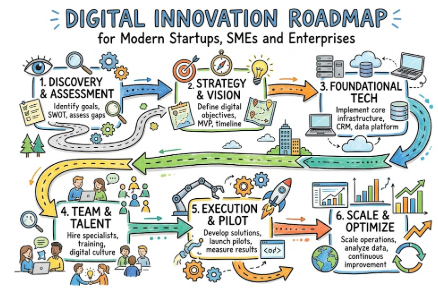
Introduction
Many businesses want to become digital, but they often start with confusion instead of clarity. A startup may buy tools before defining processes, an SME may automate only one department while the rest of the business stays manual, and an enterprise may invest heavily in technology without solving real user problems. This is where a Digital Innovation Roadmap for Startups, SMEs, and Enterprises becomes important. It helps leaders understand what to improve, why it matters, how technology should be used, and which steps should come first. Instead of making random digital decisions, businesses can create a structured plan that connects technology with customers, teams, operations, data, and long-term growth.
Understanding Digital Innovation Roadmap in Simple Words
A digital innovation roadmap is a practical plan that shows how a business will use digital tools, automation, data, cloud platforms, customer experience improvements, and modern processes to grow smarter.
For startups, a digital innovation roadmap may focus on building a scalable product, improving customer onboarding, using cloud infrastructure, and automating early operations. For SMEs, it may include digitizing sales, accounting, customer support, inventory, or marketing. For enterprises, it may involve large-scale modernization, data platforms, AI adoption, cybersecurity, governance, and process automation.
People search for this topic because digital transformation sounds attractive but often feels difficult. Many business owners hear terms like automation, AI, cloud, DevOps, CRM, ERP, analytics, and digital platforms, but they do not always know where to begin.
A beginner-friendly example is a small retail business moving from manual billing and WhatsApp-based order tracking to an integrated system with online orders, inventory tracking, payment records, and customer communication. The business is not becoming digital only because it uses software. It becomes digitally mature when the software improves speed, accuracy, customer satisfaction, and decision-making.
A common misunderstanding is thinking that digital innovation means buying expensive tools. In reality, digital innovation means improving business value through better technology, better processes, better data, and better customer experience.
The practical takeaway is simple: do not start with tools. Start with business goals, process gaps, customer pain points, and measurable outcomes.
Why Digital Innovation Roadmap Is Important
A Digital Innovation Roadmap for Startups, SMEs, and Enterprises is important because it connects technology decisions with real business priorities. Without a roadmap, companies may spend money on apps, platforms, and consultants without knowing whether those investments are solving the right problems.
For startups, the roadmap helps avoid early chaos. Many startups grow quickly, but their internal systems remain weak. Customer data may be scattered, product releases may be unplanned, and teams may depend on manual work. A roadmap helps them build scalable systems from the beginning.
For SMEs, the roadmap helps improve efficiency. Many small and medium businesses lose time because of repeated manual tasks, poor reporting, delayed approvals, weak customer follow-up, and disconnected tools. A roadmap helps them decide which process to digitize first.
For enterprises, the roadmap helps reduce complexity. Large organizations often have old systems, multiple departments, compliance requirements, security needs, and change management challenges. A roadmap gives structure to modernization.
It also supports better financial discipline. When technology investments are planned properly, businesses can compare costs, avoid duplicate tools, reduce operational waste, and prioritize high-impact areas.
A practical scenario: imagine an SME that wants to improve customer service. Without a roadmap, it may buy a chatbot immediately. With a roadmap, it first studies customer queries, response delays, support team workload, data quality, and escalation gaps. After that, it may decide whether a chatbot, CRM, helpdesk system, knowledge base, or process redesign is the right solution.
The better approach is to treat digital innovation as a business improvement journey, not a one-time technology purchase.
The Real Problem Readers Face With Digital Innovation Roadmap
The real problem is not that businesses do not want innovation. The problem is that many businesses do not know how to innovate in the right order.
Startups often face pressure to move fast. They may adopt tools quickly, but without proper documentation, security, or process ownership. This can create confusion when the team grows.
SMEs often face budget limitations. They may want digital systems but fear high cost, technical complexity, staff resistance, and implementation failure. Many owners also depend on informal processes because those methods worked in the early days.
Enterprises face a different challenge. They may have large budgets but slow decision-making, legacy systems, departmental silos, governance issues, and resistance to change.
Common reader problems include:
- Too much confusing advice online
- Too many software choices
- Lack of internal technical knowledge
- No clear digital priorities
- Weak comparison between tools
- Unrealistic expectations from automation or AI
- Poor planning before implementation
- Ignoring cybersecurity and compliance
- Depending only on vendor claims
- Not knowing the right next step
Another problem is emotional decision-making. A business leader may hear that competitors are using AI, cloud, or automation and immediately feel pressure to follow. But copying another company’s digital strategy without understanding your own business can lead to wasted time and money.
The better approach is to slow down, assess the current state, define business outcomes, identify process gaps, and then create a phased roadmap. Digital innovation should be practical, measurable, and aligned with business maturity.
How Digital Innovation Roadmap Works Step by Step
Step 1: Understand the Current Business Situation
What it means: Start by studying how your business works today. Look at teams, processes, tools, customer journeys, data, costs, delays, and pain points.
Why it matters: You cannot improve what you do not understand. Many digital projects fail because companies skip the assessment stage.
How to apply it: Interview team members, review workflows, check customer complaints, analyze manual tasks, and identify repeated delays.
Practical example: An SME may discover that sales follow-ups are delayed because leads are stored in spreadsheets and personal phones.
Common mistake: Starting with software selection before understanding the real problem.
Better approach: Document current processes first, then decide what needs improvement.
Step 2: Define Clear Business Goals
What it means: Decide what digital innovation should achieve. Goals may include faster delivery, better customer experience, lower manual work, improved reporting, stronger security, or scalable growth.
Why it matters: A goal gives direction. Without goals, digital transformation becomes a collection of disconnected tools.
How to apply it: Write goals in clear business language. For example, “reduce order processing errors” is better than “install a new system.”
Practical example: A startup may set a goal to reduce customer onboarding time by improving automation and self-service support.
Common mistake: Using vague goals like “become digital” or “use AI.”
Better approach: Connect each goal with a measurable business problem.
Step 3: Prioritize High-Impact Areas
What it means: Not every process needs digital change immediately. Choose the areas where improvement will create the most value.
Why it matters: Startups, SMEs, and enterprises all have limited time, budget, and team capacity.
How to apply it: Rank processes based on impact, urgency, cost, customer value, and implementation difficulty.
Practical example: A manufacturing SME may prioritize inventory tracking before advanced analytics because stock errors directly affect revenue and delivery.
Common mistake: Trying to digitize everything at once.
Better approach: Start with a few high-impact areas and scale gradually.
Step 4: Choose the Right Digital Solutions
What it means: Select tools, platforms, or technologies that match your needs, budget, team skills, and growth plans.
Why it matters: A powerful tool is not useful if your team cannot use it or if it does not fit your process.
How to apply it: Compare features, cost, integration, security, scalability, support, and ease of use.
Practical example: A service business may choose a CRM that integrates with email, customer support, and billing instead of using separate tools.
Common mistake: Buying a tool only because it is popular.
Better approach: Choose tools based on business fit, not market hype.
Step 5: Build a Phased Implementation Plan
What it means: Break the roadmap into manageable phases instead of launching everything together.
Why it matters: Phased execution reduces risk, improves learning, and gives teams time to adapt.
How to apply it: Create phases such as assessment, pilot, training, rollout, review, and optimization.
Practical example: An enterprise may first run automation in one department before expanding it across the organization.
Common mistake: Forcing a big-bang implementation without testing.
Better approach: Start small, learn quickly, and improve before scaling.
Step 6: Train Teams and Manage Change
What it means: Help employees understand why the change is happening and how to use new systems.
Why it matters: Digital innovation fails when people do not adopt it. Technology alone cannot change a business.
How to apply it: Provide training, user guides, internal champions, feedback sessions, and clear communication.
Practical example: A sales team using a new CRM should understand how it saves follow-up time and improves customer records.
Common mistake: Assuming people will automatically use new tools.
Better approach: Treat adoption as part of the roadmap, not an afterthought.
Step 7: Measure Results and Improve Continuously
What it means: Review whether the digital roadmap is producing real benefits.
Why it matters: Innovation is not complete after implementation. It must be measured and improved.
How to apply it: Track process speed, error reduction, customer satisfaction, team adoption, cost efficiency, and system reliability.
Practical example: A company may measure whether automation reduced manual invoice processing time and improved accuracy.
Common mistake: Not reviewing results after launching a tool.
Better approach: Set review cycles and improve based on real usage data.
Key Factors That Influence Digital Innovation Roadmap
Business Goals
Business goals decide the direction of the roadmap. A startup may want faster product delivery, while an SME may want better operational control. An enterprise may focus on modernization and governance. The mistake is copying another company’s roadmap. The better approach is to define goals based on your own stage, market, customers, and internal gaps.
Customer Experience
Digital innovation should improve customer experience. This may include faster service, easier ordering, better communication, self-service portals, personalized support, or smoother payment processes. A common mistake is improving internal systems without checking whether customers benefit. A better approach is to map the customer journey and identify friction points.
Process Maturity
If processes are unclear, technology will only digitize confusion. Before automation, businesses should simplify workflows, define responsibilities, and remove unnecessary steps. The common mistake is automating broken processes. The better approach is to improve the process first, then digitize it.
Budget and Cost Control
A roadmap must match the financial capacity of the business. Digital innovation may include software subscriptions, implementation costs, training, integration, support, security, and maintenance. The mistake is checking only the purchase price. The better approach is to review total cost of ownership.
Data Quality
Modern digital businesses depend on data. Poor data can lead to wrong reports, weak automation, and bad decisions. The mistake is collecting data without structure. The better approach is to define data ownership, accuracy rules, and reporting needs.
Technology Scalability
The tools selected today should support future growth. Startups may need flexible cloud platforms, SMEs may need integrated systems, and enterprises may need architecture that supports large-scale operations. The mistake is choosing tools only for current needs. The better approach is balancing present affordability with future scalability.
Cybersecurity and Compliance
Every digital roadmap must consider security. Customer data, business records, employee access, payment information, and internal systems need protection. The mistake is treating security as a later concern. The better approach is to include access control, backups, monitoring, and compliance checks from the beginning.
Team Adoption
The success of digital innovation depends on people. If teams do not understand the tools, they may avoid them or use them incorrectly. The mistake is forcing change without support. The better approach is training, communication, feedback, and leadership involvement.
Detailed Breakdown of Digital Innovation Roadmap
Digital Innovation Starts With Business Clarity
A roadmap should begin with business clarity, not technology excitement. Leaders must ask what the business wants to improve. Is the challenge slow delivery, poor customer support, weak reporting, manual approvals, delayed payments, scattered data, or high operational cost?
For example, a startup may need faster product releases. An SME may need better customer tracking. An enterprise may need legacy system modernization. Each case requires a different roadmap.
The common mistake is treating digital innovation as a trend. The better approach is to connect every digital initiative to a real business need.
Customer Journey Mapping
Customer journey mapping means understanding how customers discover, evaluate, purchase, use, and receive support from your business. Digital innovation should reduce friction at each stage.
For example, if customers struggle to get updates after placing an order, the solution may be automated notifications, a customer portal, or better CRM integration. If customers abandon forms because they are too long, the solution may be a simpler digital onboarding flow.
The mistake is assuming internal teams know the customer problem. The better approach is to use customer feedback, support tickets, call records, and real user behavior.
Process Digitization
Process digitization means converting manual or paper-based workflows into digital workflows. This can include approvals, invoices, HR requests, inventory updates, project tracking, service tickets, or vendor management.
However, digitization should not mean copying the same inefficient process into software. If a manual approval process has five unnecessary steps, putting it into a digital tool will still keep the process slow.
The better approach is to simplify first, then digitize.
Automation and Workflow Improvement
Automation helps reduce repeated manual work. It can be used for email responses, invoice generation, lead assignment, data entry, task reminders, customer notifications, reporting, and internal approvals.
But automation should be used carefully. If the input data is wrong or the process rules are unclear, automation can increase mistakes.
A practical example is automating lead assignment in a CRM. If leads are categorized properly, automation can help sales teams respond faster. If lead data is messy, automation may send leads to the wrong team.
The better approach is to automate stable, repeatable, and clearly defined processes first.
Cloud and Infrastructure Modernization
Cloud platforms help businesses scale applications, store data, improve availability, and reduce dependency on traditional infrastructure. Startups often use cloud from the beginning. SMEs may move from local systems to cloud-based tools. Enterprises may modernize legacy workloads gradually.
The mistake is moving to cloud without planning cost, security, architecture, and governance. The better approach is to define what should move, why it should move, and how it will be managed.
Data and Analytics
Data helps businesses make better decisions. A digital innovation roadmap should define what data is needed, where it will come from, who owns it, and how it will be used.
For example, a business may track customer acquisition, sales conversion, delivery time, support response, repeat purchases, and operational cost. These insights can help leaders improve strategy.
The common mistake is creating dashboards that look impressive but do not guide decisions. The better approach is to build reports around key business questions.
AI and Intelligent Tools
AI can support customer service, content creation, forecasting, fraud detection, document processing, personalization, and decision support. But AI should not be adopted only because it is popular.
Before using AI, businesses should check data quality, use case clarity, privacy requirements, human review needs, and risk controls.
The mistake is expecting AI to fix unclear processes. The better approach is to use AI where it supports a defined business problem and includes human oversight.
Integration Between Systems
Many businesses suffer because their tools do not talk to each other. Sales data may sit in one system, billing in another, support in another, and reporting in spreadsheets.
Integration improves visibility and reduces repeated work. For example, when a CRM connects with billing and support systems, teams can see a clearer customer picture.
The mistake is using too many disconnected tools. The better approach is to choose systems with integration capability and define data flow clearly.
Governance and Ownership
Digital innovation needs ownership. Every project should have responsible leaders, users, success measures, security rules, documentation, and review cycles.
Without governance, tools become unused, data becomes unreliable, and processes become inconsistent.
The better approach is to create clear ownership for each digital initiative.
Common Mistakes Beginners Make With Digital Innovation Roadmap
Following Random Advice
This happens when business owners copy trends from social media, competitors, or vendor pitches. It is risky because every business has different goals, budgets, processes, and customers. What works for one company may fail in another. The better approach is to assess your own needs before choosing a digital solution.
Ignoring Risk
Many beginners focus only on benefits such as speed, automation, or growth. They ignore cybersecurity, compliance, data privacy, vendor dependency, and implementation risk. This can lead to financial loss, operational disruption, or customer trust issues. The better approach is to include risk review in every roadmap stage.
Not Comparing Options
Some businesses buy the first tool they find. This can result in high cost, poor usability, weak support, or limited scalability. The better approach is to compare at least a few options based on business fit, features, security, integration, support, and total cost.
Trusting Overpromising Claims
Digital tools can improve business performance, but no tool can guarantee growth without proper process, people, and execution. The mistake is believing claims that sound too easy. The better approach is to ask for realistic use cases, limitations, and implementation requirements.
Making Emotional Decisions
A leader may feel pressure after hearing that competitors use automation, AI, or advanced platforms. Emotional decisions often lead to rushed investments. The better approach is to make decisions based on problem clarity, business value, and readiness.
Not Reading Terms and Conditions
Software contracts, subscription rules, data policies, cancellation terms, support limits, and usage restrictions matter. Ignoring them can create unexpected cost or operational problems. The better approach is to review terms before purchase.
Sharing Sensitive Information Carelessly
Digital projects involve customer data, employee data, business records, and system access. Sharing credentials or sensitive information without controls creates security risk. The better approach is to use access control, password policies, and secure data handling.
Ignoring Legal and Compliance Responsibilities
Some industries have strict rules around data, privacy, records, payments, healthcare, finance, or customer protection. Ignoring compliance can create serious risk. The better approach is to consult qualified professionals where required.
Depending Only on Social Media Advice
Social media can create awareness, but it should not be the only source of business decisions. The better approach is to combine expert consultation, internal assessment, user feedback, and practical testing.
Acting in Panic, Greed, or Pressure
Digital innovation should not be driven by fear of missing out. The better approach is steady planning, small pilots, clear measurement, and continuous improvement.
Don’t Do This Checklist
- Do not buy tools before defining the business problem.
- Do not automate broken processes.
- Do not ignore cybersecurity.
- Do not choose software only because it is popular.
- Do not depend fully on vendor promises.
- Do not skip employee training.
- Do not collect data without ownership.
- Do not launch large projects without testing.
- Do not ignore customer feedback.
- Do not treat digital innovation as a one-time activity.
Practical Real-Life Examples of Digital Innovation Roadmap
Example 1: Startup Improving Customer Onboarding
Situation: A SaaS startup gets many free trial signups, but users leave before activating their accounts.
Mistake or challenge: The team assumes more marketing is needed, but the real problem is confusing onboarding.
Better action: The startup maps the onboarding journey, simplifies steps, adds guided emails, and tracks user behavior.
Learning: Digital innovation works best when it solves the real friction point, not just the visible symptom.
Example 2: SME Moving From Manual Sales Tracking
Situation: A small services company tracks leads in spreadsheets and personal WhatsApp chats.
Mistake or challenge: Leads are missed, follow-ups are delayed, and managers cannot see sales status clearly.
Better action: The company adopts a simple CRM, defines lead stages, trains the sales team, and reviews weekly reports.
Learning: A basic digital system can create strong value when supported by process discipline.
Example 3: Enterprise Modernizing Legacy Systems
Situation: A large organization depends on old internal applications that are slow and hard to maintain.
Mistake or challenge: Teams want to replace everything at once, which creates high risk.
Better action: The enterprise prioritizes critical systems, starts with one modernization pilot, and creates governance rules.
Learning: Large digital innovation should happen in phases with proper risk control.
Example 4: Retail Business Improving Inventory Accuracy
Situation: A growing retailer faces stock mismatch between store records and actual inventory.
Mistake or challenge: Staff update inventory manually at the end of the day, causing errors and delays.
Better action: The business introduces digital inventory tracking, barcode scanning, and daily exception reports.
Learning: Digital tools improve results when they reduce repeated manual work and improve visibility.
Example 5: Professional Services Firm Using Data Better
Situation: A consulting firm has client data, project data, billing data, and team performance data in separate files.
Mistake or challenge: Leadership decisions are based on assumptions rather than reliable information.
Better action: The firm creates a basic reporting system with defined data ownership and monthly review meetings.
Learning: Better data can improve planning, but only when it is accurate, structured, and reviewed regularly.
Two Useful Tables for Better Understanding
Table 1: Digital Innovation Focus by Business Type
| Business Type | Main Digital Need | Common Challenge | Better Approach |
|---|---|---|---|
| Startup | Scalable systems and fast execution | Using random tools without structure | Build simple, flexible systems with clear ownership |
| SME | Process digitization and efficiency | Manual work, scattered data, limited budget | Prioritize high-impact processes and affordable tools |
| Enterprise | Modernization, governance, integration | Legacy systems, silos, slow change | Use phased transformation with strong governance |
| Growing Business | Customer experience and reporting | Poor visibility and inconsistent processes | Connect customer journey, data, and operations |
| Digital-First Business | Automation and analytics | Tool overload and data quality issues | Simplify workflows and measure business value |
Table 2: Beginner Mistake vs Correct Digital Innovation Approach
| Beginner Mistake | Why It Creates Risk | Correct Approach |
|---|---|---|
| Buying tools first | May not solve the real problem | Start with business assessment |
| Automating unclear workflows | Can increase errors faster | Simplify process before automation |
| Ignoring team training | Low adoption and poor usage | Include training in the roadmap |
| Choosing disconnected software | Creates data silos | Check integration before purchase |
| Skipping cybersecurity | Exposes business and customer data | Add security controls from the start |
| No success measurement | Hard to know if investment worked | Define metrics before implementation |
Tools, Methods, and Frameworks Readers Can Use
Digital Maturity Assessment
A digital maturity assessment helps a business understand where it currently stands. It reviews processes, tools, data, customer experience, security, and team skills. Beginners can use it by rating each department as manual, partially digital, integrated, or optimized. It helps avoid the mistake of starting transformation without knowing the current reality.
Process Mapping
Process mapping means writing each step of a workflow clearly. It helps teams see delays, duplicate work, approval gaps, and manual effort. Beginners can use simple flowcharts or written steps. It helps avoid automating a broken or confusing process.
Customer Journey Map
A customer journey map shows how customers interact with your business from first contact to support. It helps identify pain points in communication, onboarding, purchase, payment, delivery, or service. It prevents the mistake of focusing only on internal needs while ignoring customer experience.
Technology Comparison Checklist
This checklist helps compare tools based on features, cost, ease of use, integration, support, security, and scalability. Beginners should use it before buying software. It helps avoid emotional buying and vendor-driven decisions.
Roadmap Prioritization Matrix
A prioritization matrix compares digital initiatives by impact and effort. High-impact, low-effort improvements can be done first. High-impact, high-effort projects can be planned carefully. This helps avoid trying to do everything at once.
Pilot Project Method
A pilot project tests a digital solution in a small area before full rollout. It helps teams learn what works, what fails, and what needs improvement. It avoids the risk of large implementation failure.
Change Management Plan
A change management plan explains how people will be trained, informed, supported, and guided during digital transformation. It helps avoid resistance, confusion, and low adoption.
Monthly Digital Review
A monthly review checks progress, adoption, issues, cost, user feedback, and measurable improvements. It helps ensure that digital innovation remains practical and continuous.
Expert Tips to Make Better Decisions
1. Start With the Business Problem
The tip: Define the business problem before selecting technology.
Why it matters: Tools are useful only when they solve a real problem.
How to apply it: Write one clear problem statement before every digital investment.
2. Keep the Roadmap Simple in the Beginning
The tip: Avoid making the first roadmap too complicated.
Why it matters: Complex plans can confuse teams and delay action.
How to apply it: Start with a few priorities, clear owners, and realistic timelines.
3. Compare Multiple Options
The tip: Do not select software after seeing only one demo.
Why it matters: Different tools have different strengths, costs, and limitations.
How to apply it: Compare options using features, integrations, support, and total cost.
4. Check Team Readiness
The tip: Understand whether your team can use the new system.
Why it matters: Poor adoption reduces the value of digital investment.
How to apply it: Provide training, documentation, and internal support.
5. Protect Data From the Start
The tip: Include security and privacy early.
Why it matters: Digital systems often handle sensitive customer and business data.
How to apply it: Use access controls, backups, secure passwords, and user permissions.
6. Avoid Tool Overload
The tip: Use fewer tools that work well together.
Why it matters: Too many tools create confusion, duplicate work, and extra cost.
How to apply it: Review existing tools before buying new ones.
7. Measure Practical Outcomes
The tip: Track whether the roadmap improves real business results.
Why it matters: Digital innovation should improve speed, quality, cost, visibility, or customer experience.
How to apply it: Define simple success indicators before implementation.
8. Use Pilot Testing
The tip: Test a solution on a small scale first.
Why it matters: Pilots reduce risk and reveal practical challenges early.
How to apply it: Start with one team, one workflow, or one department.
9. Keep Customers at the Center
The tip: Digital innovation should improve customer experience.
Why it matters: Internal efficiency is useful, but customer value drives long-term growth.
How to apply it: Study customer complaints, feedback, and service delays.
10. Review Costs Beyond Subscription Fees
The tip: Check implementation, training, integration, migration, and support costs.
Why it matters: The real cost of technology is often more than the monthly price.
How to apply it: Prepare a total cost checklist before approval.
11. Create Clear Ownership
The tip: Assign owners for every digital initiative.
Why it matters: Without ownership, projects lose direction.
How to apply it: Define who is responsible for process, tool usage, data, and review.
12. Improve Continuously
The tip: Treat the roadmap as a living plan.
Why it matters: Business needs, customer behavior, and technology change over time.
How to apply it: Review the roadmap regularly and update priorities.
Case Studies: How Better Understanding Changes Decisions
Case Study 1: Startup Building a Scalable Foundation
Profile: A young technology startup with a small product and sales team.
Situation: The startup was growing quickly, but customer onboarding, support, and product updates were handled manually.
Problem: Customer data was scattered, support tickets were missed, and product releases were not properly tracked.
Wrong approach: The founders first considered buying several advanced tools without understanding which process needed improvement most.
Better approach: The team created a digital innovation roadmap. They mapped customer onboarding, selected a simple CRM, improved product task tracking, and created basic support workflows.
Result or learning: The startup learned that early digital maturity does not require complex systems. It requires clear processes, reliable data, and tools that match the team’s stage.
Key takeaway: Startups should build digital foundations early, but they should keep systems simple and scalable.
Case Study 2: SME Reducing Manual Operational Work
Profile: A medium-sized trading business with sales, inventory, billing, and delivery teams.
Situation: The business used spreadsheets and phone calls for order updates, stock checks, and customer communication.
Problem: Orders were delayed because teams did not have real-time information. Customers often called repeatedly for updates.
Wrong approach: The owner wanted to create a mobile app immediately, assuming it would solve customer complaints.
Better approach: The business first reviewed the internal process and found that inventory and order status were not updated properly. It introduced digital inventory tracking, order status updates, and customer notifications before building any advanced app.
Result or learning: The company understood that customer experience improves when internal data and process visibility improve.
Key takeaway: SMEs should digitize core operations before investing in advanced customer-facing platforms.
Case Study 3: Enterprise Managing Modernization Risk
Profile: A large enterprise with multiple departments and legacy applications.
Situation: The enterprise wanted to modernize its systems and improve data visibility across departments.
Problem: Different teams used separate applications, and leadership had no single view of operations.
Wrong approach: Some leaders wanted to replace all systems at once, which could have disrupted operations.
Better approach: The organization created a phased roadmap. It identified critical systems, created integration priorities, strengthened data governance, and started modernization with a controlled pilot.
Result or learning: The enterprise learned that transformation at scale requires governance, stakeholder alignment, security, and gradual execution.
Key takeaway: Enterprises should manage digital innovation through phased modernization, not rushed replacement.
Risk Awareness: What Readers Must Check First
Cybersecurity Risk
Cybersecurity risk means the chance of business systems, customer data, or internal records being exposed or attacked. It matters because digital systems increase data movement and access points. Businesses can reduce this risk through access controls, secure passwords, backups, monitoring, employee awareness, and regular security reviews.
Data Privacy Risk
Data privacy risk happens when personal or business information is collected, stored, or shared without proper control. It matters because customers trust businesses with sensitive details. Businesses can reduce this risk by collecting only necessary data, defining permissions, and reviewing privacy responsibilities.
Vendor Dependency Risk
Vendor dependency risk means becoming too dependent on one software provider or platform. It matters because pricing, service quality, support, or product direction may change. Businesses can reduce this risk by reviewing contracts, export options, support quality, and integration flexibility.
Implementation Risk
Implementation risk means the project may take longer, cost more, or fail to deliver expected value. It matters because poor execution can disrupt business operations. Businesses can reduce this risk through pilot testing, phased rollout, clear ownership, and practical training.
Cost Overrun Risk
Cost overrun risk happens when hidden costs appear after purchase. These may include customization, migration, integration, training, maintenance, and support. Businesses can reduce this risk by reviewing total cost of ownership before approval.
Adoption Risk
Adoption risk means employees may not use the new system properly. It matters because unused tools do not create value. Businesses can reduce this risk through training, communication, leadership support, and user-friendly processes.
Compliance Risk
Compliance risk depends on the industry, country, customer data, and business activities. It matters because legal or regulatory mistakes can create penalties and reputation damage. Businesses should verify requirements and consult qualified legal, tax, cybersecurity, or compliance professionals where required.
Misinformation Risk
Misinformation risk comes from relying on unverified online advice, vendor claims, or social media trends. It matters because wrong guidance can lead to poor investment decisions. Businesses can reduce this risk by validating information, comparing sources, and taking expert advice when needed.
Checklist Before Taking Action
Before starting a Digital Innovation Roadmap for Startups, SMEs, and Enterprises, review this checklist carefully:
- Clear business problem is identified.
- Current process is documented.
- Customer pain points are understood.
- Digital goals are written clearly.
- Options are compared properly.
- Tool cost, support, and scalability are reviewed.
- Integration requirements are checked.
- Cybersecurity and data privacy risks are considered.
- Team readiness is reviewed.
- Training plan is prepared.
- Pilot project is planned before full rollout.
- Success metrics are defined.
- Budget and hidden costs are reviewed.
- Legal or compliance impact is checked.
- Vendor terms and conditions are read.
- Data backup and access control are planned.
- Emotional or rushed decisions are avoided.
- Professional advice is considered where needed.
- Roadmap review cycle is scheduled.
Use this checklist before making major digital decisions. It helps you slow down, compare better, avoid unnecessary spending, and focus on practical business improvement.
Strategic Insights for Better Decision-Making
Build Around Business Capability
Digital innovation should improve business capabilities such as sales, delivery, service, operations, reporting, compliance, and customer engagement. Instead of asking, “Which tool should we buy?” ask, “Which capability should we improve?” This keeps the roadmap focused on business value.
Create Process Ownership
Every important workflow needs an owner. Without ownership, teams may blame tools, vendors, or other departments when problems happen. A process owner ensures that workflows are documented, improved, measured, and updated.
Use Data for Decisions, Not Decoration
Dashboards should answer real business questions. For example, leaders may need to know which process causes delays, which customers need follow-up, or which product line has repeated issues. Avoid creating reports that look good but do not support action.
Balance Speed and Control
Startups need speed, but they should not ignore security or documentation. Enterprises need control, but they should not make innovation too slow. SMEs need affordability, but they should not choose weak systems only because they are cheap. The roadmap should balance speed, cost, risk, and quality.
Think in Phases
Digital maturity grows over time. The first phase may focus on process clarity. The second may digitize workflows. The third may integrate tools. The fourth may use analytics and automation. This phased thinking reduces pressure and creates steady progress.
Prepare for Change Management
People may resist digital systems if they feel monitored, confused, or replaced. Leaders should explain the purpose clearly. The message should be that technology supports better work, reduces unnecessary effort, and improves customer value.
Review and Retire Unused Tools
A mature digital roadmap also removes tools that no longer create value. Many businesses pay for unused software. Regular review helps reduce cost and simplify operations.
Connect Innovation With Customer Trust
Digital systems should make customers feel informed, supported, and secure. Faster service, clear communication, reliable data, and safe handling of information build trust over time.
Key Terms Explained for Beginners
- Digital Innovation: Digital innovation means using technology to improve business processes, customer experience, products, services, or decision-making.
- Digital Transformation: Digital transformation is a broader business change where technology, people, processes, and strategy work together to improve how the company operates.
- Roadmap: A roadmap is a structured plan that shows what will be done, why it matters, when it will happen, and who will manage it.
- Automation: Automation means using technology to complete repeated tasks with less manual effort, such as sending reminders or updating records.
- Cloud Computing: Cloud computing allows businesses to use online servers, platforms, and software instead of depending only on local infrastructure.
- CRM: CRM means Customer Relationship Management. It helps businesses track leads, customers, communication, and sales activities.
- ERP: ERP means Enterprise Resource Planning. It helps manage business functions such as finance, inventory, operations, HR, and supply chain.
- Data Analytics: Data analytics means studying business data to find patterns, problems, and improvement opportunities.
- Integration: Integration means connecting different tools or systems so they can share information.
- Cybersecurity: Cybersecurity means protecting digital systems, data, networks, and users from unauthorized access or attacks.
- Scalability: Scalability means the ability of a system or process to handle growth without breaking or becoming inefficient.
- User Adoption: User adoption means how well employees or customers actually use a new digital tool or process.
- Legacy System: A legacy system is an older application or technology that may still work but can be difficult to maintain, integrate, or scale.
- Change Management: Change management is the process of helping people understand, accept, and use new systems or ways of working.
- Governance: Governance means rules, ownership, review systems, and controls that keep digital initiatives organized and responsible.
Who Should Read This Blog
Beginners
Beginners who feel confused about digital transformation can use this blog to understand the basics in simple language.
Students
Students studying business, technology, management, or entrepreneurship can learn how digital innovation works in real organizations.
Salaried Employees
Employees can understand why companies adopt new tools, automation, dashboards, and digital workflows.
Small Business Owners
Small business owners can learn how to digitize operations without wasting money on unnecessary tools.
Startup Founders
Founders can use the roadmap approach to build scalable systems, improve customer onboarding, and avoid early operational chaos.
SME Leaders
SME leaders can identify which processes should be digitized first and how to improve efficiency step by step.
Enterprise Managers
Enterprise managers can understand modernization, governance, integration, and change management better.
New Investors
Investors studying businesses can use digital maturity as one factor when understanding operational strength and scalability.
Traders and Finance Learners
Finance learners can understand how technology improves reporting, decision-making, data quality, and operational discipline.
Loan Seekers and Business Borrowers
Business borrowers can use a roadmap to plan technology spending carefully before taking loans for digital expansion.
Crypto Learners
Crypto learners can understand why digital security, data privacy, and platform risk matter in any technology-based system.
Casino Content Creators
Casino content creators can learn how digital strategy, compliance-sensitive writing, responsible content, and user trust matter in online platforms.
Finance Bloggers
Finance bloggers can understand how digital innovation affects business models, customer trust, automation, and decision-making.
People Improving Business Awareness
Anyone trying to avoid poor digital decisions can use this blog as a practical starting point.
Frequently Asked Questions
1. What is a Digital Innovation Roadmap for Startups, SMEs, and Enterprises?
A Digital Innovation Roadmap for Startups, SMEs, and Enterprises is a structured plan for using technology to improve business operations, customer experience, data, and growth. It helps businesses decide what to digitize, when to do it, and how to measure success.
2. Why is a digital innovation roadmap important for beginners?
It gives beginners a clear path instead of random technology decisions. Without a roadmap, businesses may buy tools that do not solve real problems. A roadmap helps connect technology with practical business goals.
3. How can a startup begin digital innovation safely?
A startup should begin by mapping its core processes, customer journey, product workflow, and data needs. It should choose simple tools that can scale later. The focus should be on clarity, speed, security, and customer value.
4. How can SMEs use a Digital Innovation Roadmap for Startups, SMEs, and Enterprises?
SMEs can use the roadmap to identify manual work, improve reporting, digitize customer management, and reduce operational delays. The roadmap helps them prioritize affordable and high-impact digital improvements.
5. What is the biggest mistake businesses make in digital innovation?
The biggest mistake is buying tools before understanding the real business problem. Technology should support a clear goal. Businesses should first assess processes, customer pain points, team readiness, and measurable outcomes.
6. Is digital innovation only for large enterprises?
No. Digital innovation is useful for startups, SMEs, and enterprises. The scale may differ, but every business can benefit from better processes, automation, data visibility, customer experience, and security.
7. What risks should businesses check before starting?
Businesses should check cybersecurity risk, data privacy risk, cost risk, vendor dependency, adoption risk, compliance requirements, and implementation challenges. Risk review should happen before major digital investment.
8. How often should a digital innovation roadmap be reviewed?
A roadmap should be reviewed regularly, especially after major business changes, customer feedback, tool adoption, or process updates. A monthly or quarterly review helps keep the plan practical and relevant.
9. Should businesses use AI in their digital roadmap?
AI can be useful, but only when the business has a clear use case, good data, and proper review controls. Businesses should not use AI only because it is trending. The better approach is to start with practical and low-risk use cases.
10. How can teams improve adoption of new digital tools?
Teams need training, clear communication, user-friendly workflows, leadership support, and feedback channels. Adoption improves when employees understand how the tool helps their daily work.
11. What should businesses avoid before taking digital action?
They should avoid rushed decisions, unclear goals, fake promises, poor comparison, weak security, and tool overload. They should also avoid launching large projects without pilot testing.
12. What is the best next step after reading this blog?
The best next step is to assess your current business processes and identify the top three digital improvement areas. Then create a simple phased roadmap with goals, owners, budget, risks, and review timelines.
Conclusion and Next Steps
A Digital Innovation Roadmap for Startups, SMEs, and Enterprises is not just a technology plan; it is a business improvement plan. It helps organizations understand where they are, where they want to go, and how digital tools can support that journey responsibly. Beginners should remember that digital innovation does not begin with buying software or following trends. It begins with understanding business problems, customer needs, process gaps, data quality, team readiness, cost, security, and measurable outcomes. Startups should focus on scalable foundations, SMEs should prioritize efficiency and visibility, and enterprises should manage modernization with governance and phased execution. The practical next step is to review your current workflows, identify high-impact pain points, compare options carefully, test solutions through small pilots, train teams properly, and measure results regularly. Businesses should also stay aware of risks such as cybersecurity, data privacy, vendor dependency, cost overruns, compliance issues, and poor adoption. Digital innovation works best when it is steady, realistic, and connected to long-term value. Instead of chasing every new trend, leaders should build a roadmap that supports better decisions, stronger operations, improved customer trust, and sustainable growth.

