
Introduction
Ten years ago, starting a tech company meant buying expensive physical servers, hard drives, and networking cables. Today, businesses rent all that computing power over the internet through cloud providers. Amazon Web Services, or AWS, is the biggest player in this market.
As more Indian startups, banks, and large enterprises move their operations online, they need people who understand how this technology works. However, jumping into cloud computing can feel overwhelming. There are hundreds of tools, confusing technical words, and many different certification paths.
If you choose the wrong path, you can waste months studying the wrong skills. This guide explains what AWS training in India involves, which skills matter most, what career opportunities you can expect, and how to build a practical learning path from scratch.
What Is AWS and Why Does It Matter in India?
Amazon Web Services is a cloud computing platform. Instead of owning physical computers, companies rent processing power, storage, and databases from Amazon’s massive data centers.
Think of AWS like renting a fully furnished apartment instead of building a house from scratch. You do not worry about plumbing, electricity, or structural safety—you just move in and start living. Similarly, companies do not worry about maintaining physical hardware. They write their software, deploy it on AWS, and pay only for what they use.
Why AWS Matters in the Indian Job Market
India has become a massive hub for technology, software development, and digital transformation.
- Enterprise Cloud Adoption: Traditional Indian banks, retail giants, and government bodies are migrating legacy systems to the cloud.
- Startup Ecosystem: Cities like Bengaluru, Hyderabad, Pune, and Gurgaon are home to thousands of tech startups that run entirely on AWS.
- Global Delivery Centers: Multinational corporations use their Indian offices to manage global cloud infrastructure, creating steady demand for certified talent.
Core Skills Needed for AWS Careers
To build a successful career in cloud computing, you need a mix of foundational IT knowledge and specific cloud skills.
1. Networking Fundamentals
You cannot secure or manage cloud servers if you do not understand how computers talk to each other. You need to know how IP addresses, virtual private clouds, firewalls, and domain name systems work.
2. Linux Operating System Basics
Most servers running in the cloud use Linux. You must feel comfortable using a command-line interface, managing file permissions, and troubleshooting basic server errors.
3. Infrastructure as Code (IaC)
Modern cloud environments are not clicked together manually; they are written in code using tools like Terraform or AWS CloudFormation. This skill lets you spin up hundreds of servers with a single command.
4. Security and Identity Management
Data breaches cost companies millions. Knowing how to set up access controls, encrypt data, and monitor system logs is vital for any cloud role.
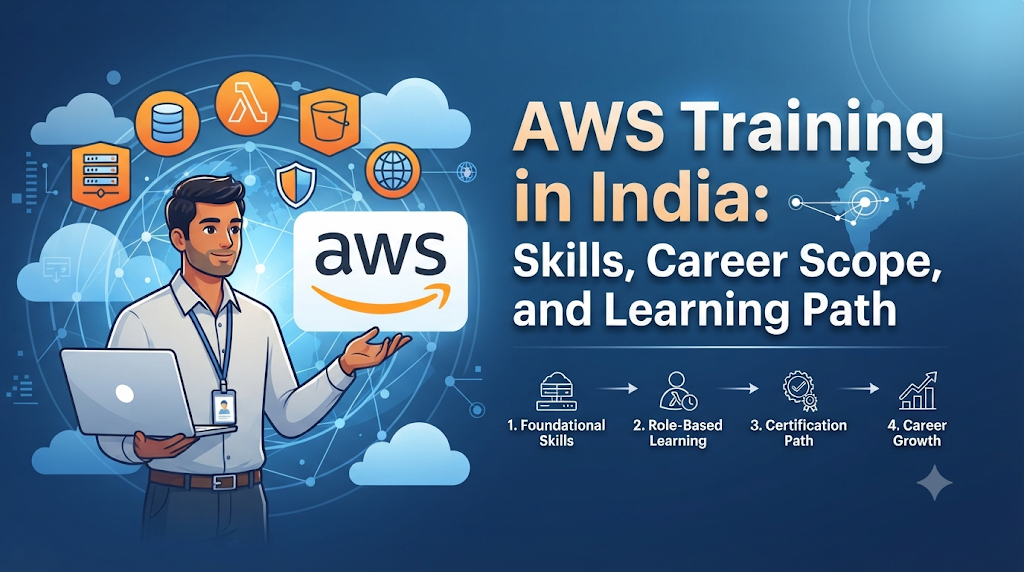
AWS Learning Path: Step-by-Step for Beginners
Following a structured learning path prevents confusion and keeps your studies focused on what employers actually want.
Step 1: Foundational Cloud Knowledge (Cloud Practitioner)
       ↓
Step 2: Core Technical Mastery (Solutions Architect Associate)
       ↓
Step 3: Hands-On Practice & Mini Projects
       ↓
Step 4: Specialization (DevOps, Security, or Data)
       ↓
Step 5: Certification & Job Search
Step 1: Learn Cloud Fundamentals
Begin with the basics. Understand what cloud computing is, the difference between public and private clouds, and basic pricing models. Preparing for the AWS Certified Cloud Practitioner exam is a great way to learn these terms.
Step 2: Master Core Services
Dive into the foundational AWS services that every company uses:
- Amazon EC2: Virtual servers in the cloud.
- Amazon S3: Scalable object storage for files and backups.
- Amazon RDS: Managed relational databases.
- VPC (Virtual Private Cloud): Isolated private networks in the cloud.
Step 3: Build Real Projects
Watching tutorials is not enough. Spin up a free-tier AWS account and build simple projects:
- Host a static personal website on S3 and CloudFront.
- Deploy a WordPress blog on an EC2 instance connected to an RDS database.
- Automate a daily system backup using AWS Lambda functions.
Step 4: Choose a Specialization
Once you understand the basics, pick a track that matches your interests:
- Solutions Architect: Focuses on designing secure, scalable systems.
- SysOps Administrator: Focuses on deployment, management, and operations.
- Developer: Focuses on writing code that interacts with cloud services.
- DevOps Engineer: Focuses on automation, CI/CD pipelines, and infrastructure as code.
Career Scope and Salary Expectations in India
The career scope for AWS professionals in India is exceptionally strong across multiple job roles.
Popular Job Roles
- Cloud Support Engineer: Helps troubleshoot and resolve infrastructure issues for customers or internal teams.
- AWS Solutions Architect: Designs complex cloud environments for businesses moving from physical servers.
- Cloud DevOps Engineer: Builds automation pipelines to make software delivery fast and reliable.
- Cloud Security Specialist: Protects cloud workloads from cyber threats and ensures compliance.
Salary Overview
Salaries vary based on experience, location, and certifications:
- Freshers / Entry-Level: INR 3.5 Lakhs to 6 Lakhs per annum.
- Mid-Level (2 to 5 years experience): INR 8 Lakhs to 18 Lakhs per annum.
- Senior-Level / Architect (5+ years): INR 20 Lakhs to 35+ Lakhs per annum.
Common Mistakes Beginners Make
Avoid these common pitfalls during your AWS training journey:
- Tutorial Hell: Spending months watching videos without building anything yourself. Fix: Build a small project after every single learning module.
- Ignoring Networking Basics: Trying to learn advanced cloud security before understanding how IP subnets work. Fix: Spend extra time learning basic networking fundamentals.
- Relying Solely on Dumps: Memorizing exam questions to pass certifications without understanding the underlying technology. Fix: Focus on practical labs and real-world scenario troubleshooting.
- Not Managing Cloud Costs: Leaving resources running in your personal AWS account and getting unexpected bills. Fix: Set up AWS billing alerts and clean up resources immediately after practice.
Key Terms Explained
- Cloud Computing: Delivering computing services (servers, storage, databases, networking) over the internet.
- IAM (Identity and Access Management): An AWS service that lets you securely control who can access your cloud resources.
- Regions and Availability Zones: Physical locations around the world where AWS clusters data centers to ensure high availability and disaster recovery.
- Serverless Computing: A cloud computing model where you write code, and AWS manages the servers for you automatically (e.g., AWS Lambda).
- CI/CD (Continuous Integration / Continuous Delivery): A method to frequently deliver apps to customers by introducing automation into the stages of development.
Frequently Asked Questions
1. Do I need programming experience to start AWS training?
Basic AWS roles like Cloud Practitioner or SysOps Administrator do not require heavy coding skills. However, knowing basic scripting languages like Python or Bash is very helpful for automation and DevOps roles.
2. Can non-IT graduates get AWS jobs in India?
Yes. Many professionals from mechanical, civil, or commerce backgrounds successfully transition into cloud computing by learning the fundamentals, earning certifications, and building practical projects to prove their skills.
3. Which AWS certification should I take first?
If you are completely new to tech, start with the AWS Certified Cloud Practitioner. If you have a background in IT or software development, you can start directly with the AWS Certified Solutions Architect – Associate.
4. Is the AWS Free Tier enough for practice?
Yes. AWS offers a generous free tier for the first 12 months, along with some services that remain permanently free within specific limits. Just remember to monitor your usage and set up billing alarms.
5. How long does it take to complete AWS training?
For a beginner studying consistently, it takes about 3 to 6 months of dedicated learning and hands-on lab practice to become job-ready for an associate-level role.
Conclusion
AWS training in India opens the door to stable, high-paying tech careers in a rapidly growing digital economy. Success comes down to balancing theory with hands-on practice, understanding core networking and security principles, and earning recognized certifications. Start with the fundamentals, build real projects in a free-tier account, and focus on solving practical problems.

