
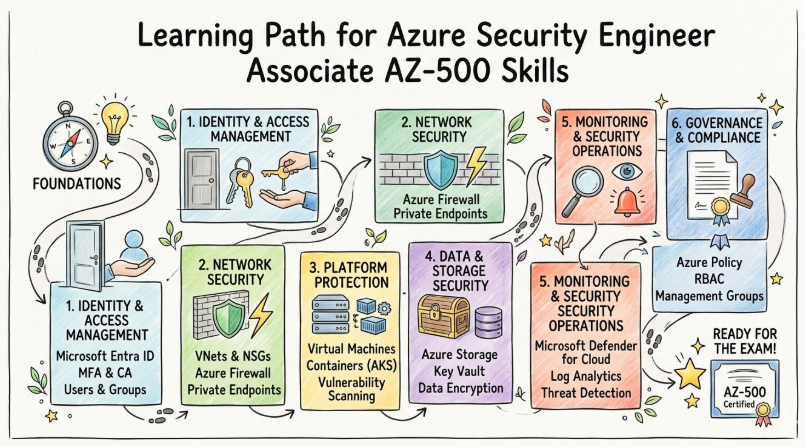
Introduction
The protection of digital assets has become a primary concern for organizations operating in the cloud. As infrastructure moves away from traditional data centers, a shift toward identity-centric security is observed. The Azure Security Engineer Associate (AZ-500) certification is recognized as a key milestone for professionals who are tasked with building and maintaining these secure cloud environments. This certification is centered on the implementation of robust security controls, the management of identity, and the protection of sensitive data within Microsoft Azure.
In the modern ecosystem of automation and rapid deployment, security is no longer viewed as a separate phase but as an integrated part of the entire lifecycle. For both engineers and managers, obtaining this certification is considered a strategic move to validate technical expertise. It is understood that a certified professional brings a level of trust and standardized knowledge that is essential for protecting enterprise-scale workloads. Long-term career growth is often tied to the ability to prove these specialized skills through globally recognized credentials.
Why Choose DevOpsSchool?
The decision to train with DevOpsSchool is often based on the quality of the mentor-led experience. Practical skills are prioritized over simple theoretical knowledge, ensuring that students are prepared for real-world scenarios. The labs provided are designed to simulate actual security breaches and configuration challenges, which helps in building a deeper understanding of the Azure platform.
Comprehensive support is provided throughout the learning journey, including access to updated study guides and a community of industry experts. It is noted that the curriculum is consistently refreshed to align with the latest exam updates from Microsoft. This dedication to quality ensures that every learner is equipped with the most relevant tools and techniques needed to excel in the field of cloud security.
Certification Deep-Dive: Azure Security Engineer Associate (AZ-500)
What is this certification?
The AZ-500 is a specialized certification focused on implementing security solutions in Azure. It covers a broad spectrum of topics, including identity management, platform protection, and security operations.
Who should take this certification?
This path is recommended for individuals who are responsible for the day-to-day security of cloud resources. It is also highly valuable for developers and administrators who wish to transition into specialized security engineering roles.
Certification Overview Table
| Domain | Proficiency | Target Group | Requirements | Core Competencies | Sequence |
| DevOps | Associate | Software Developers | Cloud Fundamentals | Automated Security | 1st |
| DevSecOps | Associate | Security Experts | AZ-104 Knowledge | Threat Remediation | 2nd |
| SRE | Specialist | Operations Teams | Infrastructure Exp | System Resilience | 2nd |
| AIOps/MLOps | Associate | AI Practitioners | Python & Data | Model Protection | 3rd |
| DataOps | Associate | Data Architects | SQL & Governance | Data Encryption | 2nd |
| FinOps | Specialist | Cloud Accountants | Cost Management | Governance Policy | 3rd |
Skills you will gain
- Enterprise identity management using Microsoft Entra ID is mastered.
- Advanced threat protection for cloud-native applications is implemented.
- Security for virtual networks and hybrid connections is configured.
- Governance and compliance standards are enforced through automated policies.
Real-world projects you should be able to do
- A comprehensive Zero Trust security model for a global organization is deployed.
- Automated incident response workflows using Microsoft Sentinel are created.
- Secure access for third-party vendors is managed through granular permissions.
- End-to-end encryption for large-scale data lakes is established.
Preparation plan
7–14 Days Plan (The Revision Focus)
- The majority of time is spent on reviewing core identity and networking services.
- Practice exams are used to identify and fill knowledge gaps quickly.
- High-level security concepts and default settings in Azure are memorized.
30 Days Plan (The Practitioner Focus)
- Daily study sessions are combined with hands-on lab exercises.
- The first half is dedicated to identity and infrastructure security modules.
- The second half is focused on data security and monitoring tools.
- Mock tests are performed weekly to track progress and improve speed.
60 Days Plan (The Expert Focus)
- Every exam domain is explored in extreme detail through extensive lab work.
- Complex scenarios, such as cross-tenant security and hybrid identity, are practiced.
- Technical documentation and white papers are studied to understand deep architectural nuances.
- The final month is reserved for intensive review and advanced troubleshooting exercises.
Common mistakes to avoid
- The importance of understanding the shared responsibility model is often neglected.
- Proper time is not allocated for learning PowerShell and Azure CLI commands.
- Outdated study materials are used, leading to confusion during the actual exam.
Best next certification after this
- Same track: Microsoft Cybersecurity Architect Expert (SC-100).
- Cross-track: Azure Solutions Architect Expert (AZ-305).
- Leadership / management: Certified Information Systems Auditor (CISA).
Choose Your Learning Path
DevOps Path
This journey is intended for those who aim to embed security into the development cycle. The focus is placed on securing secrets and automating vulnerability scans within pipelines.
DevSecOps Path
A deep dive into continuous security monitoring is provided here. This path is followed by professionals who ensure that security remains constant throughout rapid deployment phases.
Site Reliability Engineering (SRE) Path
The intersection of system uptime and security is explored. Reliability engineers use this path to build systems that can withstand both failures and attacks.
AIOps / MLOps Path
Security for intelligent systems is the main priority. This path is chosen by those who protect machine learning environments and sensitive AI data.
DataOps Path
The focus is kept on the integrity and privacy of data workflows. Data professionals follow this path to ensure that analytics platforms remain compliant and secure.
FinOps Path
Security and financial accountability are merged in this path. It is used by cloud leads to ensure that cost-reduction strategies do not open security loopholes.
Role → Recommended Certifications
| Professional Role | Core Recommended Certification | Secondary Specialist Certification | Advanced / Leadership Certification |
| DevOps Engineer | AZ-500 (Azure Security) | AZ-400 (Azure DevOps) | Certified Kubernetes Security Specialist (CKS) |
| Site Reliability Engineer (SRE) | AZ-500 (Azure Security) | AZ-104 (Azure Administrator) | Professional Cloud SRE |
| Platform Engineer | AZ-500 (Azure Security) | AZ-700 (Azure Networking) | CKAD (Kubernetes Application Developer) |
| Cloud Engineer | AZ-500 (Azure Security) | AZ-104 (Azure Administrator) | AZ-305 (Solutions Architect) |
| Security Engineer | AZ-500 (Azure Security) | SC-200 (Security Ops) | SC-100 (Cybersecurity Architect) |
| Data Engineer | AZ-500 (Azure Security) | DP-203 (Data Engineering) | DP-300 (Administering Azure SQL) |
| FinOps Practitioner | AZ-500 (Azure Security) | FinOps Certified Practitioner | AZ-305 (Solutions Architect) |
| Engineering Manager | AZ-500 (Azure Security) | AZ-900 (Fundamentals) | PMP / CISSP |
Next Certifications to Take
For the Cloud Architect:
- Same-track: Azure Solutions Architect Expert.
- Cross-track: AZ-500 Security.
- Leadership: TOGAF Certification.
For the Security Analyst:
- Same-track: Microsoft Security Operations Analyst Associate (SC-200).
- Cross-track: Certified Ethical Hacker (CEH).
- Leadership: CISSP.
Training & Certification Support Institutions
DevOpsSchool
Industry-standard training is provided by this institution through a combination of live sessions and recorded content. A heavy emphasis is placed on technical mastery and career readiness. Mentorship from seasoned professionals is a core part of the learning experience.
Cotocus
Specialized consulting and training services are offered to both individuals and corporate teams. The curriculum is designed to solve real-world technical problems using the latest cloud tools. Small batches are maintained to ensure that every student receives personalized attention.
ScmGalaxy
A vast repository of knowledge for software configuration and DevOps is maintained here. Tutorials are written by experts to help learners navigate complex technical landscapes. It is a highly trusted source for self-paced professional development.
BestDevOps
Advanced training for leadership and architectural roles is the specialty of this platform. The focus remains on bridging the gap between engineering and business strategy. In-depth case studies are used to teach complex infrastructure security.
devsecopsschool.com
This platform is dedicated to the integration of security within the DevOps world. Niche skills like container hardening and automated compliance are taught in detail. It is recognized for its focused approach to modern security engineering.
sreschool.com
Reliability and operational excellence are the primary subjects taught here. The courses are designed to help engineers build systems that are both highly available and secure. Modern SRE methodologies are used as the foundation for all training.
aiopsschool.com
The use of artificial intelligence in IT operations is explored through structured training modules. Learners are taught how to automate complex tasks and improve security using AI. It is an ideal platform for those looking to innovate in the cloud space.
dataopsschool.com
The management of data pipelines with a focus on speed and security is the core mission here. Professionals are taught how to apply operational principles to data engineering. It is a vital resource for anyone working in big data.
finopsschool.com
Cloud financial management and governance are taught with a focus on business value. Strategies for maintaining security while optimizing cloud spend are shared by experts. It is a necessary stop for cloud financial leads and managers.
FAQs Section
General FAQs
- What is the passing criteria for the AZ-500?
A score of at least 700 is required to be successful in the exam. - Is previous experience needed?
It is recommended that candidates have at least some experience with Azure administration. - How long does the exam last?
The time limit for the exam is generally around 120 to 150 minutes. - What is the best way to start preparation?
Starting with the official exam objectives and hands-on labs is encouraged. - Are there negative marks in the exam?
No, marks are not deducted for incorrect answers. - How much does the certification cost?
The fee varies by region but is typically around 165 USD. - Is the AZ-500 enough for a security job?
It is a strong foundation, but combining it with experience is most effective. - How often is the exam updated?
Microsoft updates the content every few months to include new Azure services. - What types of questions are asked?
Multiple-choice, drag-and-drop, and case studies are commonly featured. - Is the certification recognized globally?
Yes, it is one of the most respected cloud security credentials in the world. - Can the exam be taken from home?
Yes, an online proctored option is available for most candidates. - Is training mandatory?
No, but professional training is highly recommended to understand complex topics.
AZ-500 Specific FAQs
- Is Azure Firewall covered in detail?
Yes, the configuration and management of Azure Firewall are major topics. - What is the focus on Microsoft Defender for Cloud?
It is used to show how security posture is monitored across multiple resources. - How is encryption tested?
Questions on managing keys in Azure Key Vault and disk encryption are common. - Is Application Security included?
Yes, securing web apps and using Azure Front Door are part of the scope. - How are user permissions managed?
Role-Based Access Control (RBAC) and access reviews are key areas of testing. - Are hybrid identity solutions covered?
Yes, syncing on-premises identities with Azure AD is a significant domain. - What is the role of Azure Policy?
It is used to demonstrate how compliance is enforced across an entire subscription. - Is container security a priority in the exam??
Yes, specifically the security features of Azure Kubernetes Service (AKS).
Testimonials
Aarav
A huge improvement in my technical understanding of Azure was seen after the course. The practical labs made it much easier to handle the actual exam questions.
Diya
The career clarity gained from this program was invaluable. The mentors explained complex identity management concepts in a way that was very easy to digest.
Reyansh
Passing the certification on the first attempt was a direct result of the structured training. The focus on real-world projects helped me apply the skills at my workplace.
Myra
The depth of the course material was impressive. Every aspect of Azure security was covered, providing a strong sense of confidence during the job interview.
Arjun
The community support and peer discussions were a highlight of the training. Learning how to automate security policies has changed my approach to cloud management.
Conclusion
The Azure Security Engineer Associate (AZ-500) certification is viewed as a vital asset for any cloud professional. Long-term career benefits are found in the ability to lead security initiatives and protect complex cloud infrastructures. It is encouraged that a well-structured study plan is followed to master the various domains of the exam. By investing in the right training and focusing on practical skills, the path to becoming a certified security expert is made clear.

